

Limited Gains for Tripura, Northeast in Union Budget: Academics
Growth with Gaps, Stability with Silences?
Agartala Feb 1: The Union Budget 2026–27 has been presented by the Centre as an attempt to strike a balance between accelerating economic growth through higher capital spending and maintaining fiscal prudence.
However, economists have flagged that several underlying structural issues remain inadequately addressed, particularly in the areas of tax reform, employment-linked corporate incentives, social sector outlays and regional parity.
Salim Shah, Professor of Economics at Tripura University, observed that the budget places a premium on capital formation and corporate sentiment while gradually shifting greater financial pressure onto state governments and economically vulnerable sections. According to him, this approach risks widening existing disparities if not accompanied by stronger redistributive measures.
Meanwhile, Anindita Sinha, Assistant Professor of Economics at Tripura Government Law College, stated that against the backdrop of intensifying geopolitical tensions and global trade conflicts, the increased defence allocation and the measures aimed at promoting exports while discouraging imports broadly align with prevailing expectations.
Referring to regional allocations, Shah pointed out that the budgetary provision for the Ministry of Development of North Eastern Region (DoNER) has been set at approximately Rs 6,800 crore, reflecting only a marginal increase and accounting for a very small share of overall government expenditure.
While the Budget highlights region-wide initiatives in tourism, including the Buddhist Circuit Development Scheme covering Tripura, improvements in connectivity, and tribal welfare measures such as a Rs 50-crore special package for tribal communities in the state, concrete state-specific commitments remain limited.
He further noted that Tripura has not received any dedicated standalone package to tackle its long-standing structural challenges, including heavy reliance on central assistance, a narrow industrial base and persistent rural distress. Shah emphasised that incremental regional schemes cannot replace sustained and targeted investment in employment generation, healthcare, education and agriculture.
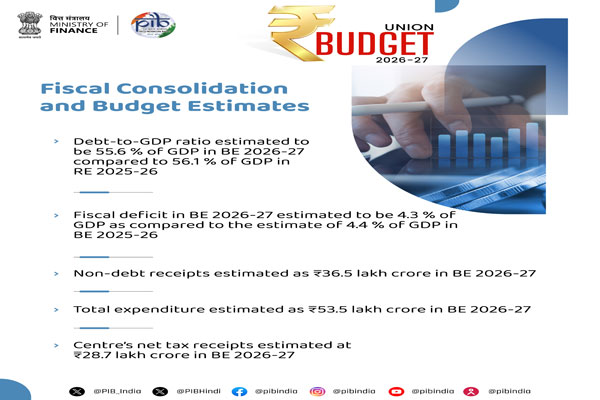
On fiscal management, the Budget has projected a fiscal deficit of around 4.3 per cent of GDP, reinforcing the government’s emphasis on consolidation over redistribution. While macroeconomic stability remains crucial, Shah argued that the pursuit of consolidation has largely been achieved through restrained social spending rather than through progressive revenue-raising measures.
Despite growing concerns over jobless growth, employment does not emerge as a core organising framework of the Budget, he said. The policy approach continues to rely predominantly on indirect employment generation through infrastructure expansion and private investment, a strategy that has historically fallen short of creating sufficient jobs at scale. Moreover, the Budget does not set explicit employment targets, introduce an urban employment guarantee, or significantly expand labour-intensive public works beyond restructured rural schemes.
Taken together, Shah described the Union Budget 2026–27 as cautious and market-oriented but uneven in its prioritisation. By favouring capital expenditure over direct job creation, corporate incentives over redistribution, and fiscal consolidation over social investment, the Budget, he noted, reinforces a growth trajectory that lacks adequate inclusivity.
Speaking about the Budget proposals, Sinha highlighted that a key feature of the Budget is the government’s effort to recalibrate economic priorities in response to mounting global headwinds. This shift is evident in initiatives such as India Semiconductor Mission (ISM) 2.0 and the proposal to establish Dedicated Rare Earth Corridors, signalling a strategic push to strengthen critical supply chains and enhance technological self-reliance.
She also pointed out that social welfare expenditure has been increased by nearly 13 per cent, with significant enhancements in allocations for education, healthcare and women-focused programmes. For states like Tripura, the expanded support for the Lakhpati Didi scheme and the introduction of community-managed SHE-Marts were described as notable gains, with the potential to create sustainable livelihood opportunities for women at the grassroots level.
However, Sinha observed that most of the measures announced for the Northeastern region largely adhere to conventional policy patterns. She suggested that more innovative interventions, similar to those rolled out for larger states, could have bolstered the region’s growth prospects.
As an illustration, she proposed that the Budget could have explored a “Silicon Shield Subsidy” to offset high logistics costs by subsidising air freight for semiconductor components, thereby incentivising advanced manufacturing in the Northeast.
Moreover, she suggested that investing in sovereign data centres in cooler regions such as Sikkim and Tripura could leverage local hydropower resources and favourable climatic conditions, potentially transforming geographic constraints into a competitive advantage in green technology for the region.
