

Own Revenue is Under 2 pc, TTAADC Bodies Heavily Dependent on Grants: Study
Agartala, Feb 16: A recent fiscal assessment has flagged serious concerns over the financial sustainability of Village Councils functioning under the Tripura Tribal Areas Autonomous District Council (TTAADC), revealing a heavy dependence on external grants and negligible internally generated revenue.
Less Than 2% Internal Revenue
The findings are based on a research study titled “Evaluation of Finances of the State of Tripura”, submitted to the Finance Commission of India by Tripura University.
The study examined revenue trends of Village Councils in TTAADC areas between 2015–16 and 2023–24.
According to the data, less than two per cent of the total receipts of Village Councils during the period were generated internally.
The overwhelming share of funds came from transfers recommended by the Central and State Finance Commissions.
While these transfers supported steady financial growth until 2022–23, a sharp decline in Central Finance Commission grants in 2023–24 resulted in a significant drop in both revenue inflows and expenditure levels.
The research led by Subhrabaran Das as Principal Investigator, with Kiran Bhowmik serving as Research Associate and Srijan Debnath as Research Assistant
Overdependence on Grants Raises Sustainability Concerns
The assessment notes that financial vulnerability in TTAADC areas stems largely from structural dependence on grants rather than the development of sustainable local revenue mechanisms.
Although grant-in-aid remains crucial, the volatility in central and state transfers underscores the need for diversified financing sources and improved fiscal management.
Citing data from the Directorate of Panchayats, Government of Tripura, the report highlights that most Village Councils possess negligible independent revenue streams and frequently rely on donations in addition to statutory grants.
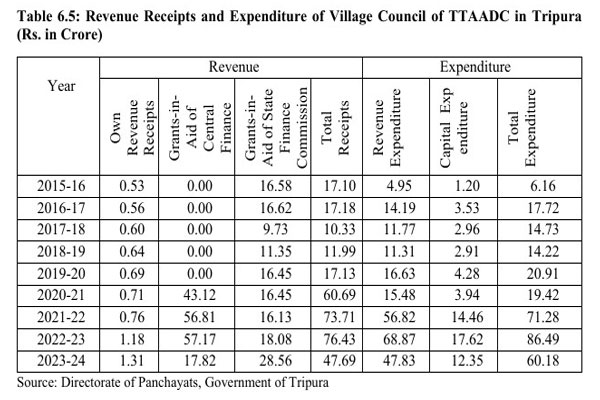
A substantial portion of available funds is consumed by salaries, administrative expenses, and routine operational costs, leaving minimal scope for capital investment or infrastructure development.
This expenditure pattern, the study warns, weakens long-term financial viability and constrains grassroots development in the Sixth Schedule areas.
Recommendations for Revenue Mobilisation
To address the imbalance, the report recommends that both the TTAADC and Village Councils undertake structural reforms to strengthen their own revenue base. Key measures suggested include:
- Improving tax collection mechanisms
- Revising local fee structures
- Enhancing administrative efficiency through targeted training
- Mobilising internal resources for productive and capital investments
The study further proposes that the Council consider levying taxes within its jurisdiction, particularly on locally manufactured country liquor and rubber cultivation.
It also recommends exploring the introduction of a wealth tax on landholdings and strengthening revenue generation through land transactions under the existing land revenue framework.
Additionally, the report suggests engaging private partners in capital-intensive projects to expand infrastructure and generate sustainable returns.
Call for Long-Term Fiscal Roadmap
Emphasizing the need for fiscal predictability, the assessment calls for the formulation of a long-term financial roadmap for the TTAADC to ensure prudent resource management and stable funding.
The study also proposed structured financial allocations to significantly improve the Council’s financial condition over the coming years.
Under the proposed framework:
Revenue Grants: A total allocation of Rs 5,745 crore is recommended up to 2030–31, to be disbursed in five instalments. These funds are intended to cover salaries, promotions, retirement benefits, and administrative expenses.
Capital Assistance Grant: An additional Rs 10,661 crore is proposed over the same period, primarily for infrastructure expansion including roads, bridges, drinking water supply systems, hospitals, schools, and irrigation facilities.
Critical for Inclusive Growth
The report concludes that infrastructure development and improved service delivery in rural and tribal regions are closely linked to fiscal strength.
Empowering Village Councils with greater financial autonomy and diversified revenue streams, it argues, is essential for ensuring inclusive growth and sustainable development across the TTAADC region.
The writer is the Founding Editor of enewstime.in and can be reached at enewstime2017@gmail.com
