

Preface: Explore how the road safety model for Tripura may be drawn from ₹3,700 Cr Lucknow-Kanpur Expressway’s advanced monitoring and prompt emergency response system.
Lucknow Mar 8: Rapid expansion of national highways across India has brought renewed attention to road safety and faster emergency response systems.
While several states are adopting advanced monitoring technology, experts say such systems remain limited in Tripura, resulting in slower response time during highway accidents.
During an exposure visit to Uttar Pradesh, the media team of Press Information Bureau (PIB) Agartala observed an advanced highway monitoring and rescue system being implemented along the ambitious Lucknow–Kanpur Expressway being developed by the National Highways Authority of India (NHAI) .
Officials believe the project could serve as an important model for smaller states like Tripura where highway surveillance and emergency intervention systems are still evolving.
Speaking about the project, Nakul Prakash Verma, Project Director of the Project Implementation Unit in Lucknow, said the expressway will extend for nearly 63 kilometres. This length includes an already constructed flyover of about 9.6 kilometres.
A key feature of the project is the installation of an Advanced Traffic Management System (ATMS) across the entire corridor.
According to Verma, the system will include 63 Pan-Tilt-Zoom (PTZ) cameras, 21 interchange cameras and 16 video incident detection systems to ensure real-time traffic monitoring and improved safety.
To strengthen emergency response, two centralised control centres are being established at kilometre points 27 and 35 along the expressway.
“In case of accidents or other emergencies, the system is designed so that rescue teams can reach the spot within 10 to 15 minutes,” Verma said while briefing the visiting journalists.
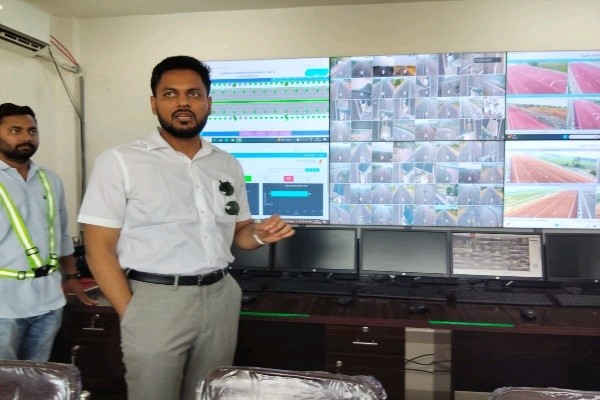
The PIB Agartala team was also taken to one of the upcoming control rooms on Saturday, where officials demonstrated how the monitoring system will function.
The control room features large display screens that simultaneously show live feeds from all cameras installed along the corridor.
Control room operators explained that any accident or unusual activity on the highway immediately triggers an alert in the system.
An ambulance equipped with emergency medical facilities is then dispatched to the location.
“The injured persons will be brought to the nearest control centre where immediate trauma assistance will be provided. If required, they will be referred to the nearest hospital for further treatment,” an operator told the journalists.
“The state currently lacks such a comprehensive monitoring and rapid response system along its national highways”, said an Agartala based noted journalist.
Experts believe that adopting similar technology could significantly improve accident management and reduce response time in the northeastern state.
Apart from safety features, the expressway is also expected to transform Lucknow-Kanpur connectivity.
Verma said the new corridor will directly link the ring roads of Lucknow and Kanpur, cutting travel time between the two major cities to around 30–35 minutes.
At present, the same journey through existing routes often takes nearly three hours.
Officials consider the project one of the major infrastructure initiatives aimed at strengthening connectivity in Uttar Pradesh.
The expressway is being developed under the Bharatmala Pariyojana to improve transport links between the state capital and one of its key industrial centres.
The construction cost of the expressway is estimated at around Rs 3,000 crore, while the total project expenditure is expected to reach nearly Rs 3,700 crore.
