

Explore the ‘lock-in’ effect in Tripura’s TTAADC Election 2026. Analysis of the BJP-TIPRA Motha rivalry and its impact on tribal and Bengali communities.
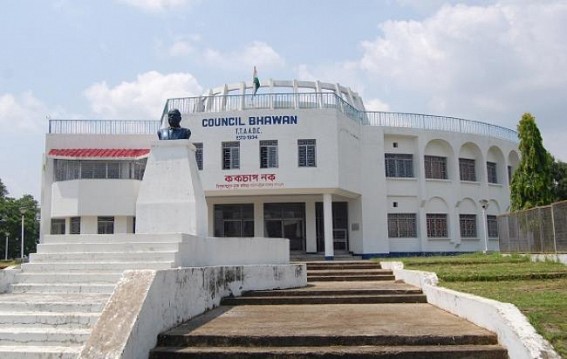
Agartala, March 21: As the state gears up for the high-stakes Tripura Tribal Areas Autonomous District Council (TTAADC) elections on April 12, a profound “lock-in” effect is surfacing, threatening to transform the political landscape into a rigid map of ethnic allegiances.
The evolving, often friction-laden equation between the ruling Bharatiya Janata Party (BJP) and TIPRA Motha has moved beyond mere seat-sharing talks, signaling a deeper shift where party lines are increasingly dictated by community identity rather than governance records.
A discernible ‘lock-in’ effect appears to be taking shape in Tripura’s evolving political landscape, with significant implications for the relationship between the ruling Bharatiya Janata Party (BJP) and TIPRA Motha ahead of forthcoming elections to the Tripura Tribal Areas Autonomous District Council (TTAADC).
The Anatomy of the ‘Lock-In’ Effect
The “lock-in” effect between political choice and ethnic identity and the emerging alignment, particularly in the context of the BJP–TIPRA Motha equation, deserve close attention not just for its electoral implications, but for what it signals about the evolving nature of politics in the state.
At its core, the lock-in effect suggests a narrowing of political flexibility. This emerging dynamic—where party alignment increasingly overlaps with ethnic identity—could fundamentally influence electoral behaviour in the tribal-dominated regions of the state.
Voters, instead of navigating across party lines based on issues or performance may increasingly align with formations that are seen as extensions of their community identity.
In the tribal-dominated TTAADC areas, this could translate into electoral outcomes that are deeply “faithful” to ethnic aspirations. Yet, ‘faithfulness’ should not be mistaken for political success.
Elections remain contingent, and outcomes are shaped by a range of strategic and structural factors.
What makes this moment particularly significant is the uncertain and delicate relationship between BJP and TIPRA Motha.
Whether this evolves into an alliance or remains an uneasy coexistence, the interaction will likely be defined by a mix of compulsion and caution.
Any attempt at convergence—especially if guided by central leadership—may produce a functional arrangement, but not necessarily a natural one.
The undercurrents of rivalry and competing claims to political space will persist.
At the core of this development lies the possibility that political affiliation and ethnic identity may become closely intertwined.
In such a scenario, electoral contests in TTAADC areas may transcend conventional party competition and instead reflect deeper assertions of identity, autonomy, and representation.
This trend, while not entirely unprecedented, appears to be intensifying in the current context.
Strategic Outlook: Alliance vs. Polarization
While speculation persists regarding a possible alliance or understanding between the two parties, the contours of such an arrangement remain unclear.
Should an alliance materialise—potentially influenced or facilitated by BJP central leadership—it is expected to be marked by both strategic necessity and underlying tensions.
Even in the event of a formal or informal partnership, the relationship is unlikely to be seamless.
Electoral rivalries, competing political objectives, and differing support bases may give rise to what can be described as an “uneasy alliance.”
The design and functioning of such an arrangement would likely be shaped by deeply rooted party loyalties as well as ascriptive community affiliations, making it inherently complex and potentially fragile.
Conversely, if no alliance emerges, the electoral contest could become even more sharply polarised, with both parties vying for influence within overlapping constituencies.
In either case, the interplay between cooperation and competition is expected to significantly impact campaign strategies and voter mobilisation.
These developments may contribute to widening social and political fissures.
For indigenous tribal communities, the consolidation of political and ethnic narratives could reinforce a sense of collective political urgency.
Community Concerns: The Bengali Minority in TTAADC
For minority Bengali populations residing within TTAADC areas, however, the situation may generate apprehension and uncertainty.
As political discourse becomes more aligned with ethnic considerations, minority groups may feel increasingly vulnerable or marginalised in the electoral process.
As elections draw nearer, the intensification of identity-based politics could lead to heightened rhetoric, increased provocation, and a more charged electoral atmosphere.
The potential for post-election tensions also cannot be ruled out.
The significance of the TTAADC elections thus extends beyond routine political competition.
The outcomes will not only determine the immediate political fortunes of the parties involved but may also influence broader perceptions of group representation and demographic alignment.
The extent to which electoral results conform to—or diverge from—underlying demographic realities can have lasting consequences, shaping both political narratives and community relations.
In this context, the notion of a “lock-in” effect acquires added importance.
It suggests a scenario in which political choices become increasingly predetermined by identity alignments, potentially limiting the fluidity of electoral behaviour and reinforcing existing divisions.
The evolving BJP–TIPRA Motha equation, the responses of different communities and the broader impact on Tripura’s socio-political fabric will be critical in determining not just electoral outcomes, but the trajectory of inter-community relations in the state.
For minority Bengali communities within TTAADC areas, the emerging trend is a source of unease.
As identity begins to overshadow issues, the risk of political exclusion becomes more pronounced, feeding a sense of uncertainty ahead of the polls.
Ground reality is that for the Bengalis residing within TTAADC areas, this trend raises legitimate concerns. When political narratives become tightly interwoven with ethnic identity, those outside the dominant axis may experience a growing sense of exclusion or insecurity.
Elections, in such a climate, risk becoming not just contests of governance, but referendums on belonging.
The consequences could go beyond electoral arithmetic. A lock-in driven by identity politics has the potential to deepen social divides, intensify campaign rhetoric, and heighten tensions both before and after the results.
If results are perceived to align too neatly—or too discordantly—with demographic realities, the consequences may extend beyond party fortunes to affect inter-community relations.
Tripura stands, therefore, at a delicate juncture. The TTAADC elections are not merely about who wins or loses.
They are about how politics is being reshaped—whether it will remain a space for negotiation and plurality, or move towards hardened lines of identity and allegiance.
The answers will unfold soon. But the questions being raised now are likely to linger far beyond the ballot.
With political lines hardening and alliances still fluid, the TTAADC polls are shaping up as a defining moment—one that may leave a lasting imprint on Tripura’s fragile socio-political fabric.
For unversed :
| Event | Date/Detail |
| Polling Date | April 12, 2026 |
| Counting of Votes | April 17, 2026 |
| Total Registered Voters | 9,62,697 |
| Total Seats | 28 Elected + 2 Nominated |
| Current Majority Holder | TIPRA Motha (18 seats in 2021) |
*Manas Pal is founding Editor of Tripuranet News portal and Executive Editor of Tripura Times.
