

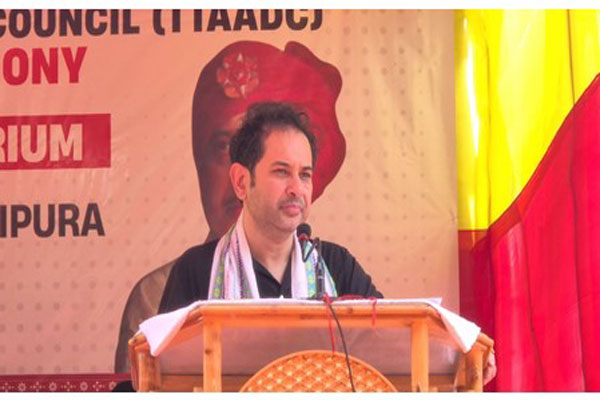
Agartala, Mar 29: Tipra Motha Party (TMP) supremo Pradyot Kishore Debbarman has broken his silence and in a social media video message, he explained the reasons for going ‘solo’.
In a candid social media address on Sunday, the TMP chief framed the decision of rejecting a pre-poll tie-up with the Bharatiya Janata Party (BJP) for the upcoming Tripura Tribal Areas Autonomous District Council (TTAADC) elections as a necessary step to save the “soul” of the party.
According to Debbarma, he rejected the pre-poll alliance as he would not compromise with demands ensuring the future of the indigenous people. Hinting about a potential possibility, the TMP chief said, “After election results were out, phone call will come – but not from the CM but from Delhi”.
However, the move has immediately triggered a logistical and political ‘turmoil’ within the TMP, as the party grapples with a massive surplus of aspirants and the looming shadow of high-profile defections.
Several indigenous leaders of different political parties opined that by rejecting a pre-poll tie-up, Debbarman has attempted a high-stakes, calculated move—even if it means risking structural collapse.
The 300-Candidate Conundrum
The most glaring challenge is the “surplus of ambition.” With only 28 elective seats in the TTAADC, over 300 party workers have staked their claims for a ticket. By opting to go solo, the party can no longer use “alliance quotas” as an excuse to trim the list.
In the present context, it is a difficult proposition for the ‘left out’ 272 influential local leaders who were not considered. It is a “ticking time bomb” that rival parties like the BJP, CPIM, and Congress are likely to exploit, said a disgruntled leader.
Political analysts suggest that this “surplus of ambition” is a ticking time bomb. With no alliance to absorb disgruntled aspirants, many of these “rejected” candidates may turn into spoilers.
Sensing the ground reality, Debbarma said, he would be looking forward to accommodating these left-out candidates for suitable responsibilities so that they serve people.
Friction Between Ideology and Pragmatism
The decision has also exposed a deepening rift between the party’s grassroots ideologues and its pragmatic leadership.
In the video message, Debbarma said a section of the TMP top brass advocated for the BJP alliance to bridge massive resource gaps and ensure administrative stability
On the internal dissent, Debbarman struck a tone of weary pragmatism. He noted he holds “no resentment” toward those who might seek “better opportunities” elsewhere—a tacit admission that the party ranks may thin significantly before the first ballot is cast.
News Analysis: The Ghost of 2021 and the ‘Greater Tipraland’ Void
Editor’s Note: This “Solo Strategy” is a echoes the 2021 TTAADC polls where the TMP swept to power on a wave of ethnic solidarity. However, the 2026 landscape is vastly different.
In 2021, the demand for “Greater Tipraland” was the singular polarizing force. At present, TMP stepped back from that core demand. In this multi-cornered ADC Poll contests, TMP faces CPIM, Congress and a dominant BJP simultaneously, without its primary ideological shield.
The Grassroots Verdict
The success of Debbarma’s calculated move rests entirely on the “Tiprasa” (indigenous) voters. If the electorate views this move as a brave defense of indigenous identity, the TMP could consolidate its base and try to go for a hard bargain with the BJP.
If, however, the voters prioritize the developmental funds and stability that come with a ruling-party alliance, the “solo” path may lead to a fragmented mandate.
The reason is simple: without funds, one cannot ensure sustainable development. By going against the ruling party, it will be hard for the TMP to ensure a regular fund supply.