

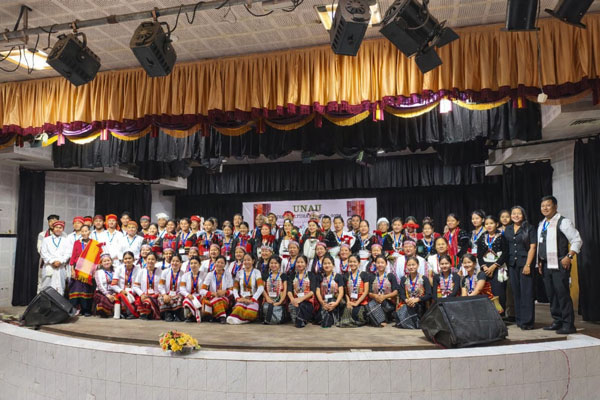
Agartala March 29: In a significant move toward ethnic consolidation, sixteen kindred tribes of the Chin-Kuki-Zo family gathered at Dasarath Bhavan on Saturday to inaugurate the first-ever Union of Native Alikeness and Understanding (UNAU) Cultural Meet.
Moving beyond traditional festivities, the assembly served as a strategic platform for minority tribal groups in Tripura to voice a collective identity and seek better representation in the state’s socio-political landscape.
| From Archive : Minority Tribes of Tripura Unite Under ‘UNAU’ |
The event, led by UNAU president Reuben Ranglong, brought together a diverse tapestry of communities—including the Molsom, Darlong, Hrangkhawl, and Kuki—to bridge linguistic and ancestral ties.
Dr. K. Sasikumar, Secretary of the Tribal Welfare Department, attended as Chief Guest, signaling a high-level recognition of this newly solidified indigenous coalition.
The Union of Native Alikeness and Understanding (UNAU) comprises sixteen kindred tribes, namely: Molsom, Kaipeng, Bongcher, Korbong, Hrangkhawl, Kuki, Darlong, Mizo, Ranglong, Chorei, Thangachep, Saihmar, Langkai, Sakachep, Dap, and Bong.
The coming together of these tribes under one platform reflects a shared commitment to strengthening mutual understanding and collective progress.
Building a Unified Voice for Tripura’s Minorities
The meeting was characterized by a “reaffirmation of shared existence.” Beyond the vibrant display of traditional weaves and rhythmic folk dances, the discourse centered on the challenges of being “minorities within a minority.”
Leaders emphasized that while each of the sixteen tribes—ranging from the Bongcher to the Sakachep—maintains distinct customs, their survival in a modern Tripura depends on mutual cooperation and a unified administrative voice.
News Analysis: A Legacy of Linguistic Identity
This 2026 gathering is not an isolated event but the evolution of a movement rooted in the mid-20th century. By invoking the legacy of Rev. Hrêngngura Darlong’s 1950 Kuki Union and the 1984 Halam-Kuki Linguistic Advisory Committee, UNAU is effectively reviving a decades-old quest for “Native Alikeness.”
In the context of 2026, this shift from fragmented tribal identities to a “Kindred” bloc suggests a growing trend in Northeast India where smaller ethnic groups are leveraging shared heritage to secure constitutional safeguards and developmental equity.
A Roadmap for Progress
In his address, the Chief Guest, Dr. K. Sasikumar, commended the organizers for creating a platform that promotes unity among diverse communities.
He underscored the significance of cultural identity in shaping inclusive development and reaffirmed the government’s commitment to the welfare of tribal communities.
General Secretary Tinkhuma Darlong outlined a vision that balances cultural preservation with modern inclusion. The presence of senior bureaucrats like Lalhmingthanga Darlong, IAS, added weight to the argument that cultural unity is a precursor to economic and educational advancement. The meet concluded with a resolve to make UNAU a permanent fixture for inter-tribal diplomacy in the region.