

Agartala, April 2, 2026 – In a move set to transform the public healthcare landscape in Tripura, the state government has officially commenced the statewide rollout of the Integrated Health Management Information System (IHMIS).
This ambitious digital overhaul is poised to connect and streamline medical services across all tiers of public healthcare. This will move Tripura toward a future where paperless, instant, and efficient patient care is the norm from urban centers to remote villages.
The initiative, reviewed high-level on Wednesday by Health Secretary Kiran Gitte, seeks to replace fragmented, manual record-keeping with a unified digital ecosystem.
The core promise of IHMIS for the patient is tangible: instantly generated OPD tickets via simple QR code scanning and, most importantly, seamless, on-demand access to personal medical records and histories, fundamentally changing the patience-facing interface of healthcare in the state.
Strategic Direction and Local Implementation
The commitment of the Tripura administration to this digital leap was evident at the recent review meeting.
Health Secretary Gitte emphasized flawless execution, directing all necessary resources towards the project.
The meeting was attended by key stakeholders, including Director of Health Services Dr. Debashree Debbarma, State Mission Director (ABDM) Dr. G. Sharath Naik, and representatives from the implementation partner, Broadcast Engineering Consultants India Limited (BECIL).
This highlights the coordinated approach between administrative leadership and technical experts to ensure the system is not only robust but also tailored to the state’s specific needs.
Gitte particularly underscored that the digital transition will pivot on the active participation of doctors and healthcare workers, recognizing them as the primary users and facilitators of this new technology.
Their seamless adoption of the platform is critical to translate technical infrastructure into improved patient outcomes.
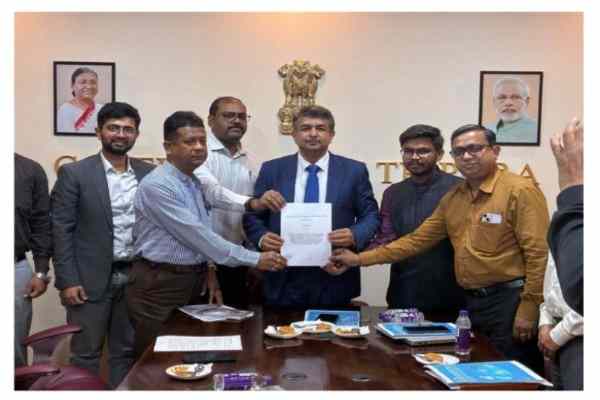
The formal foundation for this digital leap was laid earlier on March 30, with a Memorandum of Understanding (MoU) signed between the state government and BECIL.
This partnership marks the beginning of the operational phase for IHMIS across all public facilities.
The Pillars of Tripura’s Digital Health Architecture
The planned IHMIS implementation goes far beyond simple digitization of paperwork. It is designed to create a single, statewide platform with several key features:
1. A Unified Digital Health Record (DHR) for Every Citizen:
A major component will be the creation of complete digital health records. These will allow any doctor at any government facility to instantly retrieve a patient’s comprehensive medical history.
This immediate access can facilitate faster, more accurate diagnoses and prevent redundant tests, a crucial efficiency gain, especially in critical care situations.
2. Full Integration with Ayushman Bharat Digital Mission (ABDM):
Tripura’s system will be tightly integrated with the national ABDM framework.
Central to this will be the widespread issuance of the 14-digit Ayushman Bharat Health Account (ABHA) IDs to all citizens.
This unique identifier links health records across different providers and states, making the system interoperable and paving the way for a truly national, portable, and paperless healthcare ecosystem for Tripura’s residents.
3. Streamlining Access via Online Registration:
The traditional pain point of long queues at outpatient and emergency departments will be addressed via online registration.
Patients will be able to book appointments and check-in digitally, reducing wait times and improving the overall flow of patients through medical facilities.
4. Expanding the Reach of ABDM Services:
While basic ABHA-linked services are already active in several district and sub-divisional hospitals, IHMIS aims to push these capabilities to the very grassroots of the state’s healthcare network.
All Primary Health Centres (PHCs) will be equipped to leverage the ABDM integration, ensuring digital health benefits are not just limited to urban areas.
5. E-Prescriptions and Robust Telemedicine:
The transition will also enable the shift towards electronic prescriptions, reducing errors associated with handwritten notes. Crucially, IHMIS will be the backbone for significantly enhanced telemedicine services.
This feature aims to bridge the rural-urban divide, enabling doctors in remote corners of the state to facilitate virtual consultations with specialists in Agartala, including those at major tertiary centers like GBP Hospital and IGM Hospital.
Contextual Depth: A News Analysis
This state-wide IHMIS implementation is a strategic culmination of smaller-scale, prior initiatives that hinted at the potential of digital integration in healthcare.
Over the last several years, individual state-run hospitals in Agartala, such as GBP Hospital, had successfully piloted components like online OPD registration and computerized lab results.
These pilots, though effective locally, were hampered by a lack of central integration. A patient’s records at one hospital were not readily accessible at another.
This fragmented approach often meant that citizens, especially those traveling from remote districts for specialist care, would carry physical files of previous diagnoses, prescriptions, and test reports.
The state wide IHMIS rollout, combined with its mandatory ABDM integration, systematically addresses this core problem of data silos.
It is a logical progression from those early experiments, a strategic move to create a unified state-health network, mirroring similar efforts in other technologically advancing Indian states.
By making the system comprehensive and statewide, Tripura is ensuring that the digital dividend is accessible to all, laying a modern foundation that is not just efficient but fundamentally more patient-centric.
The initiative represents a proactive investment by the state government, recognizing that a modern, digitized infrastructure is essential to deliver equitable, high-quality healthcare to every citizen, regardless of geographical location.
It signals a new era of data-driven and efficient public health service delivery for Tripura.