

Agartala: A quiet but powerful economic transformation is sweeping through the remote pockets of the Dhalai district. In the heart of Tripura’s tribal belt, the Tripura Rural Economic Growth and Service Delivery Project (TRESP) is doing more than just providing funds; it is rewriting the destiny of marginal farmers.
By blending traditional knowledge with modern scientific interventions, the project—supported by the World Bank and executed by the Tribal Welfare Department—has turned struggling households into thriving rural enterprises.
Producer Groups: The Engine of Local Growth
The core strength of the TRESP initiative lies in its grassroots mobilization. Instead of focusing on isolated individuals, the project organizes rural residents into structured Producer Groups (PGs). This collective approach allows small-scale farmers to access resources that were previously out of reach.
These groups cover a wide range of activities, including fisheries, agriculture, and allied sectors. By transitioning from informal farming to business-oriented entities, these PGs provide a safety net for the economically disadvantaged.
Members receive specialized skill training, which is crucial for modernizing old practices. Furthermore, the project bridges the gap between remote villages and urban markets, ensuring that produce fetches a fair price.
The Transformation of Ratna Tripura: A Case Study
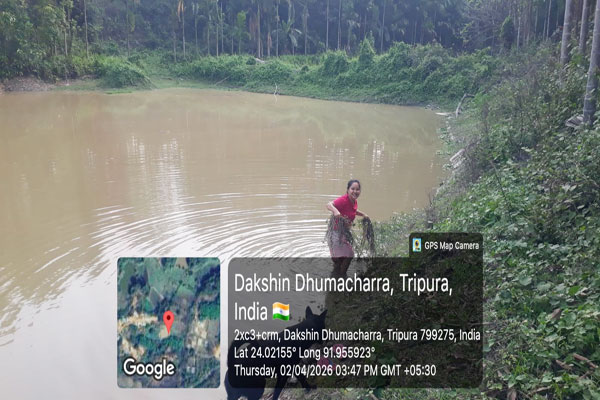
The impact of this institutional support is best illustrated by the story of Ratna Tripura, a resident of Mainama village under the Manu RD Block. For years, Ratna practiced traditional fish farming in her local pond. However, her efforts yielded little.
Without technical guidance, her annual income stagnated at a meager Rs. 12,000. High mortality rates among fish and poor-quality seeds kept her trapped in a cycle of low productivity.
Everything changed when she joined a Fishery Producer Group under the TRESP banner. The project provided her with scientific training in modern aquaculture. She learned the nuances of improved seed stocking, precise feed management, and, most importantly, disease prevention.
Breaking the Financial Barrier
Financial constraints often kill rural innovation. TRESP addressed this by facilitating a loan of Rs. 20,000 at a highly subsidized interest rate of just 3 percent. Compared to the predatory rates often found in informal lending, this capital was a lifeline.
The results were immediate and staggering:
Production Surge: Her annual fish harvest jumped from 120 kg to 400 kg.
Revenue Growth: Her gross income per production cycle reached Rs. 85,000.
Net Profit: After accounting for expenses of Rs. 38,000, she now clears a net profit of Rs. 47,000 per cycle.
This nearly fourfold increase in income has not only improved her family’s standard of living but has also positioned her as a leader within her community.
News Analysis: The Shift Toward Institutional Resilience
Historically, rural development in Tripura relied heavily on direct subsidies, which often failed to create long-term sustainability.
The TRESP model marks a significant shift toward “Institutional Resilience.” By involving the World Bank, the state has adopted global best practices in “Value Chain Development.”
This means the focus is no longer just on growing a crop or raising fish, but on the entire process—from credit access to market delivery. This systemic change is vital for Dhalai, a district that has historically faced geographic isolation.
The success here suggests that Tripura is moving away from a “relief-based” economy toward a “production-based” economy.
Empowering Women and Building the Future
The social impact of TRESP extends beyond bank balances. By placing women like Ratna Tripura at the forefront of economic activities, the project is dismantling gender barriers in the rural workforce.
Success stories are contagious; as neighbors witness the prosperity of PG members, more families are eager to adopt scientific farming methods.
TRESP serves as a blueprint for sustainable development. It proves that when low-interest financing is paired with technical expertise and community engagement, even the most marginalized groups can build lasting resilience.
As the project expands, it promises to turn the rural landscape of Tripura into a hub of inclusive growth.