

Agartala April 6: The political landscape of Tripura’s hills is witnessing a sharp ideological divide as the state inches closer to the crucial Autonomous District Council (TTAADC) polls.
Addressing a poll rally in Dhalai district, Chief Minister Dr. Manik Saha delivered a clear message: the Bharatiya Janata Party (BJP) does not need a “crutch” to govern the tribal belts.
The Chief Minister firmly positioned his party as the only viable alternative to what he termed the “failed experiments” of the past.
A Solo Path to Tribal Empowerment
During a massive election rally held in the Manu-Chailengta in Dhalai areas on Sunday, Dr. Saha addressed the buzzing rumors regarding political alignments.
He asserted that the BJP remains the principal opposition force within the TTAADC, but it possesses the internal strength to contest and win independently.
“Our strength lies in our grassroots connect,” Dr. Saha told the gathered supporters.
He emphasized that the party’s vision for the indigenous communities is not dependent on tactical alliances with regional outfits like the Tipra Motha Party (TMP).
Instead, the BJP is banking on its track record of national governance and its specific roadmap for the hills.
The ‘Sankalp Patra’: A Blueprint for the Hills
The Chief Minister heavily referenced the party’s “Sankalp Patra” (Election Manifesto) during his speech.
He described the document as a living reflection of public sentiment rather than a mere political pamphlet.
According to Dr. Saha, the manifesto was drafted after extensive consultations with local stakeholders in Dhalai and other areas of the State.
The BJP’s strategy focuses on infrastructure, transparency, and direct benefit transfers.
By highlighting these points, the CM sought to contrast the BJP’s “development-first” approach with the “identity-based” narratives of his rivals.
He promised that a BJP-led ADC would ensure that funds meant for tribal welfare actually reach the remote hamlets of Dhalai.
Sharp Critique of TMP and Left Legacy
Dr. Saha launched a blistering attack on the emergence of Laal Motha (Allegedly, leftists joined the TMP and strengthened it). He alleged that the party is effectively a reincarnation of the old Communist guard.
“We see the same faces and the same tactics,” the CM claimed. He suggested that former Left supporters have simply changed banners to maintain their influence in the hills.
Dr. Saha reminded the audience of the decades-long rule of the CPI(M), which he characterized as an era of “violence and instability.”
He cautioned voters that the current regional leadership is following a similar path of divisive politics.
Dr Saha argued that democracy thrives on dialogue and transparency, qualities he claimed are missing in the current ADC administration.
News Analysis: The Battle for the Saffron Inroads in Hills
The TTAADC elections have historically been a two-way fight between the Left Front and Congress-backed regional tribal parties.
However, the political climate in the State significantly changed after since BJP started making inroads in Tripura which ultimately came into power dethroning CPIM in 2018 with alliance with the IPFT.
The political scenario further changed in 2026 as the ruling BJP is attempting, for the first time, to break the traditional “Kingmaker” status of regional parties by appealing directly to the youth highlighting Prime Minister Modi’s “Viksit Bharat” (Developed India) initiative.
By rejecting an alliance with Tipra Motha now, the BJP is testing whether its national “double-engine” narrative can overpower the localized “Greater Tipraland” sentiment that has dominated recent discourse.
Allegations of Corruption in the Council
The Chief Minister did not mince words regarding the performance of the outgoing ADC administration.
He alleged that the last five years were defined by corruption, inefficiency, and a lack of accountability.
Dr. Saha stated that the tribal council requires a “clean-up” to restore faith in democratic institutions.
“The BJP operates on a ‘Nation First’ ideology,” Dr. Saha remarked. He urged the electorate to choose a party that prioritizes the state’s integrity over individual or party interests.
He was accompanied on stage by prominent local figures, including MLA Shambhu Lal Chakma and Dhalai district president Patiram Tripura, signaling a united front.
Looking Ahead
As the campaign intensifies, the BJP’s decision to go solo signals a high-stakes gamble.
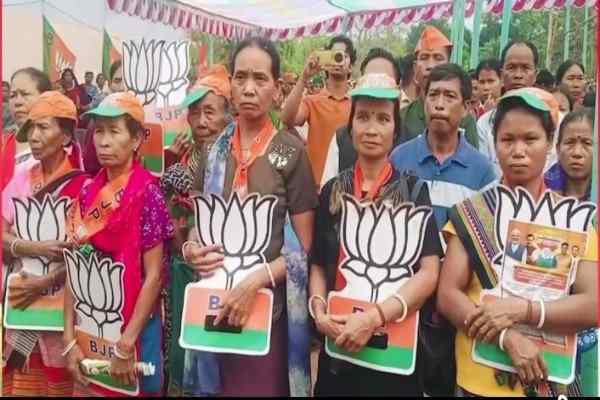
The party is betting that the promise of administrative stability central funding and proposal for elevating TTAADC to territorial council will outweigh the emotional appeals of regionalism.
For the residents of Dhalai, the choice now stands between the tested machinery of a national party and the evolving dynamics of regional aspirations solely dependent on Pradyot Kishore Debbarma.