

Agartala April 8: A quiet green revolution is taking over the skylines of Tripura as the State taste success in solar power generation.
From the narrow lanes of Agartala to the suburban households of Halhuli, rooftops are no longer just structural covers. Theses are now active power plants.
This week, Tripura officially breached the 10 MW solar power generation mark under the PM Surya Ghar Muft Bijli Yojana, signaling a fundamental shift in the state’s energy DNA.
The Rise of the ‘Prosumer’
Energy in Tripura is transitioning from a centralized commodity to a household asset. Residents are no longer just consumers; they have become “prosumers”—those who both produce and consume power.
According to TSECL Managing Director Biswajit Basu, exactly 2,933 households have successfully integrated rooftop solar systems into the state grid. This has pushed up solar power generation in Tripura touch 10MW.
This movement is backed by significant financial momentum. The government has already disbursed over ₹20 crore in subsidies to 2,397 beneficiaries. This financial cushion makes the transition accessible for the middle class.
A standard 1 kW system generates approximately 100 units of electricity monthly. For many families, this covers their entire basic needs, effectively reducing their electricity bills to zero.
Leadership Vision: Beyond Gas to Grassroots Solar
Power Minister Ratan Lal Nath believes this shift is a necessity, not a choice. Over the years, Tripura relied heavily on its natural gas reserves for power generation.
However, gas is a finite resource with inherent logistical limitations. Nath describes this 10 MW milestone as a “turning point” for the state’s self-reliance.
The strategy is now moving into “mission mode.”
Power Secretary Abhishek Singh, IAS, confirmed that the administration is not resting on this initial success. The next target is a bold 50 MW. With over 18,000 pending registrations, the demand is clearly outstripping initial expectations.
To manage this surge, TSECL has established a dedicated control room at its Agartala corporate office and is holding registration camps at the sub-division level to assist rural applicants.
News Analysis: Breaking the Geographical Power Barrier
Tripura’s power stability has been tied to large-scale thermal projects like Palatana or Monarchak.
While these plants provide the bulk of the state’s energy, they are vulnerable to transmission losses and technical outages. This new decentralized model changes the game.
By spreading 10 MW across nearly 3,000 locations, the state creates a “distributed grid.” If one house goes offline, the rest keep producing.
This democratization of energy is the most significant structural change to Tripura’s power sector since the introduction of natural gas turbines in the 1990s.
Economic Impact: Turning Sunlight into Income
The logic behind the adoption is purely economic. Beyond the savings, the “Net Metering” system allows homeowners to sell excess power back to the Tripura State Electricity Corporation Limited (TSECL). This transforms a monthly liability—the utility bill—into a potential revenue stream.
Currently, Agartala (Circle-1) leads the state in installations.
However, satellite data and field reports show a steady climb in participation from North Tripura and Dhalai districts.
The administration is focusing on ensuring that the technical expertise of engineers and field staff reaches these remote corners to maintain the hardware effectively.
A Sustainable Future
The message from the Power Department is clear: the sun is Tripura’s most reliable resource. As the state marches toward its 50 MW goal, the focus remains on the human element.
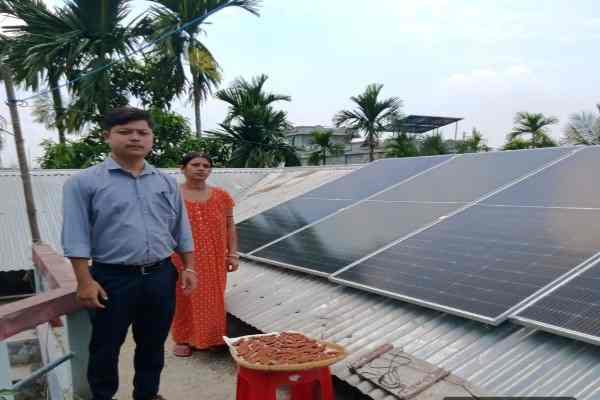
The success of the PM Surya Ghar Muft Bijli Yojana depends on the trust of the citizens. As more neighbors see solar panels on nearby roofs, the “social proof” drives further adoption.
Tripura is proving that a small state can lead the way in the national transition to renewable energy.