

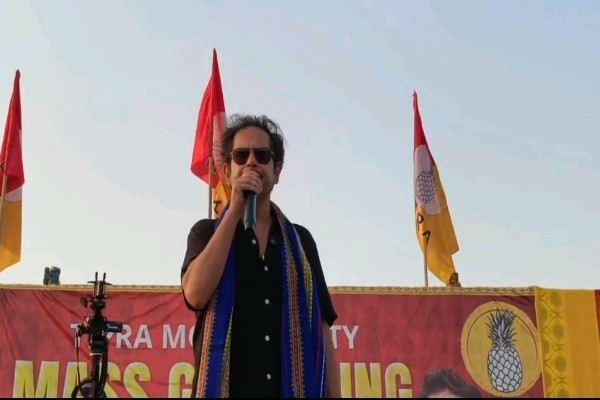
Teliamura, April 8: As the battle for the Tripura Tribal Areas Autonomous District Council (TTAADC) enters its final stretch, the Tipra Motha Party (TMP) held a poll rally for the 11 Maharani–Teliamura constituency at the Manik Bazar ground.
Pradyot Kishore Debbarma, the party’s primary face, took center stage to drum up support for candidate Utpal Debbarma.
However, his message moved beyond simple candidate promotion. He delivered a pointed appeal for “community over politics,” a move that observers say aims to consolidate the indigenous vote bank just days before the April 12 ballot.
Unity Over Party Lines
Addressing the supporters, Pradyot Kishore struck an emotional chord. He urged the indigenous Tiprasa people to view the upcoming election as a fight for survival rather than a routine political exercise.
“Parties may come and go, but our community must prevail,” he declared.
He insisted that the welfare of the indigenous people hinges on their ability to stand together against external political forces.
The TMP supremo’s rhetoric focused heavily on ethnic identity.
He suggested that the strength of the Tiprasa people lies in their collective spirit rather than the financial or organizational muscle of national parties.
This “community-first” approach has become the hallmark of his 2026 campaign strategy.
Direct Attack on BJP and ‘Money Culture’
The rally took a sharp turn when Pradyot turned his sights on Chief Minister Dr Manik Saha and the Bharatiya Janata Party (BJP).
He took a swipe at the BJP’s status as the world’s largest political party. He noted that while the saffron party possesses immense power and funds, it lacks the “organic unity” found within the TMP’s ranks.
Furthermore, the Royal scion leveled serious allegations regarding voter inducement. He claimed that certain elements are attempting to “buy” the mandate.
He specifically mentioned rumors of promises totaling up to ₹25 lakh being offered to lure voters.
“These assurances are hollow,” he warned the gathering. He urged voters to remain cautious and not fall prey to monetary tactics that might vanish after the election results.
News Analysis: The Strategy of Identity
Over the years, politics in Tripura has shifted from a class-based struggle under the Left Front to a development-centric narrative under the BJP.
However, to oust the CPIM from power which had a solid base among the indigenous people, BJP relied on tribal-based IPFT giving fuel to ethnic identity based politics.
However, the rise of the Tipra Motha has bolstered the identity based politics with ‘Greater Tipraland’.
In upcoming TTAADC Polls, Pradyot Kishore is leveraging a powerful symbolic goal by focusing on the demand for a Tiprasa Chief Minister.
This strategy effectively bypasses traditional debates on policy and governance by making the election a referendum on indigenous pride.
The Governance Gap?
Despite the high-octane energy at the Manik Bazar rally, certain gaps remained evident.
The TMP Chief did not provide a detailed roadmap for the economic development of the TTAADC.
The speech lacked specific mentions of job creation, healthcare infrastructure, or educational reforms.
Moreover, he remained notably silent on the TMP’s track record as the current ruling power in the Council.
Political analysts observe that this focus on ethnicity creates a sharp divide in Tripura’s mixed-habitat regions.
While the cheering crowds suggest the message is hitting home, critics argue that the “Identity over Industry” approach might pose challenges for the state’s long-term integrated development.
With the April 12 polls looming, it remains to be seen how the indigenous people choose members for the Council.