

Agartala: Tripura Rural Economic Growth and Service Delivery Project (TRESP) is taking scientific expertise directly to the mud and mulch moving beyond traditional classroom lectures.
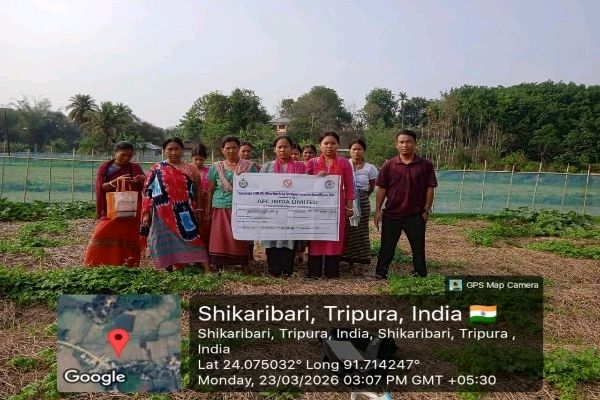
Across blocks like Tulashikhar and Karbook, local farmers—predominantly women—are rewriting the state’s agricultural narrative through the Farmer Field School (FFS) initiative.
Breaking the Traditional Barrier
For decades, rural growers in regions like Shikaribari relied on ancestral knowledge that often struggled against modern climate challenges and soil depletion. The current FFS drive, supported by the World Bank, changes this dynamic. It replaces theory with “learning by doing.”
Farmers are no longer just listeners; they are active practitioners.
On-field sessions currently focus on high-demand crops including okra (bhindi), bitter gourd, and cowpea.
By organizing through Producer Groups (PGs) and Cluster Level Federations (CLFs), the project ensures that the training reaches the most remote corners of the state.
Science in the Soil: The FFS Approach
The strength of this initiative lies in its practical rigor. Agriculture Department experts and TRESP specialists conduct live demonstrations on essential modern techniques. These include:
-
Scientific Sowing: Optimizing seed placement for maximum germination.
-
Nutrient Management: Precision application of fertilizers to prevent soil degradation.
-
Integrated Pest Management (IPM): Reducing chemical dependency through biological controls.
-
Water Saving Technologies: Implementing efficient irrigation to combat seasonal dry spells.
By witnessing these methods in their own fields, farmers see immediate results. This “real-time” validation builds a level of trust that traditional extension services often lack.
News Analysis: A Shift Toward Sustainable Autonomy
Tripura’s agriculture is facing hurdles due to fragmented landholdings and limited access to modern inputs.
Previous government schemes often focused on subsidy distribution rather than knowledge equity. The TRESP-FFS model represents a pivotal shift toward Information Gain.
By empowering “Krishi Sakhis” (community agriculture frontline workers), the project builds a self-sustaining ecosystem of knowledge.
This move toward “Local Authority” in farming mirrors global successful models where peer-to-peer learning reduces the cost of production while increasing resilience against market volatility.
It is not just about growing more vegetables; it is about cultivating a community that can solve its own technical problems.
Women as the New Architects of Growth
A standout feature of the Shikaribari sessions is the overwhelming participation of women. In many rural households, women perform the bulk of the labor but rarely hold the “specialist” title. TRESP is changing that hierarchy.
By training women-led Producer Groups, the project places decision-making power in the hands of those who manage the fields daily.
This inclusion boosts household income and ensures food security at the most fundamental level. The presence of Cluster Coordinators and Technical Support Assistants ensures that these women have a direct line to scientific resources whenever a crop crisis arises.
Looking Ahead: The Economic Ripple Effect
As farmers transition toward productivity-oriented practices, the economic landscape of rural Tripura stands to gain.
Better input management leads to lower overhead costs, while improved crop health ensures higher market prices.
The FFS drive is more than a training program; it is a blueprint for a resilient, community-driven farming system.
As these “schools without walls” continue to expand, the goal remains clear: transforming Tripura from a consumer state into a hub of scientific, sustainable horticulture.