

How BJP’s ‘Solo’ Strategic Gamble and a Lack of Tribal Leadership Ceded the Heartland to Tipra Motha Party
Agartala Apr 14: The 2026 TTAADC elections served as more than just a local body poll; it was a deliberate “litmus test” by the BJP to gauge its acceptance without relying on the regional parties within the tribal heartland. However, the results—a big collapse from 9 seats to just 4—reveal that this objective was likely a strategic gamble that lacked the necessary depth in local leadership and emotional resonance to counter identity-centric politics of Pradyot Kishore Debbarman-led Tipra Motha Party (TMP).
The “Solo Contest” Gamble
The BJP’s decision to bypass a formal seat-sharing arrangement with its state ally was an attempt to independently assert its strength and identify organizational “blind spots” before the next state elections in 2028.
Assessment vs. Reality: While the party intended to assess its grassroots reach, the strategy exposed a hollow structure in the Janajati (tribal) belts. The “solo” move was not backed by a well-thought-out outreach plan to counter the consolidated tribal vote, resulting in the BJP losing over 50% of its previous holdings.
The Absent Leadership Tier: Beyond Chief Minister Dr. Manik Saha, the party struggled to project a credible “second-in-command” tribal face. Projected Janajati leaders liked Tribal Welfare Minister Bikash Debbarma and Janajati Morcha General Secretary Bipin Debbarma failed to prove their leadership and emerge as effective counter-narratives to the royal charisma of the Tipra Motha. The party’s attempts to trigger defection in the TMP camp just before the polls did not translate into votes for saffron party.
Aggression vs. Representation: The Rhetoric Gap
The campaign trail highlighted a stark contrast in messaging. The CM led a high-decibel offensive, pitching a development-only plank and often adopting a posture of marked aggression toward the TMP’s “identity politics.”
The BJP Approach: The CM’s rhetoric was centered on administrative efficiency and the “double-engine” benefits. However, this clinical focus on development or welfare of Janajati people lacked the “soul” required in a region where land and identity have already emerged as crucial.
The TMP Counter-Punch: In contrast, Pradyot Kishore masterfully blended welfare-concept with high-octane emotion. He did not reject development; he redefined it suitable to win hearts even if his core demands like Greater Tipraland is feasible.
In his speeches, Pradyot Kishore talked about Thansa (Unity) among different Janajati communities for Land Rights, the Tiprasa Accord, and the Kokborok script. By doing so, he positioned himself as the sole representative of the Janajati people, whereas the BJP was viewed merely as a provider of schemes.
The Takeaway: Inability to Blend
The BJP’s setback in the TTAADC elections ultimately reflected a deeper failure of “strategic blending”—an inability to infuse its campaign with the emotional core necessary to resonate with voters. The party failed to design or push forward a compelling narrative that could counter the sentiment-driven outreach of the TMP.
Equally significant was the BJP’s inability to control the political narrative in the run-up to the polls. In a calculated strategic move, Pradyot Kishore Debbarma successfully reframed the electoral contest into a direct face-off between himself and Chief Minister Dr. Manik Saha.
This subtle but powerful shift diminished the relevance of local candidates. Interviews with a group of six journalism students from Tripura University reinforce this perception—they admitted their voting decisions were shaped more by their preference between the Chief Minister and the TMP chief than by the individual candidates in their constituencies.
| Feature | BJP Strategy (2026) | Tipra Motha Strategy (2026) |
| Primary Plank | Governance & Nationalist Growth | Identity & “Dofa” (Community) Survival |
| Key Face | Dr. Manik Saha (State-wide focus) | Pradyot Debbarma (Tribal-centric focus) |
| Emotional IQ | Low (Emphasis on data/infrastructure) | High (Emphasis on land/language/legacy) |
| Leadership | Top-heavy; few local tribal icons | Grassroots-led; “Bubagra” as symbol |
Final Remark
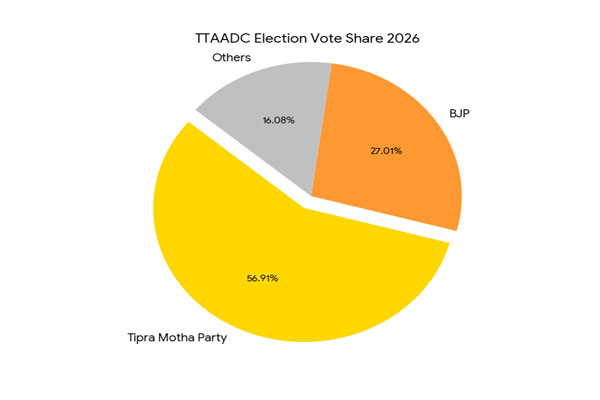
By contesting alone without a credible tribal face or a narrative capable of matching the emotional weight of Tiprasa identity politics, the BJP saw its seat tally drop sharply—from nine to just four—in the 2026 ADC elections. However, the party’s performance was not without positives. It secured 2,18,072 votes out of a total 8,04,667 valid votes and expanded its presence across 28 constituencies without depending on an alliance partner.
People Also Ask (FAQ)
Q: Why did the BJP lose seats in the 2026 TTAADC elections? A: The BJP lost 5 seats (dropping from 9 to 4) due to a “solo” contest strategy that lacked strong local tribal leadership and failed to resonate with the identity-driven sentiments of the Janajati voters.
Q: What was the main campaign theme of the Tipra Motha Party (TMP)? A: The TMP focused on “Thansa” (unity), land rights, the Kokborok script, and the emotional core of Tiprasa identity, effectively countering the BJP’s development-only narrative.
Q: Did the BJP gain anything from the 2026 TTAADC polls? A: Yes. Despite the seat loss, the BJP proved its independent reach by securing over 2.18 lakh votes and contesting across all 28 constituencies without relying on an alliance partner.
