

Agartala, April 21: RSS chief Mohan Bhagwat highlighted India’s spiritual leadership as a remedy for global instability and said on Tuesday that the nation’s heritage of Sanatan Dharma offers a roadmap for peace. Speaking in Tripura, Bhagwat asserted that India is uniquely positioned to guide a conflict-ridden world toward harmony and mutual coexistence.
Quick Glance: Key Highlights
-
Global Diplomacy: Bhagwat positions India’s philosophical wisdom as a necessary intervention against self-interest and ideological fanaticism.
-
Moral Foundation: The RSS chief warns that “power without devotion” (shakti without bhakti) leads to global nuisance and societal disruption.
-
Symbolic Consecration: The message was delivered during the Prana Pratishtha of the Maa Soundarya Chinmayi Temple, a new center for spiritual learning in West Tripura.
-
Strategic Vigilance: A call for national unity was issued to counter external forces attempting to destabilize India’s social fabric.
India’s Spiritual Leadership in a Conflict-Ridden World
During the consecration of the Maa Soundarya Chinmayi Temple at Mohanpur, Mohan Bhagwat addressed the urgent need for a shift in global consciousness. He observed that the contemporary landscape is increasingly defined by “forceful imposition of agendas” driven by fanaticism. In a conflict-ridden world where wars are easily started but rarely concluded, Bhagwat argued that India’s civilizational ethos provides the only sustainable alternative.
He emphasized that India’s spiritual leadership is not about political dominance, but about sharing universal values that prioritize the “unity of all life.” By rootedness in Sanatan Dharma, India can serve as a stabilizing force, offering a “guiding light” to nations currently embroiled in ideological and territorial disputes.
Temples as Hubs of Enlightenment
The RSS Sarsanghchalak redefined the role of religious institutions in the modern era. He noted that traditionally, temples were the centers of community life and cultural exchange.
| Element | Role in Spiritual Leadership |
| Bhakti (Devotion) | Provides the moral compass for the use of power. |
| Shakti (Power) | Destructive when untethered from spiritual values. |
| Temple Architecture | Acts as a physical manifestation of cosmic laws (Nakshatras). |
| Education | The “true knowledge” offered by missions to enlighten society. |
The Architecture of Harmony in Tripura
The inauguration was attended by Tripura Governor Indra Sena Reddy Nallu and CM Manik Saha. The Maa Soundarya Chinmayi Temple itself serves as a metaphor for this spiritual message. Its unique “roofless” design symbolizes an unobstructed connection with the divine, suggesting that India’s spiritual leadership remains open and inclusive.
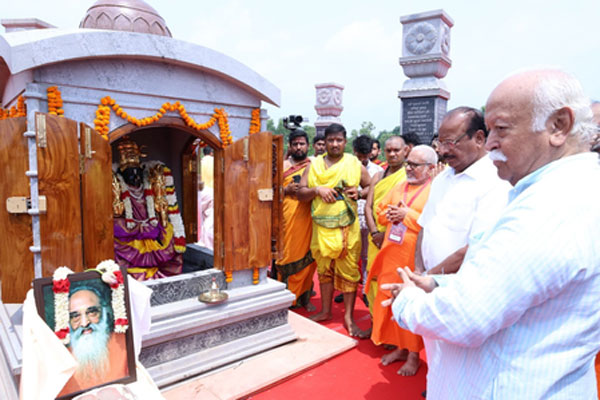
The structure features 27 black stone pillars, representing the 27 Nakshatras of Hindu astrology, and a 15-foot monolithic granite idol. Chief Minister Saha noted that the temple, inscribed with Adi Shankaracharya’s Soundarya Lahari, would become a premier site for contemplation and “cosmic connection” in the North East.
Guarding the Internal Peace
While discussing the global stage, Bhagwat remained focused on domestic stability. He reiterated that “unity in diversity” is the bedrock of the Indian state. To maintain its position of spiritual leadership, the country must remain vigilant against external influences seeking to fragment its social harmony.
The event, coinciding with Adi Shankaracharya Jayanti, concluded with a call for citizens to embrace their cultural identity as a means of contributing to global welfare. Bhagwat praised the Chinmaya Mission for providing free education, noting that an enlightened citizenry is the first step toward a peaceful, leading nation.
People Also Ask (FAQ)
Q1: What did Mohan Bhagwat say about India’s role in global conflicts? Bhagwat stated that India’s spiritual heritage and the values of Sanatan Dharma are essential for bringing peace to a conflict-ridden world, as they promote harmony over fanaticism.
Q2: How does the new Tripura temple reflect India’s spiritual leadership?
The temple serves as a center for “bhakti” and education, emphasizing that power must be grounded in devotion to avoid becoming a nuisance to society.
Q3: Why is the Maa Soundarya Chinmayi Temple considered unique?
Its architectural design includes 27 pillars representing the 27 Nakshatras and a roofless sanctum, symbolizing an open connection to the divine and the universe. (With IANS inputs)
