

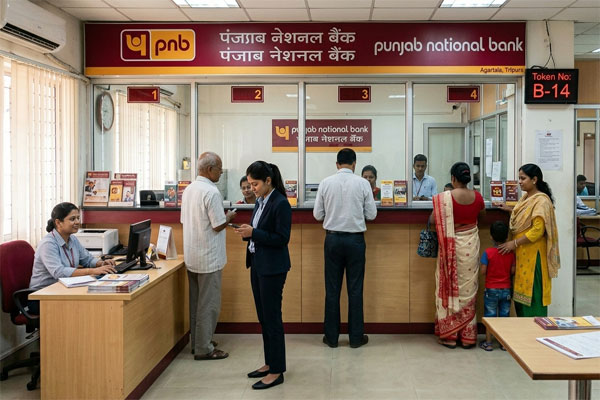
Agartala, April 24: Tripura’s financial landscape is witnessing a significant shift. Recent data shows that borrowers across the state are becoming more disciplined with repayments. However, while the balance sheets of banks look healthier, the daily experience of the average customer in Agartala and rural subdivisions tells a different story.
The 154th State Level Bankers’ Committee (SLBC) report, convened by Punjab National Bank (PNB), reveals a heartening drop in Bad Loans. The Gross Non-Performing Assets (NPA) ratio fell to 4.19% as of December 2025. This is a notable improvement from the 4.74% recorded the previous year. In simple terms, the total volume of “bad money” shrank from Rs 1,048.73 crore to Rs 997.54 crore.
Mixed Results Across Different Sectors
While the overall numbers are positive, the sectoral breakdown shows where the state is thriving and where it is struggling.
- MSME Growth: The small business sector is the star performer. Credit to MSMEs rose to Rs 5,931.37 crore. Even better, their NPA ratio dropped to 5.52%. This suggests that local entrepreneurs in Tripura are utilizing loans effectively to scale their operations.
- Agriculture Concerns: The farming sector remains under pressure. Although credit flow reached Rs 4,793.74 crore, the NPA ratio climbed to 7.68%.
- Kisan Credit Card (KCC) Stress: The most alarming statistic comes from the KCC portfolio. The NPA ratio here has soared to 24.59%. Nearly one-fourth of these loans are now classified as non-performing, indicating a deep-rooted crisis in rural repayment capacity.
Infrastructure vs. Customer Reality
Banks are physically expanding across the state. The total number of branches grew to 618 this year. Canara Bank led this expansion by adding three new outlets, while Union Bank of India added one.
However, physical buildings do not always equate to better service. Residents across Tripura continue to report frequent ATM downtime and chronic cash shortages. While public sector banks increased their ATM count to 441, private banks actually reduced their kiosks from 108 to 104.
“Physical expansion is only half the battle. Banks must prioritize technological efficiency and customer experience to ensure that financial inclusion is meaningful,” noted Kiran Bhowmik during the report analysis.
News Analysis: The CD Ratio Hurdle
Historically, Tripura has struggled with a low Credit-Deposit (CD) Ratio. This ratio measures how much of the money collected as deposits is being re-invested back into the state as loans. Currently, the ratio stands at 57%.
While this is an improvement, it remains below the national benchmark of 60%. For years, the state government has urged banks to stop “exporting” Tripura’s savings to other states and instead lend more to local youth and farmers. The current trend shows that while banks are becoming safer (lower NPAs), they are still hesitant to hit the 60% mark, which is vital for the state’s GDP growth.
Quick Glance: Tripura Banking 2026
| Indicator | Current Status (Dec 2025) | Previous Year |
| Gross NPA Ratio | 4.19% | 4.74% |
| Total Deposits | Rs 46,401.19 Cr | – |
| Total Advances | Rs 23,844.21 Cr | – |
| CD Ratio | 57% | Slight Increase |
| Total Bank Branches | 618 | 604 |
FAQ
Q1: Why is the KCC NPA ratio so high in Tripura?
Agricultural loans often face issues due to weather-related crop failures and market fluctuations, making it harder for farmers to maintain a steady repayment schedule.
Q2: Which bank is expanding the most in Tripura?
According to the latest SLBC report, Canara Bank has been the most active in opening new branches recently.
Q3: What is the target CD Ratio for the state?
The SLBC and state authorities are pushing for a CD ratio of at least 60% to ensure local capital fuels local growth.
