

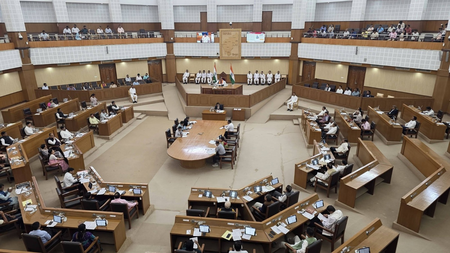
Ruling & Oppn Leaders Discuss Women’s Bill in State Assembly
Agartala April 30: The Tripura Legislative Assembly successfully passed a resolution on Thursday urging the Central Government to revive the Women’s Reservation Bill (Nari Shakti Vandan Adhiniyam). Following a seven-hour debate, the House called for a swift delimitation process to ensure 33% female representation in the Lok Sabha and State Assemblies by 2029.
Quick Glance: Key Highlights
-
Resolution Passed: Tripura Assembly appeals to the Centre for the immediate revival of the Nari Shakti Vandan Adhiniyam.
-
Political Divide: Supported by BJP, Tipra Motha, and IPFT; opposed by CPIM and Congress over delimitation links.
-
Delimitation Demand: The motion seeks a prompt delimitation process based on the 2011 Census to facilitate the 33% quota.
-
Extended Debate: 25 legislators participated in a marathon 7-hour session concluded by a voice vote.
Legislative Action in Agartala: A Push for Gender Parity
The Tripura Legislative Assembly has taken a significant step toward domesticating the national conversation on gender-based political quotas. Government Chief Whip Kalyani Saha Roy introduced a formal resolution appealing to the Union Government to expedite the implementation of the long-delayed Women’s Reservation Bill.
The move comes at a critical juncture following the failure of the Constitution (131st Amendment) Bill, 2026, to pass in the Lok Sabha earlier this month. The resolution was bolstered by 16 members of the treasury benches, representing a unified front between the Bharatiya Janata Party (BJP) and its allies, including the Tipra Motha Party and the Indigenous People’s Front of Tripura (IPFT).
Seven-Hour Marathon Debate
The session witnessed intense deliberations lasting nearly seven hours. A total of 25 legislators, including Chief Minister Dr. Manik Saha, shared their insights. While the ruling coalition celebrated the resolution as a landmark for women’s empowerment, the opposition—comprising the CPIM and Congress—voiced stern objections.
The primary point of contention lies in the mechanism of implementation. The resolution specifically urges the Central government to initiate the delimitation process based on the 2011 Census, a move the opposition claims unnecessarily complicates the reservation issue by linking it to constituency restructuring.
Political Stakeholders & Stances
| Entity | Political Stance | Key Representative |
| BJP & Allies | Supported the Resolution | CM Manik Saha, Ratan Lal Nath |
| CPIM | Opposed (linked to delimitation) | Jitendra Chaudhury (LoP) |
| Congress | Opposed (procedural concerns) | Sudip Roy Barman |
| Tipra Motha | Supported | Animesh Debbarma |
CM Dr Manik Saha Criticizes “Anti-Women” Opposition
During his address, Chief Minister Dr Manik Saha did not hold back, accusing the opposition of historical obstructionism. He noted that while attempts to introduce women’s reservation failed in 1996, 1998, and 2010, it was the Modi government that finally saw it through in 2023.
“The opposition is attempting to mislead the public by spreading confusion regarding the Nari Shakti Vandan Adhiniyam,” Dr. Saha stated. He later took to social media to label April 17—the day the recent amendment failed in the Lok Sabha—as a “Black Day for Indian Democracy.”
Counter-Arguments from the Opposition
Leader of the Opposition Jitendra Chaudhury countered that the BJP was using the 131st Amendment for “narrow political gains.” He emphasized that while the opposition supports the principle of reservation, they reject the government’s strategy of tying the bill to the delimitation exercise, which delays actual implementation.
Congress MLA Sudip Roy Barman echoed these sentiments, pointing out that several opposition-led states have already achieved 50% reservation for women in local self-government bodies without the need for complex federal amendments.
People Also Ask (FAQ)
Q1: What is the Nari Shakti Vandan Adhiniyam? The Nari Shakti Vandan Adhiniyam is the formal name for the Women’s Reservation Bill, which seeks to reserve 33% of seats in the Lok Sabha and State Legislative Assemblies for women.
Q2: Why did the Tripura Assembly pass this resolution? The resolution aims to pressure the Central Government to revive the bill and start the delimitation process so that the 33% quota can be implemented by the 2029 elections.
Q3: Why did the CPIM and Congress oppose the resolution? Opposition parties argue that the BJP is complicating the reservation by linking it to the delimitation exercise and the census, which they view as a delay tactic for political leverage.