

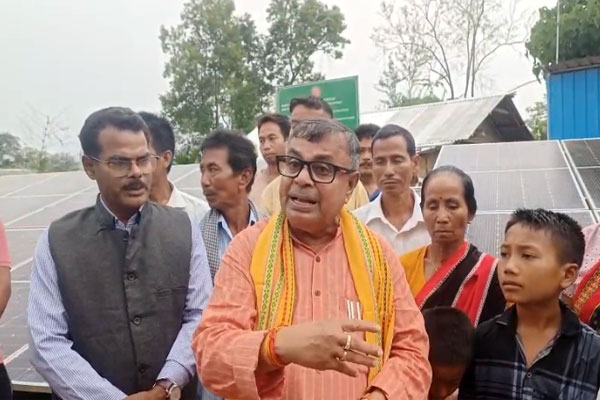
The Tripura government has expanded solar microgrid project in remote hill regions to provide electricity and purified drinking water to underserved communities. Power Minister Ratan Lal Nath inaugurated a new solar-powered facility at Khabaksa Kami village under Teliamura on Sunday, benefiting dozens of tribal families.
Quick Glance
- Solar microgrid and purified drinking water plant inaugurated at Khabaksa Kami village in Teliamura.
- Around 11,933 families across Tripura have already benefited from solar microgrid projects.
- The initiative targets remote hilly areas where conventional electricity lines cannot reach.
- The state has set a target of establishing 80 solar-powered purified drinking water units.
Govt Focuses on Renewable Energy in Remote Areas
Agartala: The Tripura government has intensified efforts to bring electricity and clean drinking water to remote villages located in difficult hilly terrains. The initiative is being implemented jointly by the Power Department and the Tripura Renewable Energy Development Agency (TREDA).
Speaking at the inauguration ceremony in Khabaksa Kami village under Teliamura block in the Baramura hill range, Power Minister Ratan Lal Nath said the government is committed to ensuring that no village remains deprived of basic utilities because of geographical barriers.
The newly inaugurated project includes a solar microgrid power facility and a community-based solar purified drinking water plant. The village, inhabited by 42 families from different communities, had been facing severe electricity shortages for years.
According to the minister, conventional electricity infrastructure such as poles and transmission lines cannot be installed easily in many hill areas due to technical and terrain-related difficulties. As a result, the government has shifted its focus toward renewable energy-based decentralized power systems.
Solar Microgrids Reach Hundreds of Villages
The minister informed that Khabaksa Kami Para is one among 348 locations in Tripura where solar microgrid systems have already been introduced through TREDA.
Each household in the village has received three electric lights and mobile charging facilities under the project. Street lighting has also been installed under the PM-DevINE scheme to improve safety and mobility after sunset.
Officials said the initiative has significantly improved daily life in remote settlements. Families that once depended on kerosene lamps can now access reliable solar-powered lighting.
The minister further stated that nearly 11,933 families across Tripura have already benefited from similar renewable energy initiatives.
Solar Drinking Water Facilities Also Expanded
Apart from electricity, the state government is also expanding access to safe drinking water through solar-powered purification plants.
Nath said the government has fixed a target of installing 80 community-based solar purified drinking water units across the state. Out of these, work on 37 units has already been completed, while another 38 units are currently under construction.
The purified drinking water systems are particularly important for remote villages where conventional water supply systems remain difficult to maintain.
Rural Economy Gets New Support
The minister emphasized that the solar initiative is not limited to electricity alone. According to him, the project is also helping improve livelihoods and social development in interior villages.
Students can now continue their studies at night because homes are illuminated with solar-powered lights. Earlier, many families depended on kerosene lamps, which affected both education and health.
Access to mobile charging and television has also improved communication and information access for villagers. Residents can now stay connected with the outside world through digital platforms and news services.
Traditional bamboo craft work, weaving activities and small-scale cottage industries are also receiving a boost. Local artisans can continue their work during evening hours, increasing productivity and income opportunities.
The minister added that improved street lighting has enhanced safety during nighttime and strengthened social interaction within the community.
Govt Plans More Welfare Measures
During the programme, Nath announced that the government would distribute fruit-bearing saplings such as mango, jackfruit and lemon among villagers to encourage self-reliance and sustainable livelihoods.
He also said discussions would be held with the Agriculture Department to develop additional welfare initiatives for remote communities.
The state government believes that renewable energy projects can become a long-term solution for sustainable rural development in Tripura’s inaccessible hill regions.
| Project Component | Details |
|---|---|
| Location | Khabaksa Kami village, Teliamura |
| Region | Baramura hill range |
| Families Benefited in Village | 42 |
| Total Beneficiaries Across Tripura | 11,933 families |
| Solar Microgrid Locations | 348 in Tripura |
| Target for Solar Water Plants | 80 units across State |
| Completed Water Units | 37 |
| Ongoing Water Projects | 38 |
News Analysis
The Tripura government’s focus on solar microgrids reflects a broader shift toward decentralized renewable energy solutions in geographically challenging regions. Several remote villages in the Northeast still face infrastructure limitations due to forests, hills and sparse habitation patterns.
By using solar-powered microgrids, the government is reducing dependence on expensive transmission infrastructure while simultaneously improving access to basic services. The integration of drinking water systems with renewable energy projects also highlights a more comprehensive rural development strategy.
The initiative may also contribute to local economic growth by extending productive hours for artisans, shopkeepers and students. If implemented effectively across more villages, the project could become a model for sustainable rural electrification in Northeast India.
