

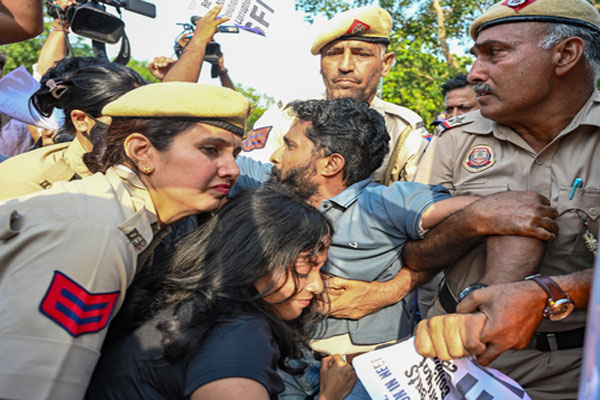
The nationwide cancellation of NEET-UG 2026 has triggered massive concern over the integrity of India’s medical entrance system. Authorities acted after investigators uncovered a large-scale paper leak network linked to encrypted messaging platforms. More than 22 lakh students now face uncertainty as the probe expands.
Quick Glance
- NEET-UG 2026 cancelled nationwide after alleged large-scale paper leak
- Investigators found leaked questions circulating through WhatsApp and Telegram
- Over 22 lakh medical aspirants affected by the unprecedented decision
- Central Bureau of Investigation now probing organised cheating syndicates
NEET-UG 2026 Cancellation Raises Fresh Questions Over Exam Security
New Delhi/Agartala: The cancellation of the National Eligibility-cum-Entrance Test Undergraduate (NEET-UG) 2026 has reignited debate over the reliability of India’s competitive examination system. The decision has drawn nationwide attention because it affects more than 22 lakh aspirants preparing for medical admissions.
Authorities described the cancellation as necessary after evidence suggested that organised networks compromised the examination process. The move also highlighted growing concerns over digital fraud, weak monitoring systems, and loopholes in paper-based national examinations.
The controversy emerged shortly after the examination held on May 3, 2026. Reports indicated that the National Testing Agency (NTA) received inputs about suspicious activities linked to leaked question papers.
Investigators from the Rajasthan Special Operations Group reportedly uncovered a sophisticated digital leak operation. According to officials, a “guess paper” carrying nearly 410 questions circulated through encrypted platforms such as WhatsApp and Telegram. Later verification reportedly showed that around 120 questions matched the actual examination paper.
Officials suspect that candidates paid amounts ranging from Rs 20,000 to Rs 5 lakh to access the leaked content.
Previous Exam Leak Cases Reveal Long-Standing Problems
India’s medical entrance examination system has faced repeated controversies over the years. Several major incidents exposed weaknesses in exam management and monitoring mechanisms.
In 2015, the Supreme Court cancelled the All India Pre-Medical Test after answer keys leaked across nearly 10 states. Investigators then discovered the use of Bluetooth devices and micro-SIM technology by organised cheating gangs.
Another major scandal surfaced in 2014 when authorities scrapped the Combined Pre-Medical Test after detecting tampered paper boxes.
Later, in 2017, students raised concerns about unequal difficulty levels in regional-language question papers distributed in West Bengal and Tamil Nadu. In 2021, police arrested a Jaipur candidate accused of receiving exam questions through WhatsApp connections linked to solver gangs. However, the NTA then termed the matter an isolated case.
The controversy intensified again in 2024 when Bihar’s Economic Offences Unit uncovered a racket allegedly selling question papers for Rs 30 lakh to Rs 50 lakh. Although the Supreme Court acknowledged irregularities, it declined to order a nationwide re-test because evidence did not indicate a complete systemic collapse.
Major Examination Leak Cases in India
| Year | Examination | Key Issue | Action Taken |
|---|---|---|---|
| 2014 | Combined Pre-Medical Test | Tampered paper boxes | Exam cancelled |
| 2015 | All India Pre-Medical Test | Answer key leak | Supreme Court ordered re-test |
| 2021 | NEET-related case | WhatsApp-linked solver gang | Candidate arrested |
| 2024 | NEET controversy | Papers sold for lakhs | Grace marks withdrawn |
| 2026 | NEET-UG | Large-scale digital leak | Nationwide cancellation |
CBI Probe Begins Into Organised Leak Syndicates
The Central Government has transferred the investigation to the Central Bureau of Investigation. Agencies will now focus on tracing the networks allegedly responsible for distributing leaked questions.
Authorities have assured candidates that the fresh examination will take place without additional registration fees. Officials also promised simplified procedures for affected students.
Despite these assurances, the cancellation has deeply affected students and parents. Many aspirants had prepared for months and now face another round of intense preparation amid uncertainty.
Education experts believe the 2026 controversy stands apart because of the scale and technological sophistication of the alleged fraud. They argue that organised cheating networks have adapted faster than existing security systems.
Why Paper-Based Exams Remain Vulnerable
Security specialists say paper-based national examinations involve several vulnerable stages. Question papers pass through moderation, translation, printing, transportation, and storage before reaching examination centres.
Each stage creates opportunities for breaches.
Experts warn that unauthorised copying at printing presses, weak transport monitoring, and insider involvement can compromise examination security. They also stress that many large-scale leaks often involve internal cooperation.
As a result, specialists now demand stricter audit trails, digital tracking systems, and tamper-proof handling mechanisms.
Meanwhile, social media platforms have complicated the challenge further. During examination seasons, Telegram and WhatsApp groups frequently promise “confirmed leaks” in exchange for online payments.
Although many of these claims are fraudulent, investigators reportedly found genuine leaked material in the 2026 case. This discovery has intensified fear among students and parents.
Courts Balance Fairness With Students’ Rights
Legal experts say courts treat the cancellation of nationwide examinations as an extraordinary measure. Judges generally examine whether irregularities were isolated or widespread enough to destroy the credibility of the entire process.
In several landmark rulings, the Supreme Court held that authorities can cancel examinations if the process becomes fundamentally compromised. However, courts also consider the interests of honest students who did not benefit from malpractice.
According to legal analysts, the crucial issue involves identifying whether beneficiaries of the leak can be separated from genuine candidates. If authorities fail to isolate the offenders, a complete re-test becomes the only legally sustainable option.
The NTA reportedly concluded that identifying all beneficiaries in the 2026 case would not be possible. Therefore, the agency decided to cancel the entire examination.
News Analysis
The NEET-UG 2026 controversy has exposed serious weaknesses in India’s examination management system. The incident also demonstrated how rapidly organised cheating syndicates have adopted encrypted communication technology.
Unlike earlier controversies limited to specific centres or regions, the 2026 breach triggered fears of a nationwide compromise. That distinction forced authorities to take the unprecedented step of cancelling the entire examination.

The issue has also highlighted the urgent need for structural reforms. Experts now demand stronger digital surveillance, tighter custody systems, transparent grievance mechanisms, and strict enforcement of the Public Examinations Act, 2024.
Most importantly, the crisis has shaken students’ confidence in merit-based competitive examinations. Restoring trust may now require both technological reforms and stricter institutional accountability.
People Also Ask (FAQs)
Why was NEET-UG 2026 cancelled?
Authorities cancelled the examination after investigators found evidence of a large-scale paper leak linked to digital communication platforms.
How many students are affected by the cancellation?
More than 22 lakh medical aspirants across India have been impacted.
Which agency is investigating the NEET paper leak case?
The Central Bureau of Investigation (CBI) is currently probing the organised leak network. (Edited)