

Quick Glance
- Nagaland University professor Dr. Jayanta Choudhury participated in a national climate governance Gram Panchayat workshop in Hyderabad.
- The event focused on climate-resilient and carbon-neutral planning for Gram Panchayats.
- Experts reviewed a training module aimed at strengthening local climate action strategies.
- The workshop brought together researchers, policy experts and sustainability specialists from across India.
Hyderabad/Agartala: Experts from across India gathered at the National Institute of Rural Development and Panchayati Raj (NIRDPR) in Hyderabad for a two-day workshop on climate-resilient and carbon-neutral Gram Panchayat planning. Among them, Nagaland University professor Dr. Jayanta Choudhury stressed the importance of indigenous knowledge and traditional institutions in achieving sustainable rural governance.
NIRDPR Hosts National Workshop on Climate Governance
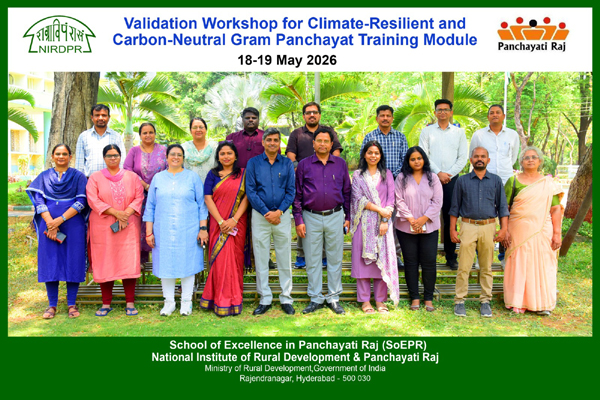
The National Institute of Rural Development and Panchayati Raj organised the two-day Validation Workshop on Climate-Resilient and Carbon-Neutral Gram Panchayat Training Module on May 18 and 19 at Hyderabad.
The programme took place under the School of Excellence in Panchayati Raj (SoEPR). The workshop aimed to strengthen and validate a specialised training module designed for Gram Panchayats across India.
Officials said the initiative seeks to improve climate resilience, encourage carbon-neutral development and promote sustainable local governance systems.
The workshop also highlighted the increasing need for climate-conscious planning at the grassroots level.
Nagaland University Professor Advocates Indigenous Knowledge
Dr. Jayanta Choudhury, Head of the Department of Rural Development and Planning at Nagaland University, participated in the expert validation sessions during the workshop.
During his intervention, he underlined the importance of traditional institutions and indigenous knowledge systems in creating climate-neutral villages.
He noted that local communities in North East India have long relied on sustainable practices that protect forests, biodiversity and water resources. According to him, policymakers should integrate such traditional wisdom into modern climate action frameworks.
His observations gained attention during discussions on sustainable governance and community participation.
Experts Emphasise Climate Action at Grassroots Level
The workshop began with a welcome address by Dr. Anshika Singh, Assistant Professor at SoEPR. Later, Dr. Anjan Kumar Bhanja, Associate Professor and Head of CPR&SSD at NIRDPR, delivered the keynote address.
Dr. J. Saravanan, Consultant at SoEPR, introduced the training module and explained its objectives.
Speakers stressed the urgent need to integrate climate resilience, low-carbon development and environmental planning into Panchayati Raj Institutions.
They also highlighted the growing impact of climate change on rural livelihoods, agriculture and local infrastructure.
Experts agreed that Gram Panchayats can play a critical role in implementing climate adaptation strategies at the village level.
Key Themes Discussed During the Workshop
Participants reviewed multiple thematic modules designed to support local governance institutions.
The discussions focused on environmental awareness, climate risks and carbon-neutral planning. Experts also examined practical strategies to reduce greenhouse gas emissions at the Gram Panchayat level.
Several sessions explored participatory governance, monitoring systems and adaptation planning.
Major Topics Covered
| Topic | Focus Area |
|---|---|
| Climate Change and Carbon Neutrality | Sustainable rural development |
| Greenhouse Gas Reduction | Emission control at village level |
| Climate Risk and Adaptation | Community resilience planning |
| Participatory Governance | Local involvement in climate action |
| Monitoring Frameworks | Evaluation of climate practices |
| Government Schemes | Support systems for Panchayats |
The workshop also included case studies, thematic exercises and climate action planning sessions.
Interactive Sessions Strengthen Training Module
The organisers conducted expert group discussions and case-based exercises throughout the programme.
Participants analysed the practical applicability of the training module within local governance systems. They also suggested improvements to make the module more accessible for Panchayat representatives and rural administrators.
The thematic consolidation sessions allowed experts to finalise recommendations for future implementation.
Officials stated that the validated module would help Gram Panchayats incorporate climate action into everyday planning and development activities.
National Experts Join Climate Governance Discussions
The workshop witnessed participation from academicians, development practitioners, researchers and climate specialists from several institutions across India.
Among other experts includes Dr. K.A. Gopinath, Principal Scientist, ICAR, Central Research Institute for Dryland Agriculture; Dr. Soumya Vinayan, Assistant Professor, Council for Social Development, Hyderabad, N. Mythili Sastry, Associate Professor, Mahindra University, Hyderabad; Sadhna, Climate Change Advisor, GIZ, Hyderabad; Farida Tampal, State Director, WWF-India, Hyderabad Office; Vanitha Kommu, Consultant (Environmental Specialist), The World Bank Group, Hyderabad; Deepak Ramaiyan, Wildlife Expert , SCCL Mines, Hyderabad; Balasubramanian Sambasivam, Assistant Professor, Centre for Sustainability, Mahindra University, Hyderabad ; Madhulika Choudhary, CEO, Dhruvansh Organization, Hyderabad; Monish Jose, Assistant Professor, KILA, Kerala; Dr. Priyanka Sarkar, Consultan, NITI Aayog, New Delhi; Dr. Subha Muthu Kumar, Senior Consultant, Indian Institute for Human Settlements, Bengaluru.
The organisers said the interdisciplinary participation significantly strengthened the quality of the training module.
Climate-Resilient Panchayats Key to Sustainable Development
Experts attending the workshop agreed that climate action must begin at the grassroots level.
They noted that local governance bodies can play an important role in reducing environmental risks and building resilient rural communities.
The validated training module will now support Gram Panchayats in integrating sustainability goals into village development planning.
Experts also stated that the initiative aligns with India’s long-term climate commitments and Sustainable Development Goals (SDGs).
The workshop concluded with discussions on future roadmaps and collaborative approaches for climate-resilient rural governance.
North East Perspective Gains Importance
The participation of Dr. Jayanta Choudhury added a strong North East India perspective to the national workshop.
His emphasis on indigenous governance models reflected the region’s rich traditions of community-based resource management.
Experts believe the inclusion of North East experiences can strengthen India’s broader climate adaptation policies.
As climate challenges continue to affect rural regions, policymakers increasingly recognise the value of local knowledge systems and participatory governance.
People Also Ask
Q1: What was the main objective of the NIRDPR workshop?
The workshop aimed to validate and strengthen a training module for climate-resilient and carbon-neutral Gram Panchayat planning.
Q2: Who represented Nagaland University at the workshop?
Dr. Jayanta Choudhury, Head of the Department of Rural Development and Planning, represented Nagaland University.
Q3: Why are climate-resilient Gram Panchayats important?
Climate-resilient Gram Panchayats help villages manage climate risks, reduce emissions and promote sustainable local development.