

When Time Was Writing ‘The End’, Brazil Wrote the ‘Beginning’
Football, sometimes, turns time into a liar.
When the clock says the game is over, the grass on the field still knows — one pass, one mistake, one run, one touch can still rewrite history.
That is exactly what happened on the night in Houston.
For almost sixty-five minutes, Japan was teaching Brazil that football is not played only with talent, but also with discipline, speed, and courage. They were not afraid of the five-time world champions. Instead, in the first half, their football looked more organised, sharper, and more carefully planned.
At the 29th minute, that courage was rewarded. A moment of uncertainty in Brazil’s defence. Kaishu Sano seized the opportunity. As the ball hit the back of the net, it felt as if an entire continent of Asia began to believe — perhaps the impossible could become possible today. Brazil went into the break trailing.
Brazil’s history carries an old habit — they become the most dangerous precisely when everyone believes their story is over.
In the second half, coach Carlo Ancelotti changed the pattern. A new speed entered the attack, and the pressure increased in midfield. Vinicius Junior began moving relentlessly across the pitch, while Endrick came on and unsettled Japan’s defence. The rhythm of the game changed.
The equaliser came in the 56th minute. A cross, a perfect header, and midfield warrior Casemiro seemed to announce — Brazil was still alive. 1-1.
Then began the wait.
With every passing minute, Japan was using their bodies to stop the waves of yellow shirts. The goalkeeper, defenders, and midfielders — everyone was giving everything they had left. It seemed the match was heading towards extra time.
But football can be cruel too.
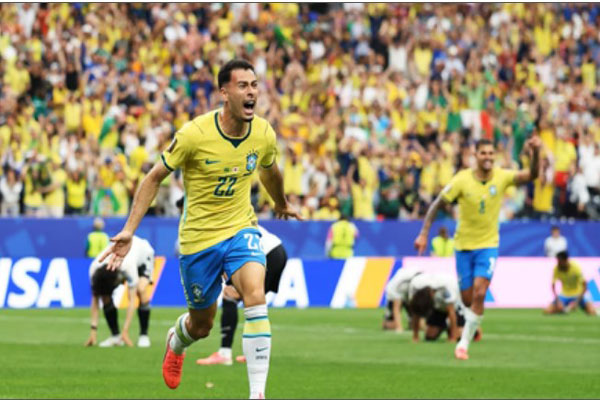
The fifth minute of stoppage time. A mistake from Japan. Brazil got only one chance. And that one chance was enough.
Substitute Gabriel Martinelli sent the ball into the net. 2-1.
The final whistle blew.
Brazil survived. Japan collapsed.
But the story of this match is not only about Brazil’s victory.
It is the story of Japan — a team that no longer steps onto the field merely as representatives of Asia; they arrive as genuine contenders on the global football stage. Their organised defence, rapid counter-attacks, and movement without the ball showed that the era of complete dominance by Europe and Latin America is gradually fading.
And Brazil?
This Brazil is no longer the Brazil of 1970, nor the Brazil of 1982.
This Brazil is not the poetry of 1970, nor the artist painting a masterpiece on the canvas of 1994. They may not mesmerise spectators in every match, but they will exhaust opponents, force mistakes, and strike at the decisive moment.
This is a Brazil built on realism rather than pure beauty. They no longer defeat opponents by simply making them dance; they wait, they fight, they absorb pressure, and when the opportunity arrives, they deliver the final blow.
In Ancelotti’s Brazil, artistry has been joined by patience — and patience has been combined with ruthless efficiency.
Football does not always deliver justice.
But it always creates memories.
On this night, Japan lost, yet walked off the field with pride. Brazil won because they never stopped believing until the final whistle. Perhaps the art of survival has become their new identity, more than the pursuit of beautiful football.
In the end, the scoreboard will say — Brazil 2, Japan 1.
But those who watched the match will know — on that night in Houston, Japan did not surrender.
Only time did.