

The East Para Durga Puja Committee in Shantir Bazar, South Tripura, marked the beginning of Saptami worship on October 17 morning through Ganga invocation and other traditions at the Laugang River, as its Four-decade long celebrations highlighted disappearing rural architecture, cultural heritage and efforts to create a drug-free festival environment.
Key Takeaways
-
East Para Durga Puja celebrates its 40th year with a Rs 12 lakh budget and a theme inspired by traditional thatched houses.
-
The committee began Saptami rituals through a Vedic invocation of the sacred Ganga at the local Laugang River.
-
Organisers are promoting a drug-free festival and undertaking social initiatives, including activities under the Swachh Bharat Abhiyan.
In an age of digital technology and rapid change, a Durga Puja committee in Shantir Bazar has turned to the memories of humble rural life for inspiration.
The East Para Durga Puja Committee has chosen traditional thatched houses as its central theme this year, bringing attention to a form of rural architecture that has gradually disappeared from everyday life.
The committee has entered the 40th year of its annual Durga Puja with a budget of Rs 12 lakh.
Its theme, centred on houses built with straw and thatch, seeks to recreate the atmosphere of an earlier time when such homes formed part of the familiar rural landscape.
Alongside this effort to revive memories of the past, the committee has retained traditional religious practices and introduced initiatives to promote a drug-free festival. Its celebrations combine cultural remembrance, devotion and social responsibility.
Thatched houses bring back memories of rural life
Houses built with straw and thatch once represented a familiar feature of rural life. However, these traditional structures have gradually disappeared in the modern era.
The East Para Durga Puja Committee has made this changing landscape the focus of its pandal theme.
Its members have recreated the appearance of traditional thatched homes and incorporated elements associated with an earlier way of life.
The concept offers more than a decorative setting for the annual festival. It brings attention to rural architectural traditions that modernisation has pushed into the background.
The theme also provides an opportunity to reflect on the relationship between traditional homes and the environment.
Houses made with locally available natural materials formed part of the traditional rural landscape.
Their gradual disappearance raises questions about the changing materials, lifestyles and surroundings of village communities.
However, the committee’s stated focus remains the revival of memories associated with these disappearing homes. The theme brings those memories into a public space where residents and visitors can reconnect with a familiar part of their cultural past.
Ganga invocation marks the beginning of Saptami worship
The committee has also placed traditional religious observances at the heart of its celebrations.
On Saturday morning, local women, men and youths gathered at the Laugang River to perform the Ganga invocation. They recited Vedic chants and conducted the ritual that marked the auspicious beginning of Saptami Puja.
The ceremony reflected the continuing importance of traditional practices in community celebrations. By gathering beside the local river, participants linked the beginning of the day’s worship with a ritual rooted in religious tradition.
The observance also highlighted the place of rivers in community life and religious customs.
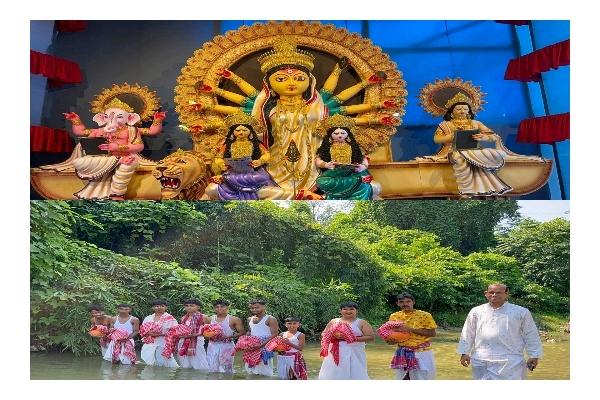
The celebration combines this traditional ritual with a pandal theme that recalls the material and cultural features of an earlier rural society.
Together, the thatched-house theme and the Ganga invocation give this year’s puja a distinct identity. One recalls a disappearing way of life, while the other preserves a customary form of worship.
Drug-free celebrations remain a priority
The committee has also taken steps to address a modern social concern: substance abuse.
It has issued guidelines aimed at promoting a drug-free environment during the festival. The initiative reflects the organisers’ intention to keep the celebrations focused on devotion, community participation and a safe social atmosphere.
Festivals bring people from different backgrounds together. The committee’s initiative seeks to ensure that the celebrations do not become an occasion for activities that threaten community well-being.
The organisers have also undertaken several social programmes, including activities under the Swachh Bharat Abhiyan. These initiatives extend the committee’s work beyond religious observances and the construction of the puja pandal.
By combining social awareness with cultural celebrations, the committee has sought to make its 40th-year event relevant to both tradition and contemporary community concerns.
Organisers share details of the celebrations
The committee’s treasurer briefed the media on the overall arrangements and other aspects of the puja. The priest responsible for the East Para Durga Puja also shared information about the rituals and the festival schedule.
The celebrations have generated considerable enthusiasm across the Shantir Bazar subdivision. Local residents have shown keen interest in the annual event as the committee marks four decades of organising the puja.
This year’s theme gives the milestone a particular significance. By bringing traditional thatched houses back into public view, the organisers have chosen to celebrate not only Goddess Durga but also memories of a rural landscape that is steadily fading.
The combination of heritage, religious observance and social initiatives defines the committee’s approach this year.
Its message is clear: community celebrations can preserve cultural traditions while encouraging people to confront present-day social challenges.