

Brahman — not our “Brahmin” priest! In Vedanta philosophy, Brahman is identified with pure consciousness—the ultimate reality, the absolute essence of existence, or Sat–Chit–Ananda (existence, consciousness, and bliss).
Brahman transcends all conditions and any dependence on external things. Simply put, Brahman is consciousness—all is Brahman.
If we must say it in the simplest possible way, I believe the best phrasing is this: “Brahman is the universal metaphysical truth of physical reality.” Brahman is neither this nor that—yet it is present in all observable existence, beyond the limitations of the mind.
It is not the same as the workings of the mind, which arise from consciousness but are not consciousness itself. Rather than being an effect, Brahman is the source, the ground of all consciousness and existence.
When we say “Brahman is consciousness,” we mean that ultimate reality is unconditioned, pure awareness underlying everything that exists. Our individual consciousness (Chetna) is a reflection of this emergence.
Chetna is not limited to the individual—it is universal consciousness, pervading everything, as expressed in the timeless phrase “all is Brahman.”
Liberation (Moksha) comes through realizing that one’s individual essence (Atman) is a tiny yet inseparable part of Brahman.
Brahman as the Metaphysical Truth of Physical Real
So, what does that physical reality look like? Science tells us that time itself and space itself began with the Big Bang—an event of unimaginable scale that released staggering amounts of energy and light.
With that moment, the universe was born, and existence began. In the blink of cosmic time, the newborn universe expanded at an astonishing speed. It started as an extremely hot, dense plasma of quarks, electrons, and photons (light).
As the universe expanded and cooled, conditions became stable enough for quarks to bind together. Within the first few seconds after the Big Bang, they formed the building blocks of atomic nuclei—protons and neutrons—along with other fundamental subatomic particles.
Atoms came much later. Initially, the universe was far too hot for electrons to bind with protons and neutrons. Around 380,000 years after the Big Bang, the universe finally cooled enough for electrons to be captured by atomic nuclei, forming the first stable atoms—mostly hydrogen, with a little helium.
All of this began roughly 13.6 billion years ago. With light and energy, the universe came alive, and with it began time, matter, and space.
In summary: quarks were among the very first fundamental particles. They led to protons and neutrons, which eventually formed the first atoms (mainly hydrogen) once the universe cooled sufficiently.
Over billions of years, through cosmic events such as star formation and supernovae, those simple hydrogen and helium atoms gave rise to every element in the periodic table.
Everything we see today—about two trillion galaxies, each containing tens to hundreds of billions of stars—was built from that humble beginning.
And yet, astrophysicists still scratch their heads: about 85% of the universe’s matter cannot be found. We know it’s there, but we can’t see it. Hence the name—dark matter.
Consciousness Manifests Only in Existence
Consciousness arises only where existence exists—no matter how simple that existence may be. Even a humble bacterium exhibits Chetna: the ability to respond, adapt, grow, and maintain itself in relation to its surroundings.
Something is clearly “at work” there. What do we call it? Mere biological intelligence—or a manifestation of pure consciousness?
Now ask: How did that bacterium come into existence? The answer takes us back billions of years, to the primordial oceans of early Earth, where something extraordinary happened.
A complex chemical cocktail produced the first life-building molecules. Perhaps intelligence emerged from consciousness—or consciousness expressed itself through intelligence.
Here’s the fun twist: those same life-building molecules have been found on asteroids. This suggests they may have originated beyond Earth, perhaps even beyond our solar system.
Our Sun itself was born about 4.6 billion years ago from cosmic dust left behind by ancient supernovae. And all of those trace back—once again—to the Big Bang.
From Brahman to Brain Cells
Our individual consciousness (Chetna) is a reflection of its emergence from Brahman—the universal consciousness. On a physical level, our consciousness arises from neurological activity: neurons, electrical charges, energy, and matter interacting in astonishing harmony.
We are literally made of elements from the periodic table—hydrogen, oxygen, carbon, nitrogen, iron, etc—each with a long history stretching back to the Big Bang. These atoms bond into molecules—proteins, fats, DNA—that form our bodies and our brains.
Existence began with the birth of space and time, and consciousness manifests only within that existence. Every atom in our body has a history in time and contains vast amounts of space within it.
Most of you is space. Yes—empty space, born at the Big Bang.
Scientists have discovered that atoms are mostly empty space. To visualize this: if an atom’s nucleus were the size of a football, the electron of the simplest atom hydrogen would orbit about a kilometer away.
For larger atoms like oxygen, electrons could be spread across bigger distances. The nucleus occupies only a tiny fraction of the atom’s volume; the rest is empty space covered with electron clouds.
In a simple water molecule—two hydrogens bonded to one oxygen—imagine three football-sized nuclei kilometers apart, surrounded by overlapping electron clouds, like a peanut shell.
These ‘overlapping electron clouds’ called covalent bonds. In bigger atoms like oxygen, there are multiple layers of ‘peanut’ shells. Now think about the enormous molecules like DNA or proteins that make up your body. Funny, isn’t it?
The Dance of Energy, Matter, Space, and Consciousness
Consciousness manifests only where existence exists, and existence requires space. Yet the bonds that hold atoms together to form molecules—water, proteins, and all the complex chemistry of life—are incredibly strong. They require enormous energy to form and to break.
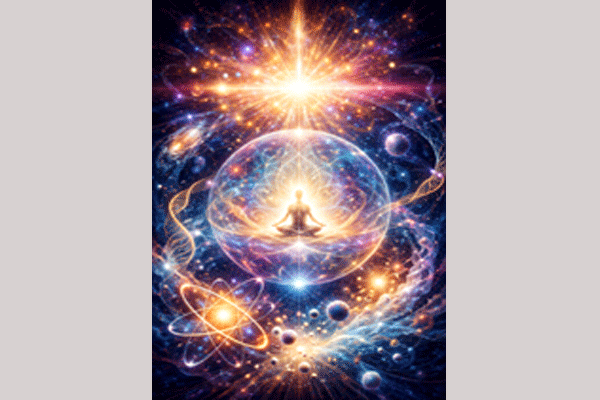
That energy was born in the Big Bang. Some of it condensed into matter—quarks, protons, neutrons, electrons—the fundamental particles that make us who we are.
When we break atoms, we release vast amounts of energy, as in nuclear power, beautifully captured by Einstein’s equation: E = mc²—a tiny mass multiplied by the square of the speed of light.
So, everything—atoms, molecules, planets, bacteria, trees, animals, and humans—is made of space, energy, and matter, engaged in a magnificent balancing dance through which consciousness expresses existence.
Can we then ask: Was the Big Bang the birth of the first consciousness?
The full answer is still unclear. But the story we know—of the universe, of matter, of life, and of awareness—fits remarkably well with the ancient insight of Vedanta.
In that sense, the brief history of Brahman is pretty much this story…… Or will it be same Brahman remains after our current universe cease to exist (Big Crunch) and will continue when another universe come in existence?
*The views and opinions expressed in this article are those of the author and do not necessarily reflect the official policy or position of Enewstime. Any content provided by our authors is of their opinion and is not intended to malign any religion, ethnic group, club, organization, company, or individual.
*Dr Anirban Ghosh is actively involved in redefining how active ingredients are built and delivered using patented bio-native nano-bio technology. He is also a writer with interests on various issues.
