

FM Tables Rs 53.5 Lakh Cr Budget, No Change in Income Tax Slabs
New Delhi/Agartala, Feb 1: Finance Minister Nirmala Sitharaman on Sunday presented the Union Budget 2026-27, her ninth consecutive Budget, outlining a calibrated path of fiscal consolidation while sustaining public investment to drive long-term growth. This was the first time the Union Budget was presented in Parliament on a Sunday.
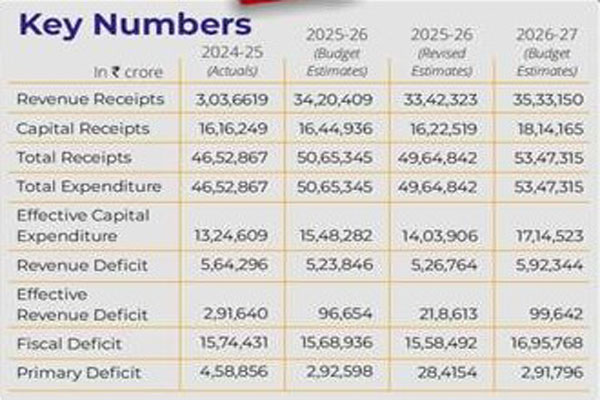
The Finance Minister pegged the fiscal deficit for 2026-27 at 4.3 per cent of gross domestic product (GDP), lower than the 4.4 per cent estimated for the current financial year. The total size of the Budget for the coming year has been placed at Rs 53.5 lakh crore.
Gradual Fiscal Consolidation Roadmap
Reaffirming the Centre’s commitment to fiscal discipline, budget documents indicate a further easing of the government’s debt burden. The debt-to-GDP ratio is projected to decline to 55.6 per cent in 2026-27 from 56.1 per cent in the revised estimates of 2025-26.
Officials said the gradual reduction in debt would help contain interest costs and create additional fiscal space for priority spending.
The fiscal deficit for 2025-26 has been retained at 4.4 per cent of GDP in the revised estimates, maintaining continuity with the earlier Budget projections.
Revenue, Expenditure and Capital Push
For 2025-26, non-debt receipts are estimated at around Rs 34 lakh crore, with net tax collections contributing Rs 26.7 lakh crore. Total expenditure for the year is projected at about ₹49.6 lakh crore, reflecting continued government spending amid global and domestic economic uncertainties.
Capital expenditure remains a key pillar of the government’s growth strategy. Capex for 2025-26 is estimated at close to Rs 11 lakh crore, underscoring the emphasis on infrastructure development and asset creation.
Looking ahead, non-debt receipts in 2026-27 are projected to rise to approximately Rs 36.5 lakh crore, supported by improved tax buoyancy. Net tax receipts are expected to increase to Rs 28.7 lakh crore, while total expenditure is estimated at Rs 53.5 lakh crore, with a substantial allocation for capital outlay aimed at crowding in private investment.
Borrowing Programme
To bridge the fiscal gap in 2026-27, the Centre plans net market borrowings of about Rs 11.7 lakh crore through dated securities. Gross market borrowings are estimated at Rs 17.2 lakh crore, with the balance financing to be met through small savings and other sources. The government said the borrowing programme has been carefully structured to support development priorities without unsettling the debt market.
Policy Priorities and Tax Proposals
Outlining the philosophical framework of the Budget, Sitharaman said it is anchored around three key “Kartavyas”: accelerating and sustaining economic growth, fulfilling the aspirations of the people, and ensuring equitable access to resources, amenities and opportunities across families, sectors and regions under the vision of Sabka Vikas.
While no changes were announced in income tax slabs, the Finance Minister said the New Tax Act will come into force from April 1, 2026, marking a significant structural reform in India’s tax architecture.
In a bid to position India as a global digital infrastructure hub, the Budget also proposed a tax holiday until 2047 for foreign companies offering cloud services globally through data centres located in India.
Overall, the Budget seeks to balance fiscal prudence with growth imperatives, combining a steady consolidation path with continued emphasis on capital investment and long-term structural reforms.
