

Gist: Sonia Gandhi slams the Modi government’s “silence” following Iran’s Supreme Leader Khamenei’s killing. In a sharp Indian Express op-ed, she labels India’s neutral stance an “abdication”.
Agartala Mar 3: Silence is abdication, Sonia Gandhi commented criticizing the central government over the killing of Iran’s Supreme Leader Ali Khamenei.
Congress Parliamentary Party (CPP) Chairperson Sonia Gandhi on Tuesday came down heavily on the Central government for remaining silent on the reported assassination of Iran’s Supreme Leader Ayatollah Ali Khamenei during joint US-Israel airstrikes.
She said the government’s silence does not reflect neutrality. Instead, she called it an “abdication” of responsibility.
Sonia Questions India’s Foreign Policy Stand
In an op-ed published in The Indian Express, Sonia Gandhi argued that the killing of a sitting head of state during ongoing negotiations marks a serious rupture in international relations.
Moreover, she said New Delhi’s silence raises deeper concerns.
According to her, the Government of India has neither condemned the assassination nor addressed the alleged violation of Iranian sovereignty.
She also referred to recent remarks by Prime Minister Narendra Modi.
Initially, she said, the Prime Minister condemned Iran’s retaliatory strike on the UAE.
However, he did not comment on the sequence of events that led to the escalation.
Later, he expressed “deep concern” and called for “dialogue and diplomacy.”
Gandhi pointed out that diplomatic talks were already underway before the alleged attacks.
‘Silence Is Not Neutral’
Furthermore, Sonia Gandhi stressed that the assassination reportedly took place without a formal declaration of war.
It also occurred during an active diplomatic process. Therefore, she said, the act challenges global norms.
She cited Article 2(4) of the United Nations Charter.
The provision prohibits the use or threat of force against the territorial integrity or political independence of any state.
A targeted killing of a serving head of state, she argued, strikes at the core of these principles.
Consequently, she warned that if the world’s largest democracy fails to object on principle, it could normalise the erosion of international law.
Sonia Gandhi Recalls Iran’s Support on Kashmir
Gandhi highlighted Iran’s past support for India. She recalled that in 1994, when sections within the Organisation of Islamic Cooperation pushed a resolution against India at the UN Commission on Human Rights over Kashmir, Iran made efforts to block the move.
She also mentioned Iran’s role in enabling India’s diplomatic presence in Zahedan, near the Pakistan border.
This presence, she said, acts as a strategic counterbalance to Gwadar port and the China-Pakistan Economic Corridor.
Moreover, she recalled that in 2001, then Prime Minister Atal Bihari Vajpayee visited Tehran and reaffirmed deep bilateral ties.
However, she suggested that the current government appears to overlook those long-standing relations.
Criticism Over Israel Policy
At the same time, Gandhi criticised what she described as the Prime Minister’s “unequivocal support” for the Israeli government led by Benjamin Netanyahu, especially in the context of the Gaza conflict.
She said India’s high-profile political endorsement, without moral clarity, marks a visible and troubling shift in foreign policy.
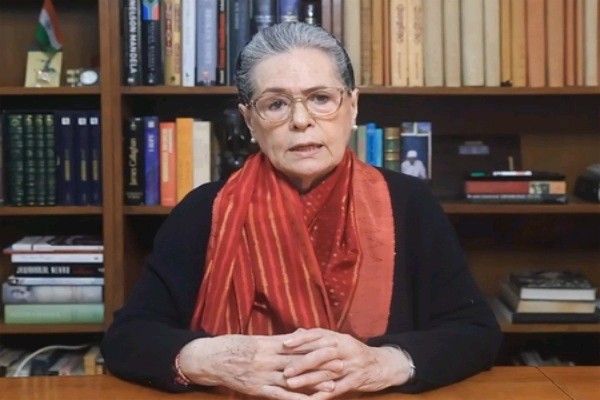
In addition, she reiterated the Congress party’s position. She termed the alleged assassination of the Iranian Supreme Leader a “dangerous escalation” with serious regional and global consequences.
Call for Strategic Clarity and Moral Position
Sonia Gandhi acknowledged that India’s ties with Israel have expanded in defence, agriculture and technology.
Nevertheless, she said India’s strength lies in maintaining relations with both Tehran and Tel Aviv.
Therefore, she argued, India must use its diplomatic space to urge restraint.
However, such space depends on credibility. And credibility depends on principle, not expediency.
She also expressed concern for Indian citizens living in Gulf nations amid rising tensions.
India, she said, protects its nationals best when it acts as an independent global player.
Finally, invoking the principle of “Vasudhaiva Kutumbakam,” Gandhi said India must stand for justice, restraint and dialogue.
At a time when the rules-based international order faces strain, she added, silence amounts to abdication.
She concluded by urging the government to clearly articulate India’s position on the Iran Supreme Leader assassination, West Asia conflict, and evolving global tensions. (With IANS inputs)
