

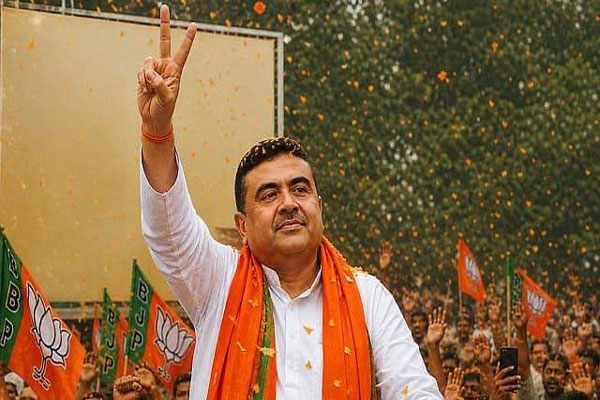
Suvendu Adhikari rose from leading the historic Nandigram anti-land agitation to becoming the BJP’s first Chief Minister in West Bengal. Once a trusted aide of Mamata Banerjee in the All India Trinamool Congress, Adhikari later joined the BJP and emerged as one of its strongest leaders in Bengal.
Kolkata, May 8: The political rise of Suvendu Adhikari marks one of the most dramatic transformations in West Bengal politics. Once known as the face of the anti-land acquisition movement in Nandigram, Adhikari is now set to become the first Chief Minister of a BJP-led government in the state since Independence.
Nandigram and Singur Changed Bengal Politics
The downfall of the 34-year-old Left Front government in West Bengal was shaped largely by two major land agitation movements — Singur in Hooghly district and Nandigram in East Midnapore district.
The Singur protest against the Tata Motors small car project attracted national and international attention because of the involvement of the Tata Group and the direct leadership of Mamata Banerjee.
However, political observers believe the Nandigram agitation had a deeper political impact. The proposed chemical hub project by Indonesia’s Salim Group triggered widespread protests, eventually turning public opinion sharply against the CPI(M)-led Left Front government.
The situation intensified after police firing on March 14, 2007, left 14 protesters dead. The incident became a defining moment in Bengal’s political history.
Suvendu Adhikari Emerged as the Face of Nandigram
While Mamata Banerjee spearheaded the Singur movement, the responsibility of leading the Nandigram agitation was handed to Suvendu Adhikari, then one of her closest associates.
At that time, Nandigram was heavily surrounded by CPI(M) cadres led by veteran leader Lakshman Chandra Seth. The administration also deployed large police contingents to control the region.
Despite the pressure, Adhikari managed to unite villagers and strengthen resistance against land acquisition. Protesters blocked entry routes into Nandigram, preventing both police and ruling party workers from entering the core protest zones.
He also succeeded in mobilising support from several ultra-left groups, helping the agitation sustain momentum during its most difficult phase.
The police firing in March 2007 transformed the movement into a statewide issue. Intellectuals, civil society members and celebrities joined protests across West Bengal, accelerating anti-Left sentiment.
Electoral Rise After Nandigram
The 2009 Lok Sabha elections marked Adhikari’s entry into national politics. Contesting from Tamluk as a Trinamool Congress candidate, he defeated CPI(M)’s Lakshman Chandra Seth by over 1.7 lakh votes.
His political influence continued to grow after he retained the Tamluk seat in the 2014 Lok Sabha elections.
Ahead of the 2016 Assembly polls, Mamata Banerjee brought him into the state Cabinet. Adhikari contested from the Nandigram Assembly constituency, won comfortably and later took charge as Transport Minister.
As Transport Minister, he introduced several reforms aimed at improving public transport services in West Bengal. He was also credited with promoting eco-friendly electric buses within state transport corporations.
Rift with Trinamool Congress Leadership
For years, Adhikari was considered one of Mamata Banerjee’s most trusted political aides. However, tensions within the Trinamool Congress began surfacing around 2019.
Differences reportedly intensified after Abhishek Banerjee started playing a dominant role in organisational and administrative matters. Several senior leaders in the party allegedly felt sidelined during that period.
The BJP’s strong performance in the 2019 Lok Sabha elections further widened the divide. The party won 18 out of 42 Lok Sabha seats in West Bengal, its best-ever performance in the state at the time.
Adhikari openly criticised the Trinamool Congress leadership and blamed administrative failures for the BJP’s rapid growth in Bengal.
The situation worsened after political consultancy firm I-PAC became closely associated with the Trinamool Congress strategy team in 2020. Adhikari reportedly objected to its growing influence over ministerial and administrative decisions.
Shift to BJP and the Giant-Killer Image
Before the 2021 Assembly elections, Suvendu Adhikari resigned from the state Cabinet and the Assembly before joining the BJP in the presence of Union Home Minister Amit Shah.
The political battle that followed became one of the most closely watched contests in the country.
Adhikari contested from Nandigram as the BJP candidate and defeated Mamata Banerjee, who had chosen the constituency for a high-profile electoral battle.
Although Mamata Banerjee later returned to the Assembly through the Bhabanipur bypoll and retained the Chief Minister’s post, Adhikari’s victory established him as one of Bengal’s most influential BJP leaders.
With the BJP securing 77 seats in the 2021 elections, he was appointed Leader of the Opposition in the West Bengal Assembly.
Aggressive Opposition Politics
As Opposition leader, Adhikari launched statewide campaigns on several controversial issues, including alleged recruitment scams, attacks on Hindus, the Sandeshkhali controversy and the rape and murder of a junior doctor at R.G. Kar Medical College and Hospital in Kolkata.
He repeatedly targeted Mamata Banerjee and Abhishek Banerjee during public rallies, accusing them of heading a corrupt administration.
Inside the Assembly too, Adhikari remained one of the fiercest critics of the Trinamool Congress government. His aggressive protests led to multiple suspensions from the House by former Speaker Biman Bandopadhyay.
Even during suspensions, he continued demonstrations within the Assembly premises alongside BJP legislators.
Strengthening BJP in East Midnapore
Away from the spotlight, Adhikari focused on building a strong BJP organisation in East Midnapore district, particularly in Nandigram and surrounding regions.
His efforts paid off during the 2024 Lok Sabha elections. Although the BJP’s overall tally in West Bengal dropped from 18 to 12 seats, the party captured both Tamluk and Kanthi constituencies — long considered Trinamool strongholds.
Former Calcutta High Court judge Abhijit Gangopadhyay won from Tamluk, while Adhikari’s younger brother Soumendu Adhikari emerged victorious from Kanthi.
The Adhikari family has remained politically influential in the district for decades. From 2009 to 2024, Kanthi was represented in Parliament by Suvendu Adhikari’s father Sishir Adhikari.
The BJP also swept all 16 Assembly seats in East Midnapore during the recently concluded state elections.
BJP Forms Government in Bengal
The Assembly election results declared on May 4 dramatically altered Bengal’s political landscape. The BJP won 207 seats, while the Trinamool Congress was reduced to 80.
Suvendu Adhikari secured victories in both Nandigram and Bhabanipur. Mamata Banerjee again suffered defeat, this time from Bhabanipur by more than 15,000 votes.
After defeating a sitting Chief Minister twice in high-stakes electoral contests, Adhikari emerged as the unanimous choice for leading the BJP government in West Bengal.
On Friday, Amit Shah formally approved his name as the leader of the BJP Legislative Party, clearing the way for Suvendu Adhikari to become the next Chief Minister of West Bengal. (Edited)