

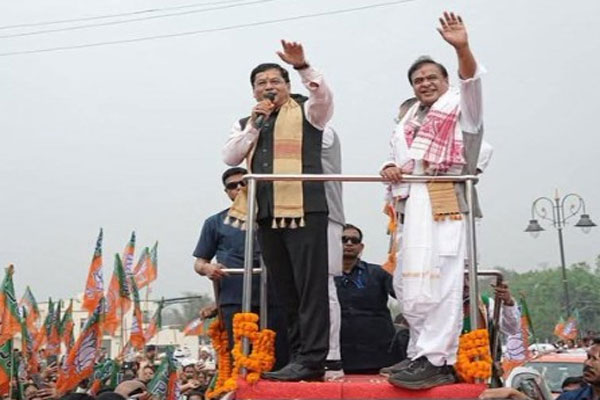
Sarbananda Congrats Himanta
Agartala/Guwahati: In a watershed moment for Northeast Indian politics, Union Minister Sarbananda Sonowal officially welcomed the “spectacular performance” of the Bharatiya Janata Party (BJP)-led National Democratic Alliance (NDA) following the 2026 Assam Assembly elections.
Speaking from Guwahati on May 5, the former Chief Minister and current MP from Dibrugarh characterized the landslide victory as a definitive endorsement of Prime Minister Narendra Modi’s development-driven governance.
Sonowal extended his congratulations to Chief Minister Himanta Biswa Sarma, crediting his “tireless energy” for translating the central government’s vision into a grassroots reality that secured the trust of the Assamese electorate.
2026 Assam Poll Mandate
The 2026 mandate serves as a critical barometer for the geopolitical stability of the entire Northeast region, specifically resonating with neighboring states like Tripura. For the last decade, the political narrative in the “Seven Sisters” has shifted from one of insurgency and isolation to integration and infrastructure.
This victory solidifies the “Double-Engine” model—a synergy between state and central administrations—that has become the hallmark of BJP’s regional strategy since 2014. For a local reader in Agartala or Guwahati, this result isn’t just about party politics; it is about the continuity of the Act East Policy.
The historical context of this win cannot be understated. From the tumultuous decades of the Assam Accord and ethnic friction, the state has transitioned into a phase where “Viksit Bharat” (Developed India) aspirations take precedence over identity politics.
This shift mirrors the political evolution seen in Tripura in 2018 and 2023, where voters prioritized the “Green Gold” economy (bamboo and rubber) and connectivity over traditional rhetoric. The 2026 results suggest that the Northeast is no longer a peripheral political theater but a core pillar of India’s national sovereignty and economic expansion.
The Mechanics of a Landslide: Infrastructure and Welfare Delivery
The NDA’s victory is built on a foundation of tangible “welfare delivery” and “inclusive growth.” According to Sonowal, the scale of the win reflects deep-seated trust in the government’s ability to execute large-scale infrastructure projects.
This includes the expansion of the national highway network connecting Upper Assam to the rest of the country and the modernization of the Brahmaputra riverfront.
The grassroots engagement by party workers was cited as the primary engine that translated these governance outcomes into votes.
-
Key Pillars of the Mandate:
-
Connectivity: Massive investments in bridge projects over the Brahmaputra, reducing transit times between North and South banks.
-
Economic Empowerment: Focused initiatives on youth empowerment and the “self-reliant Assam” (Atmanirbhar Axom) scheme.
-
Social Harmony: A focus on maintaining peace in previously disturbed areas through dialogue and development.
-
Leadership Synergy: The collaborative effort between the central leadership (PM Modi, Amit Shah) and the state machinery led by Himanta Biswa Sarma.
-
Sonowal emphasized that this mandate is not merely a political win but a “responsibility to serve with greater commitment.” He specifically credited Union Home Minister Amit Shah’s efforts in strengthening governance and BJP President Nitin Nabin for the party’s emphatic performance across Assam, Bengal, and Puducherry, signaling a broader regional shift.
National Security and the “Green Gold” Frontier
Through a security lens, the 2026 mandate ensures a “safe and secure” Northeast, a point Sonowal reiterated with vigor. Border stability is paramount for Assam, which shares boundaries with several neighboring nations.
The continuity of the NDA government ensures that the “zero-tolerance” policy toward illegal immigration and cross-border insurgency remains intact. This stability is the prerequisite for the economic “Big Picture”—the transformation of the Northeast into a trade hub for Southeast Asia.
Economically, the victory provides a green light for the continued expansion of the “Green Gold” (bamboo) and tea economies. Assam’s tea industry, coupled with Tripura’s rubber and bamboo sectors, forms the backbone of the regional GDP.
By ensuring political stability, the government aims to attract further private investment into food processing and sustainable manufacturing. The “Self-Reliant India” vision mentioned by Sonowal is directly tied to utilizing these local resources to reduce import dependency, turning the Brahmaputra valley into a manufacturing corridor.
What’s Next: The Road to 2027 and Beyond
Over the next 3–6 months, observers can expect an acceleration of “Double-Engine” projects. The immediate focus will likely be on finalizing major hydroelectric and transport projects that have been in the pipeline. With the electoral hurdle cleared, the Himanta Biswa Sarma administration is expected to push for more aggressive digital transformation in rural governance.

The verdict is clear: Assam has opted for “stability over volatility.” This result will likely influence the political climate in other Northeastern states facing elections in the near future, reinforcing the narrative that development is the ultimate electoral currency.
As Sonowal noted, the NDA government will continue to focus on social harmony, ensuring that the diverse ethnic fabric of the state remains a source of strength rather than friction. (Edited)