

Agartala/New Delhi Mar 25: In a landmark ruling that clarifies the intersection of faith and constitutional identity, the Supreme Court of India has reaffirmed that individuals who convert to Christianity and actively practice the faith forfeit their Scheduled Caste (SC) status.
For the diverse socio-religious landscape of Tripura and the Northeast, the verdict provides a critical distinction. While SC status is legally tied to specific religious affiliations, Scheduled Tribe (ST) status remains rooted in ethnic identity, offering a shield for the region’s tribal Christians.
The Legal Verdict: Faith Over Inheritance
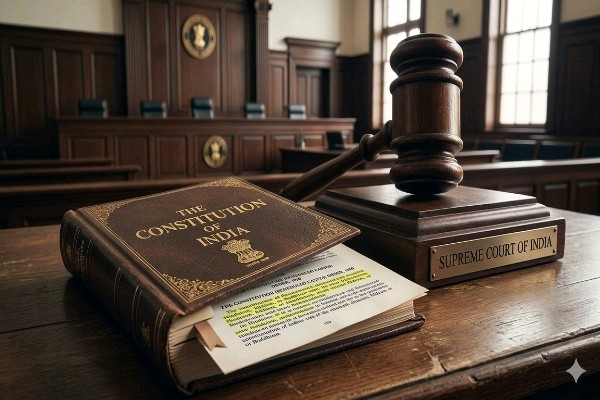
A Bench comprising Justices Prashant Kumar Mishra and N. V. Anjaria upheld a previous decision by the Andhra Pradesh High Court, stating that the Constitution (Scheduled Castes) Order, 1950 is absolute.
Under this order, SC recognition is strictly limited to those professing Hinduism, Sikhism, or Buddhism.
The case centered on an individual serving as a Christian pastor for over a decade.
The Court noted that by leading Sunday prayers and identifying as a Christian, the appellant had severed his legal link to the SC framework.
Consequently, such individuals cannot invoke the SC/ST (Prevention of Atrocities) Act, as the law does not recognize the caste system within the Christian faith.
Key Clarification: Why ST Status Remains Unaffected
The ruling has sparked significant interest across the Northeast, where a large percentage of the population identifies as both Scheduled Tribe and Christian. Legal experts emphasize a “High-Wall” distinction between the two categories:
Scheduled Castes (SC): Status is contingent upon religious profession (Hindu, Sikh, or Buddhist). Conversion to Christianity or Islam results in an immediate loss of benefits.
Scheduled Tribes (ST): Status is religion-neutral. It is determined by “primitive traits,” distinctive culture, geographical isolation, and socio-economic backwardness.
| Read More at Live Law Here |
A person from the Tripuri, Reang, or Lusai communities retains their ST status regardless of whether they practice indigenous faiths or Christianity.
Provision for Regaining SC Status
In a notable “News Analysis” regarding the path forward, the Supreme Court clarified the “Reversion Doctrine.” An individual who lost their SC status through conversion can legally regain it under two conditions:
- 1. Reconversion: They must return to Hinduism, Sikhism, or Buddhism.
- 2. Community Acceptance: They must be formally accepted back by their original caste community (e.g., the Madiga community in this specific case).
News Analysis: The Historical Context of the 1950 Order
The 1950 Order was originally designed to provide reservations to groups that suffered from the specific social stigma of “untouchability” within the Hindu fold.
Over decades, Sikhism (1956) and Buddhism (1990) were added via amendments, acknowledging that these faiths emerged from or exist in close proximity to the Hindu social structure.
The current ruling reinforces the 2026 legal consensus that Christianity and Islam—as egalitarian faiths—do not theoretically recognize caste, thus placing their followers outside the ambit of SC reservations. (With inputs from IANS & Bar and Bench)
