

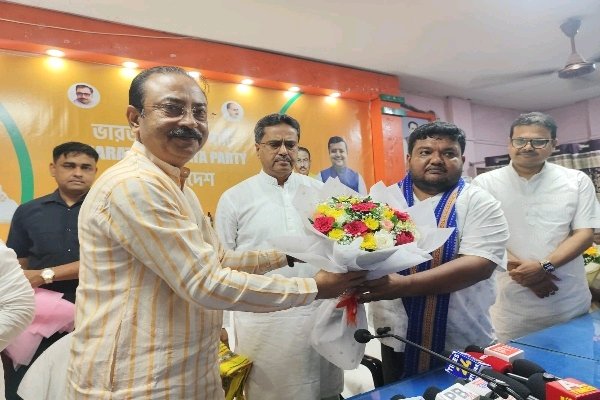
Political challenge before newly appointed Tripura BJP president Abhishek Debroy is clear – formulating a well defined hill politics strategy.
The rise of Pradyot Bikram Manikya Debbarma-led TMP, fragile alliance politics and shifting electoral equations have intensified pressure on the ruling party before key elections.
Quick Glance
- BJP faces growing political resistance from the Tipra Motha Party in tribal areas.
- Nearly 20 Assembly seats fall under the Tripura Tribal Areas Autonomous District Council region.
- The BJP-TMP alliance remains politically sensitive despite cooperation in government.
- Rebuilding grassroots support in Hill Tripura is emerging as the biggest challenge for new BJP chief Abhishek Debroy.
Complex Political Landscape
Agartala: The appointment of Abhishek Debroy as the new president of the BJP’s Tripura unit comes at a crucial political moment for the ruling party.
Although the BJP continues to dominate large parts of the plains in Tripura, the situation in the tribal-dominated hill regions has changed significantly in recent years. Political analysts now believe the BJP’s biggest electoral challenge no longer comes from the CPI(M). Instead, the most serious threat has emerged from its ally-turned-competitor, the Tipra Motha Party.
The rise of TMP has reshaped political equations across tribal constituencies and forced the BJP to rethink its long-term electoral strategy in the Northeast.
Hill Tripura Emerges as BJP’s Biggest Concern
One of the most pressing challenges before the BJP leadership is the gradual erosion of its support base in tribal areas governed by the Tripura Tribal Areas Autonomous District Council.
The political significance of these regions is substantial. Out of Tripura’s 60 Assembly seats, nearly 20 constituencies fall within the TTAADC jurisdiction. These seats are expected to play a decisive role in future Assembly elections.
Political observers say the BJP cannot afford to ignore the shifting mood in these regions.
The trend became visible during the TTAADC elections when TMP secured overwhelming support across tribal belts. The results reflected strong public backing for tribal identity politics and demands linked to constitutional safeguards and indigenous rights.
For the BJP, the outcome exposed growing vulnerability in hill politics.
CPIM No Longer the BJP’s Main Rival
Tripura politics has undergone a dramatic transformation over the last decade.
The BJP’s initial rise in the state was built around defeating the CPI(M), which governed Tripura for 25 years. The saffron party successfully ended Left Front rule in 2018 and retained power again in 2023.
However, the political battlefield has now shifted.
While the CPI(M) still maintains pockets of influence among traditional Left supporters, it no longer appears to be the BJP’s principal challenger in tribal areas.
Instead, TMP has emerged as the dominant political voice in Hill Tripura.
The party has succeeded in creating a strong emotional connection with indigenous communities using identity-based ethnic politics. TMP’s aggressive mobilisation around tribal identity, regional aspirations and constitutional rights has generated significant support among tribal youth and voters.
As a result, the BJP now faces resistance from a far more emotionally driven and politically assertive regional force than the CPIM.
Fragile BJP-TMP Alliance Adds Political Uncertainty
Another major challenge before Debroy is managing the politically delicate alliance between the BJP and TMP.
Although the two parties currently maintain a working relationship, the alliance remains strategically fragile. Differences over tribal demands, governance priorities and political expansion continue to exist beneath the surface.
Political analysts describe the alliance as one built more on practical necessity than long-term ideological compatibility.
For the BJP, maintaining ties with TMP is important for political stability in the state. At the same time, the party also wants to recover its lost organisational influence in tribal regions.
This dual objective creates a difficult balancing act for the new BJP president.
If the BJP aggressively attempts to rebuild its tribal base, tensions with TMP may increase. On the other hand, excessive dependence on the alliance could weaken the BJP’s independent organisational strength in Hill Tripura.
Debroy’s political handling of this relationship may therefore become one of the defining aspects of his tenure.
BJP Needs Aggressive Grassroots Rebuilding
Within the BJP organisation, Debroy is known for his close contact with grassroots workers and booth-level karyakartas. Party insiders believe his organisational style influenced the central leadership’s decision to appoint him as state president.
However, rebuilding confidence in tribal areas will require more than organisational reshuffling.
The BJP may need to intensify outreach in remote ADC villages, improve engagement with tribal youth and address perceptions that local aspirations are being overshadowed by national political narratives.
At the same time, TMP’s grassroots presence continues to expand rapidly across hill constituencies.
Supporters of the regional party remain highly motivated and politically vocal. Their increasing confidence has already transformed electoral discussions in tribal areas.
Consequently, political complacency could prove costly for the BJP in future elections.
Balancing Plains and Hills Politics Will Be Crucial
Another challenge before Debroy will involve maintaining political balance between the Bengali-majority plains and the tribal-dominated hills.
The BJP still enjoys strong support in urban and semi-urban regions. Nevertheless, sustaining long-term political dominance in Tripura will require the party to remain electorally relevant in both demographic segments.
Any visible imbalance could create complications before the 2028 Assembly elections.
Political analysts believe Debroy’s leadership will likely focus on three parallel goals — strengthening organisation, rebuilding tribal outreach and carefully managing alliance politics.
A Defining Political Test for Abhishek Debroy
The road ahead for Abhishek Debroy is expected to be politically demanding.

The rise of the Tipra Motha Party has fundamentally altered the nature of electoral politics in Tripura’s hill regions. Although the BJP-TMP alliance currently offers temporary stability, it also creates strategic uncertainty for the ruling party.
How Debroy manages tribal outreach, alliance coordination and organisational rebuilding could significantly influence the BJP’s future political fortunes in Tripura.
For now, the BJP’s biggest challenge remains clear — regaining trust in Hill Tripura while preserving its dominance in the plains.
People Also Ask
Why is Hill Tripura important for the BJP?
Hill Tripura includes nearly 20 Assembly constituencies under the TTAADC region, making it electorally crucial for any ruling party.
Why is TMP considered a challenge for the BJP?
TMP has gained strong support among tribal voters through its focus on indigenous identity, constitutional safeguards and regional aspirations.
What is the BJP’s biggest challenge in Tripura now?
The BJP’s biggest challenge is rebuilding its support base in tribal areas while maintaining its alliance with TMP.