

Khumulwng/Agartala April 5: In a move that signals a tectonic shift in Tripura’s ethnic politics, the Bharatiya Janata Party (BJP) has officially proposed to elevate the current Autonomous District Council (TTAADC) structure to a more powerful Tripura Autonomous Territorial Council (TATC).
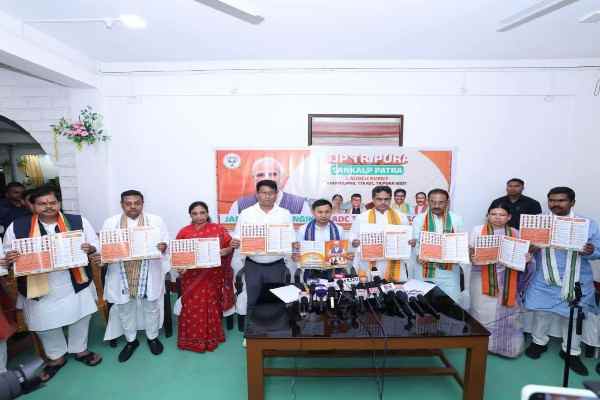
Chief Minister Dr Manik Saha alongwith other BJP leaders unveiled the 29-point “Sankalp Patra” (Vision Document) at the TTAADC headquarters in Khumulwng on April 4 evening.
During the event, Dr. Manik Saha framed the upcoming April 12 elections not merely as a local body poll, but as a referendum on the constitutional empowerment of the indigenous Tiprasa people.
The proposal to upgrade the council to a “Territorial” status aims to address decades of grievances regarding financial autonomy and legislative limitations that have historically hamstrung the Sixth Schedule body.
The TATC Framework: More Than a Name Change
The centerpiece of the BJP’s manifesto is the transition from TTAADC to TATC.
This isn’t cosmetic, Dr Saha said. By seeking “Territorial” status, the BJP aims to grant the council expanded legislative powers, effectively reducing its dependence on the state capital, Agartala.
Key pillars of this institutional overhaul include:
Institutional Elevation: Recasting the council to signify a higher constitutional standing with broader administrative reach.
Judicial Preservation: The establishment of Customary Courts to adjudicate matters based on traditional tribal laws, ensuring that justice remains rooted in indigenous culture.
Grassroots Decentralization: Introducing elected Village and Municipal Councils to ensure that funds and decision-making powers reach the last mile of the hills.
Healthcare and Economic Empowerment
Dr. Manik Saha emphasized that the document is an “emotional commitment” rather than a list of electoral sops. To bridge the urban-rural healthcare divide, the party has committed to establishing a Medical College in Dhalai district, the state’s most topographically challenging region.
Furthermore, Khumulwng is slated to host new nursing and paramedical institutes to create local employment for tribal youth.
On the economic front, the manifesto pivots toward the “Lakhpati Didi” initiative, aiming to empower women-led Self-Help Groups (SHGs).
By integrating traditional tribal crafts—specifically weaving and bamboo work—into a modernized supply chain through dedicated training centers, the BJP hopes to turn Khumulwng into a hub for the “Vocal for Local” movement.
News Analysis: The Battle for the “Territorial” Narrative
> Editorial Insight: The shift in terminology from “District” to “Territorial” is a calculated political maneuver.
By proposing the TATC, the BJP is attempting to offer a significant constitutional empowerment within the existing framework of Tripura.
The proposal has effectively put the Tipra Motha Party (TMP) in a tough electoral pitch. BJP has turned the table in such a manner that TMP and other opposition parties will have to think about new approach beyond regionalism.
This “Territorial Council” model mirrors successes seen in Assam’s Bodoland, suggesting that the BJP is looking to replicate a proven administrative template to quell regionalist sentiments while maintaining the state’s integrity.
The subtle message is loud and clear: align with the ruling national party for the holistic development of the present generation and Gen Next.
Security and Political Friction:
The Chief Minister did not mince words regarding the current state of the ADC, currently governed by the Tipra Motha.
Dr Saha alleged that certain pockets of the tribal belt have seen a dip in stability and law and order.
He reiterated the government’s “Zero Tolerance” policy against violence and drugs, positioning the BJP as the only party capable of ensuring a Nasha Mukt (Drug-Free) Tripura.
The event saw a heavy-weight presence, including MP Rajib Bhattacharjee and key tribal faces of the party like Rebati Tripura and Bikash Debbarma.
Their presence underscores the party’s intent to make deep inroads into the 20 seats of the TTAADC, which are often considered the “kingmaker” in Tripura’s 60-member assembly dynamics.