

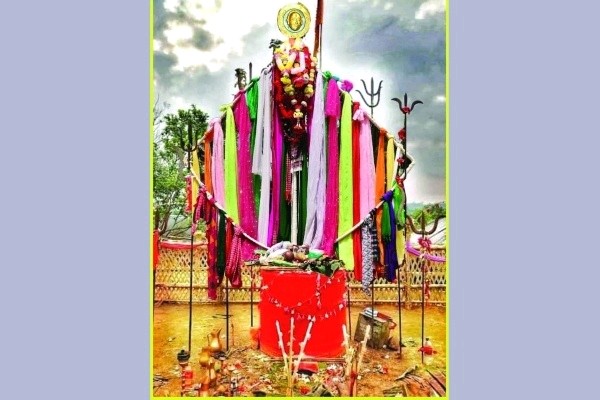
Teliamura, April 13: The Jamatia community of Teliamura prepares for a landmark religious event.
For the first time in 435 years, the sacred Baba Garia Puja has returned to the Hadray village region of Teliamura. This homecoming marks a generational shift for the indigenous community, as the deity—traditionally known as Biya Kwrwi—graces Garjantali with its presence.
The atmosphere in Khowai district has shifted from quiet rural life to a vibrant center of cultural resurgence.
Thousands of devotees are already trekking from the distant corners of South and Dhalai districts to witness this once-in-many-lifetimes occurrence.
A Historic Transformation in Garjantali
The Seven-day festival officially commences on April 14, coinciding with the tribal New Year. However, the energy in Garjantali has reached a fever pitch much earlier. The local landscape has undergone a total transformation to accommodate the massive influx of pilgrims.
Consequently, the state government has mobilized 22 different line departments to manage the infrastructure.
These departments are working on everything from temporary sanitation to high-capacity lighting and medical camps.
Tripura Governor Nallu Indrasena Reddy officially inaugurated a grand seven-day festival on Monday evening.
The event, which is scheduled to run through April 14.
Key Attendees and Ceremony Highlights
The inaugural ceremony saw a gathering of prominent political figures and community leaders. Notable attendees included:
-
Kalyani Saha Roy: MLA of Teliamura and Chief Whip of the State Legislative Assembly.
-
Rajat Panth: District Magistrate.
-
Jagdishwar Reddy: District Police Officer.
-
Data Mohan Jamatia: Former Principal Secretary of the State.
Community and Traditional Leadership
The event also highlighted the involvement of the Jamatia Hoda and other indigenous leadership structures. In attendance were:
-
Pulindra Kumar Jamatia: Advisor to the Jamatia Hoda.
-
Bipra Kumar Jamatia: Akra Nayakphang.
-
Sangroma Riang Dafa Bichitra Mohan Jamatia, along with several other distinguished members of society.
The Scale of Devotion: 20,000 Expected
Organizers expect a massive gathering of approximately 20,000 devotees.
People are traveling from diverse locations including Amarpur, Udaipur, Karbook, Birchandramanu, and Raisyabari.
Even remote areas like Jampuijala and Golaghati will see significant participation. This massive migration highlights the deep-rooted faith the Jamatia people place in Baba Garia.
The Jamatia community operates under a highly organized three-tier social structure. This includes the Hoda (the supreme body), the Moyals (regional units), and the village Chowdhuries.
In Hadray, there are currently 304 Jamatia families. In a remarkable display of communal hospitality, these households have opened their doors to the visiting pilgrims.
Instead of staying in commercial hotels, many devotees will reside within these family homes, fostering a deep sense of brotherhood.
Rituals, Sacrifice, and the Bamboo Deity
The core of the festival begins at dawn on April 14. The idol of Baba Garia is unique. It is not made of stone or metal, but carefully crafted from bamboo and cloth.
The chief priest, known as the Kherthang, leads the high-stakes rituals. He receives assistance from the Uchui and Mohanta priests.
The installation process involves a ritual bath before the deity is placed in the temporary temple. Devotees believe that Baba Garia is a benevolent protector. They seek blessings for:
-
The health and well-being of children.
-
Success in employment and career growth.
-
Agricultural prosperity and bountiful harvests.
Faith is so strong that many believe a sincere prayer at this specific Teliamura site will yield immediate results. Tradition also dictates significant animal sacrifices.
Reports suggest that nearly a thousand offerings, including buffaloes, goats, and pigeons, are prepared to appease the deity and ensure the community’s safety for the coming year.
News Analysis: The Significance of the 435-Year Gap
The return of the Garia Puja to Teliamura after 435 years in 2026 is more than a religious milestone; it is a journey from a lost geography.
Princely Tripura was much a bigger State which included parts of Bangladesh till the independence in 1947.
Historically, the movement of the “Biya Kwrwi” (the traveling deity) is dictated by complex traditional laws and communal rotations.
The four-century absence from Hadray likely stems from historical migrations and the shifting political borders of the ancient Tripura Kingdom.
By returning to this specific soil in 2026, the Jamatia Hoda is effectively reconnecting the modern generation with a topographical spiritual map that existed during the late 16th century.
This Baba Garia Puja 2026 strengthens the “Local Authority” of the region, re-establishing Teliamura as another place of indigenous cultural identity.