

Janajati demands to be met directly by us, says CM
Agartala Jan 4: Chief Minister Prof. Dr. Manik Saha on Sunday made a significant remark – ““Our government is firmly committed to the development of the Janajati communities, and therefore we will fulfill their various demands ourselves, not through others”. According to political analysts, the remark assumes importance in view of ensuing TTAADC polls and ruling BJP’s stance on alliance.
Meanwhile, the Chief Minister launched a sharp political attack on the opposition, especially CPIM and continued making strong remarks on identity-based protests and past militancy while highlighting BJP’s ideological approach.
Addressing a BJP joining programme organised by the Mandwi Mandal at in West Tripura District, Dr. Saha said politics driven by deception, provocation, or short-term political gains cannot survive in the long run. He asserted that people, especially in tribal-dominated areas, have now begun to reject divisive narratives and are instead aligning with what he described as a politics of development, peace and inclusive growth under the BJP.
The Chief Minister alleged that opposition parties continue to “use” Janajati communities for political mileage while simultaneously working against development initiatives. According to him, repeated attempts are being made to derail progress by raising emotionally charged issues aimed at creating unrest rather than resolving genuine concerns.
He maintained that the BJP, guided by Prime Minister Narendra Modi’s vision, remains committed to addressing all legitimate demands of Janajati people through dialogue, policy support and sustained development efforts.
Dr. Saha also took a critical view of protests related to identity and script-related demands, questioning what he termed as selective outrage and “crocodile tears” from political groups that, he said, suddenly surface to provoke people.
He remarked that communities are free to develop and preserve their own linguistic identities, pointing out that several groups have successfully created scripts over time. He added that the adoption of widely used scripts, including Devnagari, should not be projected as a threat, and cautioned against politicising cultural issues for narrow gains.
Drawing a contrast with the past, the Chief Minister strongly criticised the CPIM, accusing it of unleashing large-scale violence during its years in power. He alleged that militant outfits such as the ATTF and NLFT emerged during the Left Front regime, resulting in the deaths of people from both Jaati and Janajati communities and pushing the Northeast into a prolonged phase of insecurity and fear.
“The situation in the Northeast was once extremely grim,” Dr. Saha said, adding that lasting peace has returned to the region only after Prime Minister Narendra Modi took charge at the Centre. He credited the current period of stability to firm governance, coordinated security measures and a development-first approach adopted by the BJP-led governments.
Reiterating the BJP’s ideological plank, the Chief Minister said the party believes in unity and collective progress, a principle he linked to the concept of “Thansa,” which he explained as harmony among all sections of society. He said this philosophy mirrors the national vision of “Sabka Saath, Sabka Vikas and Sabka Prayaas,” and stands in contrast to what he called the opposition’s politics of division.
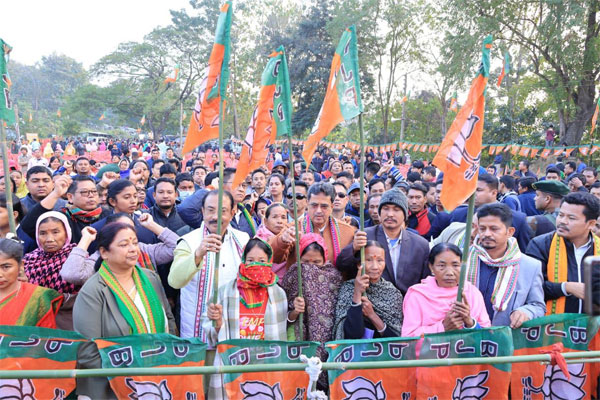
On the occasion, Dr. Saha also welcomed 495 voters from 181 families into the BJP, describing the move as a sign of growing public trust in the party’s leadership and governance model. He said people are increasingly rejecting fear-driven and identity-based politics and are choosing stability, development and peace.
The Chief Minister expressed confidence that the BJP’s ideological clarity and governance record would continue to resonate with the people, paving the way for further political gains in tribal areas and strengthening what he described as the foundation of a “New Tripura” rooted in unity and progress.