

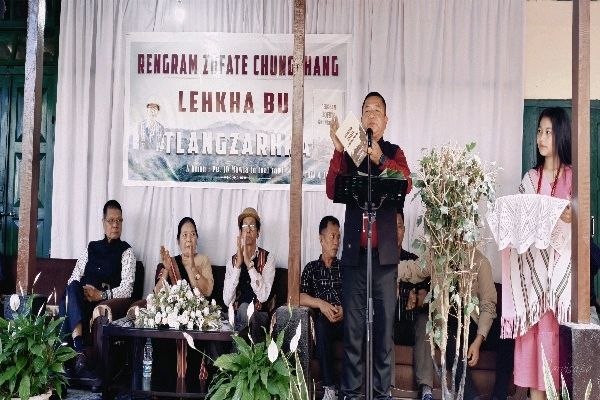
Vanghmun (Jampui) April 10: A landmark moment for Tripura’s literary and historical landscape unfolded in the misty heights of the Jampui Hills this week.
Pu JD Mawia, a revered elder and President of the Jampui Hill Mizo Convention, officially released his comprehensive historical work, “Rengram Zofate Chungchang”.
The event, held at Mawia’s residence in Vanghmun, marks a significant step in documenting the indigenous narratives of the Mizo people within the borders of Tripura.
The title, which translates to “Story of Mizo Kindred of Tripura,” represents more than just a memoir.
It is a 447-page deep dive into the soul of the community. The Directorate of Kokborok & Other Minority Languages, Government of Tripura, published the volume.
This collaboration highlights the state’s growing commitment to preserving the heritage of its diverse tribal populations.
Bridging the Gap Between Oral Tradition and Written Record
For decades, much of the Mizo history in the region lived within oral traditions.
Pu JD Mawia has now bridged that gap. His book serves as an encyclopedic resource for scholars and the younger generation alike.
It meticulously compiles the origins of Mizo tribes. Furthermore, it tracks their early migrations into the state under the strategic leadership of the Sailo chiefs.
The narrative provides much-needed clarity on the territorial extent once governed by these chiefs. Many young residents are unaware of the vast influence their ancestors held.
The book explains how the Tripura Kingdom recognized these Mizo leaders. It even details the specific titles conferred upon them by the reigning monarchs of the time.
This connection between the hill chiefs and the Agartala-based royalty offers a fascinating look at the administrative synergy of historical Tripura.
A Socio-Political Snapshot of the Jampui Hills
Beyond ancient history, the book captures the pulse of modern life in the Jampui Hills. Mawia draws from personal experiences and secondary sources to paint a vivid picture of the socio-economic conditions.
He explores the nuances of Jhum (shifting) cultivation and traditional food practices. These elements are essential to understanding the Mizo identity.
The author does not shy away from complex topics. He provides critical insights into tribal politics and inter-group relations.
The text documents the participation of the community in various political movements. By doing so, it places the Mizo struggle and success within the broader historical context of Northeast India.
News Analysis: Why This Publication Matters Now
This book arrives at a crucial juncture for Tripura’s social fabric. As the state moves toward modernization, the risk of losing linguistic and cultural nuances increases.
By documenting the specific lineages of the Sailo chiefs and the unique migration patterns into Jampui, Mawia provides a “cultural anchor.”
This work assists in the “Information Gain” sought by modern historians. It moves beyond generic tribal histories to offer granular, location-specific data.
It reinforces the fact that Tripura’s history is not a monolith but a rich tapestry of interwoven migrations and royal recognitions.
A Reference for the Future
Scholars at the ceremony expressed that the book will resolve long-standing debates regarding Mizo lineage in the state.
The rich content serves as a foundation for future academic research. As local communities strive for better representation, having a documented history is a powerful tool.
Pu JD Mawia’s work ensures that the stories of the Zofate (Mizo kindred) will not fade into the mists of the Jampui Hills. Instead, they are now etched into the permanent records of Tripura’s literary heritage.