

Kailashahar/Agartala, April 3: A harrowing incident of sexual assault on a nine-year-old girl in the Doluchhara area has ignited public anger and protests in Kailashahar area.
The incident, once again, exposed deep-seated concerns and anxieties over child safety and law enforcement transparency.
According to sources, simmering tension is prevailing with residents demanding that the police prioritize the victim’s legal rights, ensuring justice over procedural shortcuts.
The incident has highlighted the extreme vulnerability of children belonging to the daily-wage labor community, particularly those residing near the state’s numerous brick kilns.
The atmosphere in Kailashahar transitioned from shock to outright rage as details of the accused surfaced, followed by alleged apathy of the local police station.
Villagers Intervene: The Apprehension of Bachhut Ali
The crime occured at the Bhagaban Nagar Gram Panchayat when the victim’s parents, both laborers at a nearby brick kiln, were away at work.
Taking advantage of the empty household, the accused, identified as 30-year-old Bachhut Ali, allegedly abducted the child and dragged her into a nearby forest.
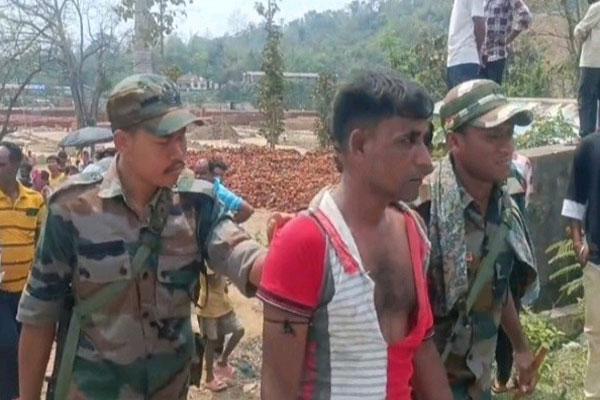
Visual evidence from the scene confirms the intensity of the community’s response.
In a video obtained by enewstime.in, a disheveled Ali, his shirt torn during a scuffle with the public, is seen being led away by personnel from the Tripura State Rifles (TSR) and local police.
The backdrop of the footage clearly shows the towering chimneys of the brick kiln where the girl’s parents were working—a grim reminder of the socioeconomic landscape that often leaves children unsupervised and at risk.
Villagers caught Ali “red-handed” after hearing the child’s screams, subsequently handing him over to the authorities after a brief confrontation.
A Standoff Over Justice: Police Procedure vs. Victim Rights
The arrest has been overshadowed by a brewing controversy. Sources within the victim’s village allege that the Officer-in-Charge (OC) of the local women’s police station initially refused to accept a formal, written complaint from the victim’s mother.
The police reportedly preferred to register the case suo motu (on their own motion), a move the family fears could lead to a diluted investigation and eventually facilitate bail for the accused.
This procedural tug-of-war has intensified public suspicion. “The mother is adamant about a formal FIR based on her statement to ensure no loopholes are left for the accused to exploit,” a local activist stated.
While the police have since recorded statements and moved the child to the Unakoti District Hospital for medical examination, the initial reluctance has created a trust deficit that local leaders warn could spiral into a larger law-and-order issue, potentially taking on communal undertones.
News Analysis: The “Labor Belt” Vulnerability
This incident is not an isolated case of rural crime but a symptom of a systemic gap in labor-heavy regions. The “brick kiln belt” of Kailashahar often lacks the social safety nets or childcare facilities required for migrant and daily-wage workers.
The temporary standoff between the police and the victim’s family over lodging an FIR is a direct reflection of a community that is no longer willing to accept “official versions” of justice without transparent documentation.