

Gist: How do native communities in the world’s wealthiest nation survive without running water? Explore the reality and discover why tribal leaders are demanding an end to the water burden and the long wait for critical infrastructure.
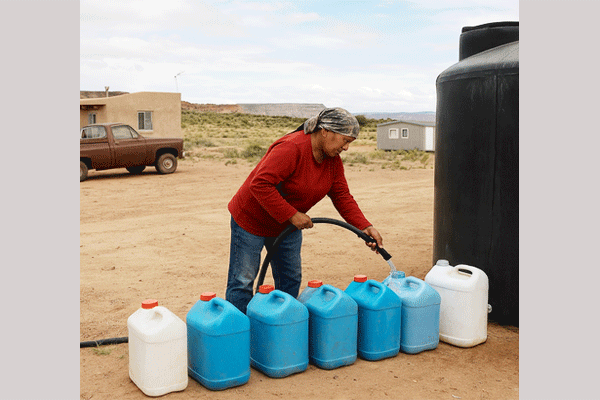
Agartala Mar 4: Wait! The picture above is not showing people’s hardship in Tripura or even in India – it’s a picture of tribal regions of otherwise glittering America, reported by IANS.
The United States commands the world’s most powerful economy. Yet, inside its borders, a silent crisis persists. In several tribal regions, daily living remains challenging despite the country’s overall wealth and development.
Tribal leaders recently testified before the Senate Committee on Indian Affairs. They described a world of crumbling systems and daily survival. For many Native communities, basic infrastructure remains a luxury.
The 30-Mile Commute for Water
In the Navajo Nation, the struggle for water is a daily labor. President Dr. Buu Nygren told lawmakers that nearly one-third of households lack running water. Dr. Nygren grew up without it himself. Today, thousands of families still drive 30 miles round-trip for a single tank of water, IANS reported.
These families travel over rough, unpaved roads to meet their basic needs. The financial burden is staggering. Families who haul water pay the equivalent of $43,000 per acre-foot.
Meanwhile, nearby suburban users pay only $600 for the same amount. Dr. Nygren called this disparity unacceptable in 2024. Children and elders continue to wait for a reliable tap.
A Sacred Resource Under Siege
The Hopi Tribe shares this heavy burden. Chairman Timothy Nuvangyaoma reported that 30 percent of Hopi homes lack running water. To the Hopi, this is more than a logistical failure. Water represents life, identity, and a sacred connection to the earth.
In New Mexico, the Zuni Tribe watches its history disappear. Upstream water diversions and failed dams have destroyed traditional agriculture.
Governor Arden Kucate described the Zuni River as a mere trickle. This decline has collapsed a farming system that once sustained his people for generations.
The High Cost of Economic Fragility
Economic stability in these regions is equally thin. In Montana, the Crow Tribe faces a sudden revenue crisis. Chairman Frank White Clay reported a 95 percent drop in tribal revenue. This collapse followed the shutdown of a single major coal mine.
The loss of this industry puts everything at risk. Funding for elder care, social services, and public safety has vanished. The tribe now faces the challenge of protecting its most vulnerable members with almost no budget.
The Long Path to Progress
Lawmakers are currently reviewing a $5 billion water settlement. This plan focuses on tribes in northeastern Arizona. Bryan Newland from the Department of the Interior said the bill would fund safe water delivery. It aims to build modern drinking water and wastewater facilities.
However, hope remains cautious. Congressional approval takes time. Negotiations often stretch over decades. Until these projects receive final signatures, the gap between the U.S. economy and Tribal reality continues to widen. Indigenous nations remain in a state of uncertainty, waiting for the infrastructure they were promised long ago. (With IANS inputs)