

Gist: NABARD stresses climate-resilient agriculture in Tripura as the state expands solar energy, watershed development, afforestation, bio-villages, millet cultivation and disaster preparedness under its SAPCC-driven green growth strategy.
Agartala, Mar 4: The National Bank for Agriculture and Rural Development (NABARD) has called for adaptive planning in Tripura’s agriculture sector, citing rising climate risks and ecological vulnerability. The bank stressed that climate resilience must drive the state’s future development strategy.
In its State Focus Paper (SFP) 2026-27 for Tripura, NABARD mentioned the State is facing multiple climate threats. First, the state experiences a prolonged monsoon. As a result, farmers get only four to six months of effective working time each year. This short agricultural window limits productivity and income stability.
At the same time, many indigenous communities depend heavily on forests and natural resources. Therefore, environmental degradation directly affects livelihoods. Traditional Jhum cultivation continues in several hill areas. However, shifting cultivation puts pressure on forest cover. In addition, forest fires sometimes spread beyond control and threaten nearby villages.
Although drought is not frequent, dry spells occur during summer. Meanwhile, heavy rainfall triggers recurrent floods in the plains and flash floods in hilly regions. Furthermore, Tripura falls under Seismic Zone V. This makes it highly earthquake-prone. The state also lies less than 100 km aerial distance from the Bay of Bengal. Consequently, it faces high wind speeds and cyclone risks.
Climate Action Plan in Tripura
To address these risks, the state government has aligned its development programmes with the State Action Plan on Climate Change (SAPCC). The plan integrates climate mitigation and adaptation with poverty reduction and sustainable growth.
Under this framework, Tripura promotes solar energy and water-efficient agriculture. For instance, authorities have installed solar-powered streetlights and irrigation pumps in rural areas. Farmers now adopt rainwater harvesting, organic farming and vermi-composting. Moreover, the state supports bamboo cultivation, wetland restoration and afforestation.
These measures aim to reduce carbon emissions and strengthen climate-resilient agriculture in Tripura.
Watershed, Agroforestry and Resilient Farming
Several flagship projects support this climate strategy. The Watershed Development Component under PMKSY 2.0 covers nearly 32,000 hectares. The project focuses on groundwater recharge and soil conservation. As a result, it improves water security for farmers.
In addition, ICAR’s NICRA programme promotes climate-resilient technologies in vulnerable zones. Multi-tier agroforestry models help farmers diversify income and protect soil health.
NABARD also backed the international conference “PASEL-2025” hosted by ICAR’s Tripura centre. Around 300 agricultural scientists and researchers from India and Bangladesh attended the event. They discussed sustainable hill farming and ecological balance.
Plantation Drive Expands Green Cover
Tree plantation drives have gained momentum across the state. Under the “Ek Ped Maa Ke Naam” campaign, six programmes were organised and over 500 seedlings planted. Furthermore, NABARD’s TRIBES initiative facilitated plantation of more than one lakh saplings to enhance carbon sequestration.
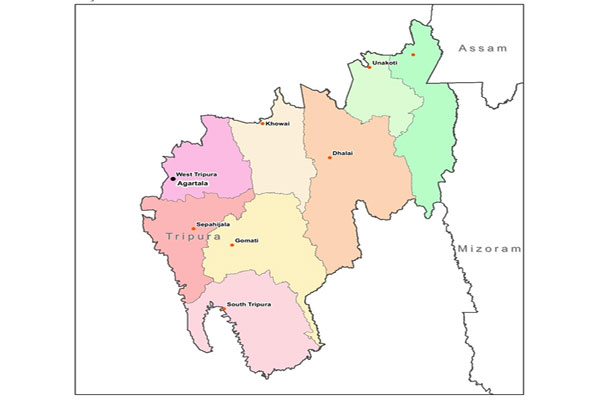
The State Forest Department manages over 6,294 sq km of forest land. During 2024–25, it brought nearly 9,856 hectares under plantation. Roadside plantations covered 313 km, while riverbank plantations extended over 24 km. These efforts strengthen flood control and ecological balance.
Bio-Villages Promote Green Rural Economy
The Tripura government has also launched a bio-village project to promote climate-smart rural living. The target is to establish 100 bio-villages across the state. So far, 26 bio-villages have become operational as of January 2025.
These villages use solar-powered agricultural equipment, biogas plants and energy-efficient devices. They also promote bio-fertilisers to reduce chemical use. Consequently, farmers shift toward nature-based livelihoods.
Millet Cultivation and Water Security Push
Farmer Producer Organisations (FPOs) now play a key role in climate-resilient agriculture. Bagma Agri Producers Company Ltd., promoted by NABARD, introduced millet cultivation across 12 hectares. The FPO trained 50 farmers in collaboration with the College of Agriculture, Tripura. It also distributed improved millet seeds to boost productivity.
Meanwhile, Tata Trusts supports a springshed management programme in Dhalai district. The initiative revives natural springs through check dams, trenches and recharge ponds. Local “water champions” lead community-driven conservation efforts. As a result, villages gain safer and more reliable water access.
Climate-Resilient Growth Becomes Core Agenda
Overall, Tripura has placed climate adaptation at the centre of its development model. Agriculture, forestry, water management and rural livelihoods now follow an integrated climate strategy.
NABARD believes that sustainable growth in Tripura depends on ecological balance and disaster preparedness. As climate challenges intensify, adaptive planning will remain critical for long-term agricultural resilience and inclusive rural development in the state. (Source: State Focus Plan 2026-27, Tripura by NABARD)