

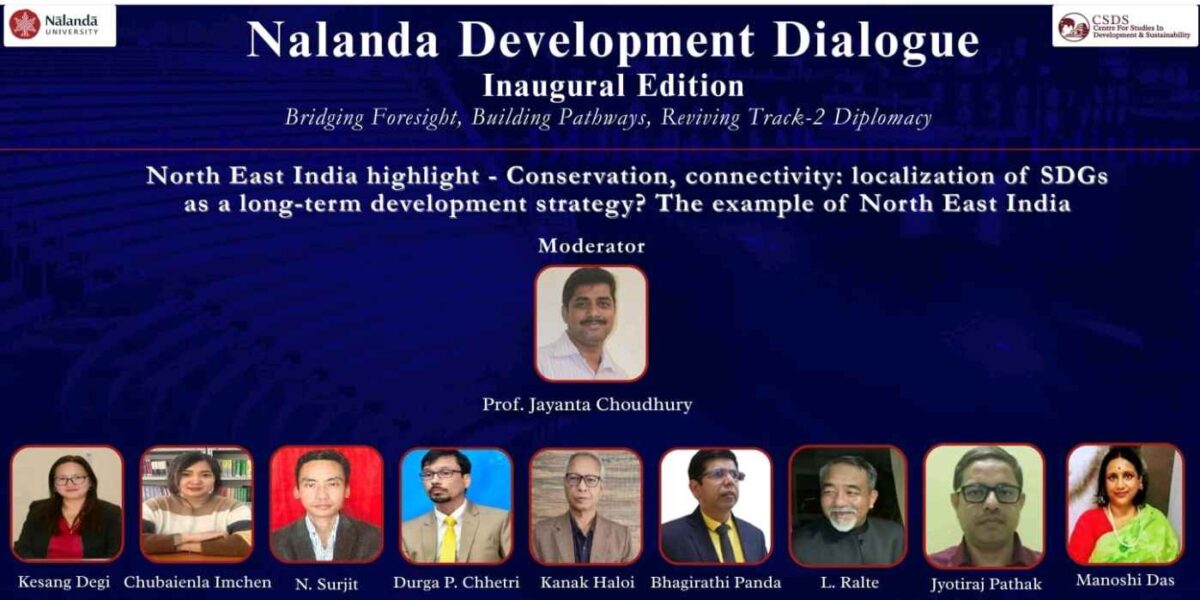
Rajgir, Mar 11: A special session focusing on sustainable development in Northeast India was organized during the inaugural Nalanda Development Dialogue at Nalanda University.
The session highlighted the importance of conservation, connectivity, and localization of the Sustainable Development Goals (SDGs) as long-term strategies for regional development.
The session titled “North East India Highlight: Conservation, Connectivity and Localization of SDGs as a Long-Term Development Strategy – The Example of North East India” was presented by scholars associated with the North Eastern Training Research and Advocacy Foundation (NETRA Foundation), a research and advocacy organization dedicated to promoting sustainable development and policy dialogue in Northeast India.
The session was moderated by Jayanta Choudhury, Professor and Head of the Department of Rural Development and Planning at Nagaland University.
The panel featured distinguished speakers representing different states of the Northeast, including Kesang Degi, Professor at Rajiv Gandhi University; Chubainila Imchen, Assistant Professor at Jubilee Memorial College; and Nameirakpam Surjit Kumar, Professor at Indira Gandhi National Tribal University.
Other speakers included Durga Prasad Chhetri of Sikkim University; Kanak Haloi, former Professor and Head at National Institute of Rural Development and Panchayati Raj; Bhagirathi Panda, Director and Professor at ICSSR North East Regional Centre; Jyotiraj Pathak, Professor at Kumar Bhaskar Varma Sanskrit and Ancient Studies University; Laldhuthlana Ralte, former Ambassador from Mizoram; and Manoshi Das, Anthropologist representing NETRA Foundation, Tripura.

During the discussion, speakers emphasized that Northeast India possesses immense ecological wealth and cultural diversity that must be protected while advancing economic growth.
The panel highlighted the importance of promoting agro-ecology, forest-based enterprises, eco-tourism, and stronger local value chains to strengthen rural livelihoods across the region.
Participants also underscored the transformative role of physical, digital, and cross-border connectivity, noting that improved infrastructure and regional integration could position Northeast India as a strategic gateway linking South Asia and Southeast Asia.
The discussion further emphasized the importance of youth entrepreneurship, governance innovation, and sustainable finance in achieving a resilient and inclusive Northeast by 2040.
On the sidelines of the dialogue, Nalanda University and North Eastern Training Research and Advocacy Foundation signed a Memorandum of Understanding (MoU) to promote mutual academic cooperation.
The MoU aims to facilitate joint research, policy dialogue, academic exchanges, and collaborative initiatives focused on sustainable development in Northeast India.
The partnership is expected to strengthen academic engagement and policy research on regional development challenges and opportunities in Northeast India.
The Nalanda Development Dialogue seeks to foster global conversations on development, sustainability, and policy innovation, drawing inspiration from Nalanda’s historic legacy as a center of knowledge exchange and intellectual dialogue.