

Police dilemma over ganja smuggling. Lorry drivers block NH at Tripura–Assam border for slow vehicle checking.
Churaibari (Tripura) Dec 7: Unabated ganja smuggling attempts along the Tripura–Assam border have pushed Churaibari police in North Tripura into a critical situation.
To curb the smuggling bid, they started strict vehicle screening, but initiative has now triggered severe public inconvenience.
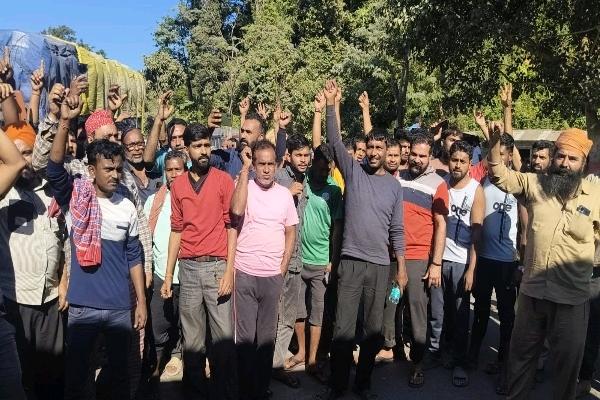
Venting anger, lorry drivers on Sunday blocked the national highway near the sale tax area. They alleged that elaborate screening and slow checking procedures have left them stranded for nearly a week.
Police have been conducting thorough inspections on every truck passing through the Churaibari point, following continuous reports of cannabis being transported outside the state.
Despite the transfer of seven officers by the Superintendent of Police in an effort to curb the smuggling network, the issue remains far from resolved.
Authorities fear that any relaxation in checking would give traffickers a free passage, enabling them to resume illegal transport without resistance.
However, the strict mechanism has come with a heavy cost. Lorries are forced to wait in long queues for days, creating heavy congestion on the national highway and affecting both goods and passenger vehicles.
Drivers complained that they have been living on the roadside for six to seven days at a stretch due to the gridlock.
With no access to proper bathing facilities or toilets, their discomfort has escalated into frustration, ultimately pushing them into protest action.
The drivers demanded that either the checking process be expedited or scanner machines be installed so vehicles can be cleared faster.
Many pointed out that there are three unused sheds inside the Churaibari Modern Checkpost which could be converted into operational inspection zones, potentially reducing driver’s ordeal significantly.
Police, however, asserted that they cannot compromise with security, especially when smugglers are continuously exploiting the route.
With insufficient space in front of the police station for large-scale scanning, vehicles must be checked one by one, resulting in long queues on both sides of the border.
The situation has placed law enforcement in a tight corner — ensuring smooth traffic flow on one hand and preventing drug syndicates from escaping on the other.
Unless technology-driven solutions or additional infrastructure is introduced, both the crackdown on trafficking and the hardship of transporters are likely to continue.