

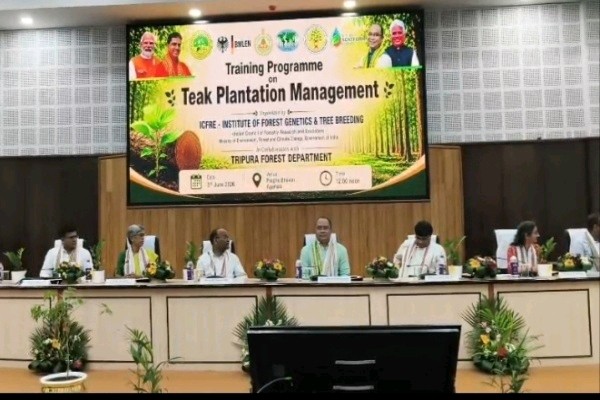
The Tripura government has launched a scientific teak plantation initiative to strengthen the rural economy, enhance forest revenue, create employment, and reduce India’s dependence on imported timber.
Forest Minister Animesh Debbarma unveiled the programme with technical support from forestry scientists and community stakeholders across the state.
Quick Glance
- Tripura launches scientific teak plantation drive under an agroforestry model.
- Farmers may earn up to Rs 2.5 crore from one to two hectares of teak cultivation over 20-25 years.
- India spends nearly USD 2.7 billion annually on timber imports.
- Government plans to generate rural jobs while strengthening forest conservation efforts.
Agartala: The Tripura government has initiated a large-scale scientific teak plantation programme aimed at transforming the state’s rural economy while strengthening environmental sustainability.
Speaking at the inaugural programme, Forest Minister Animesh Debbarma said Tripura possesses ideal climatic conditions for teak cultivation. He emphasized that the state can emerge as a major timber-producing region if farmers and communities actively participate in the initiative.
The programme is being implemented with technical assistance from scientists of the Indian Council of Forestry Research and Education (ICFRE). The training programme will involve forest officials, Joint Forest Management Committees (JFMCs), Self-Help Groups (SHGs), and local stakeholders.
According to the minister, the state will promote genetically superior teak varieties through a structured agroforestry model. The initiative seeks to combine environmental protection with long-term economic growth.
Teak Cultivation Offers Significant Returns for Farmers
The government views teak plantation as a long-term investment opportunity for rural households.
Experts associated with the programme estimate that farmers cultivating teak on one to two hectares of land could earn nearly Rs 2.5 crore after 20 to 25 years at current market rates.
Debbarma said teak cultivation should not be viewed only as an environmental activity. Instead, it can become a powerful economic asset for farmers seeking stable long-term returns.
He noted that teak plantations can generate wealth while simultaneously preserving biodiversity, improving ecological balance, and increasing green cover.
India Timber Demand Creates Opportunity for Tripura
The minister highlighted the growing national demand for timber and wood-based products.
India currently requires approximately 57 million cubic metres of wood annually. Experts estimate that this demand will increase significantly by 2030.
The minister also pointed out that India spends nearly USD 2.7 billion every year on timber imports. Expanding teak plantations in Tripura could help reduce this import burden while strengthening domestic production.
According to Debbarma, increasing domestic timber production can contribute significantly to India’s economic growth while creating opportunities for local communities.
Lessons from Kerala, Maharashtra and Tamil Nadu
The minister cited examples from other states where timber cultivation has generated substantial revenue.
Kerala, with nearly 13,699 hectares under timber cultivation, generated around Rs 261.97 crore through timber sales during 2022-23. Maharashtra also ranks among India’s leading timber-producing states.
Meanwhile, Tamil Nadu has adopted policies encouraging farmers to cultivate high-value tree species such as teak, sandalwood, red sandalwood, and rosewood under agroforestry programmes.
Debbarma said Tripura has similar advantages and can successfully replicate these models.
Rural Employment and Value Addition at the Core
The government expects the programme to create employment opportunities throughout the timber value chain.
Jobs can emerge in nursery management, plantation activities, maintenance, harvesting, transportation, timber processing, and furniture manufacturing.
The minister outlined a broader vision for the sector with the slogan: “Plant Here, Protect Here, Process Here, Save Here.”
He stressed that Tripura should move beyond supplying raw timber. Instead, local industries should process timber within the state and manufacture furniture and other value-added products.
Such an approach would retain economic benefits within Tripura and support the growth of local enterprises.
Teak Plantation to Support Forest Conservation
The initiative also aims to strengthen forest protection.
Debbarma said expanding teak cultivation on private lands could reduce pressure on natural forests. Farmers with access to profitable timber cultivation may be less likely to depend on illegal extraction of forest resources.
The minister also addressed concerns over forest crimes and recent attacks on forest personnel during anti-smuggling operations in North Tripura.
He announced that the government is enhancing forest protection mechanisms through fresh recruitment of forest guards and foresters. Authorities are also expanding specialised training programmes and strengthening the Forest Protection Unit (FPU).
Community Participation Will Determine Success
The government has placed local communities at the centre of the programme.
During the event, the minister stressed the importance of involving villagers, SHGs, and JFMC members in plantation activities and training programmes.
He instructed officials to ensure that community representatives receive maximum exposure to scientific plantation techniques and agroforestry practices.
According to the minister, widespread community participation will determine the long-term success of the initiative.
A Long-Term Vision for Tripura
The teak plantation mission reflects a long-term strategy to diversify rural incomes, strengthen forest conservation, and build a sustainable timber economy.
If implemented successfully, the programme could transform large areas of rural Tripura over the next two decades. It could also position the state as a significant contributor to India’s timber sector while creating lasting economic opportunities for farmers and rural communities.
People Also Ask
How much can farmers earn from teak cultivation in Tripura?
Experts estimate that farmers cultivating teak on one to two hectares of land could earn nearly Rs 2.5 crore after 20-25 years at current market prices.
Why is Tripura promoting teak plantation?
The state aims to increase forest revenue, generate rural employment, reduce timber imports, and support sustainable agroforestry development.
How will teak plantation help forest conservation?
Profitable timber cultivation on private land can reduce dependence on natural forests and discourage illegal logging activities.