

Shantir Bazar (Tripura), April 5: While the relentless march of the digital age threatens to overshadow ancestral folk traditions, the vibrant echoes of Shiber Gajan recently reclaimed the streets of Shantir Bazar in Tripura.
In an era where local heritage often takes a backseat to globalized content, the residents of Sen Para have emerged as the primary custodians of this centuries-old ritual.
Their recent initiatives signify more than just a religious observance; they represent a deliberate act of cultural defiance by a group of youths determined to bridge the gap between historical identity and modern lifestyle.
A Ritual Reborn: Sen Para Leads the Way
The festivities commenced with the Baruni Snan, a sacred ritual bath that marks the spiritual cleansing of participants. Following this purification, the quiet neighborhoods of the Shantir Bazar subdivision were transformed into open-air theaters.
Youths from Sen Para traversed various localities, bringing the divine to the doorsteps of common households through the traditional Har-Gauri dance.
Unlike many state-sponsored events, this celebration was entirely community-driven. Youths, who are often criticized for their detachment from traditional roots, took the lead.
Organizers noted that these young performers remained awake throughout the night, mastering complex mythological dramatizations.
These acts, inspired by ancient texts, serve a dual purpose: they entertain the local populace while functioning as a living archive, passing on oral histories, traditions and moral narratives to the children of the subdivision.
News Analysis: The Socio-Cultural Significance of Gajan
> Shiber Gajan functions as a powerful social equalizer in the Bengali-speaking regions of Northeast India. While traditional societal structures often imposed rigid hierarchies, the Gajan festival temporarily dissolves these boundaries.
During the festival, any devotee, regardless of their caste or economic standing, assumes the identity of a “Shiva Bhakta.”
By reviving these practices, the youth of Shantir Bazar are not just preserving a “dance,” or folk culture but are reinforcing a historic framework of social harmony and communal belonging that predates modern administrative interventions.
Preserving Heritage in the Age of Technology
The decline of folk arts is a growing concern across the state, yet the large crowds gathered in Shantir Bazar suggest that the appetite for authentic, human-centric performance remains high.
The organizers emphasized that while technology has changed how people consume information, it cannot replicate the tactile and spiritual experience of a live Gajan performance.
Participants adorned themselves as deities—Shiva, Parvati, and Kali—creating a vivid spectacle that stood in stark contrast to the sterile environment of smartphone screens.
The sustained efforts of the Sen Para community highlight a rare but vital trend in Tripura: the decentralization of cultural preservation, where the responsibility shifts from government departments to the actual practitioners in rural and semi-urban belts.
Traditional Roots and the Chaitra Sankranti
As the Bengali month of Chaitra nears its end, the intensity of these celebrations is expected to peak during Chaitra Sankranti.
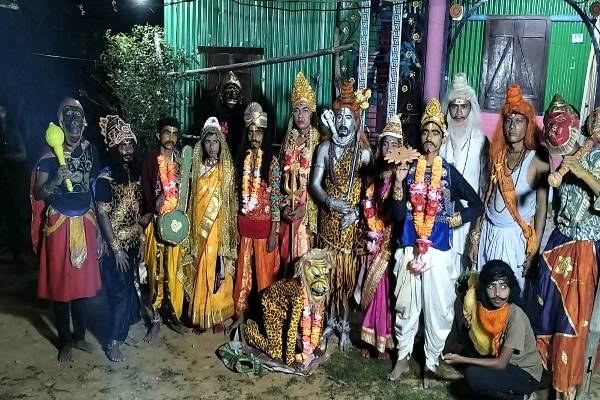
Across Tripura, Shiber Gajan remains as one of the most potent expressions of folk faith.
The event in Shantir Bazar serves as a hopeful blueprint for other subdivisions, proving that with localized initiative, Tripura’s unique cultural fabric can survive the pressures of the 21st century.
