

Tripura’s impressive economic growth may soon face a serious demographic challenge as declining birth rates due to a drop in Total Fertility Rate (TFR) and a rapidly aging population threaten the state’s future workforce, productivity, and long-term development trajectory, according to NFHS-5 and NITI Aayog data.
TFR Crisis in Tripura
Agartala: A silent yet seismic demographic shift is underway in Tripura. While national attention often focuses on India’s overall “demographic dividend,” government data reveals that Tripura is rapidly transitioning toward an aging society.
Tripura is currently an economic outlier in the Northeast. With a real GSDP growth rate averaging 7.7% (outpacing the national average of 5.6%), the state’s economy is in a “sweet spot.”
However, a deeper dive into the National Family Health Survey (NFHS-5) and NITI Aayog reports reveals a demographic pincer movement that could soon throttle this momentum.
Shrinking cradle:
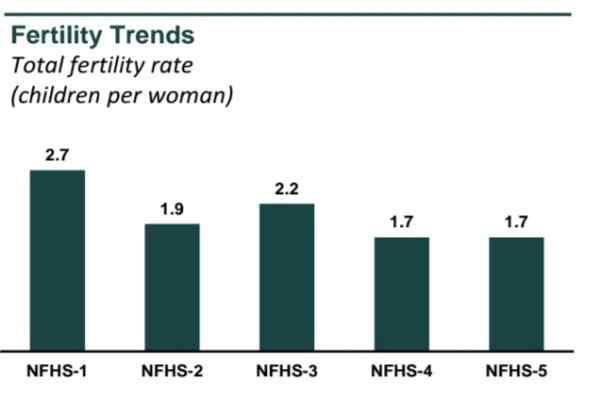
According to NFHS-5 (2019-21), Tripura’s Total Fertility Rate (TFR) has plummeted to 1.7, far below the replacement level of 2.1 (NFHS-6 data is yet to be officially released).
This means that for every 1,000 women, only 1,700 children are born, leading to a shrinking base of the population pyramid.
Total Fertility Rate (TFR) is the average number of children born to a woman in her lifetime.
The national TFR has declined from 2.2 (NFHS-4) to 2.0 (NFHS-5). The latest SRS data released in late 2025 indicates a further slight dip to 1.9.
While this is often celebrated as a milestone in population control, it signals an impending “labor drought.”
Factors such as high female literacy rates (Tripura consistently ranks high nationally), increased age at marriage, and effective family planning coverage etc are laudable drivers of this decline, the speed at which the TFR has fallen below replacement level means fewer young people entering the demographic pyramid in the coming decades.
The demographic danger is obvious: while the cradles are empty, the retirement homes are filling up.
The Labor Chokepoint:
Services Sector (43% of GSDP) and Agriculture (40%) are currently running the state’s economic engine.
Both are labor-intensive. With the current birth rate, the “pipeline” of young workers entering these sectors will begin to contract significantly within the next decade.
If Tripura cannot replace its retiring workforce with local youth, it may face two unenviable choices: wage-push inflation (leading to higher costs of services) or a heavy reliance on migrant labor.
The Productivity Paradox:
Tripura’s economic survival depends on doing “more with less.” While the state boasts a high literacy rate, government data highlights two critical weaknesses that hinder economic resilience:
1. Low Female Labor Force Participation (FLFPR): At 35.2%, Tripura’s women are underutilized in the formal economy. With fewer children being born, the economic “cost of missed opportunity” for women staying out of the workforce becomes even higher.
2. The Skill Mismatch: NITI Aayog reports suggest that while literacy is high, enrollment in higher education but technical vocational training remains lower than the national average.
Need of the Hour:
The official data suggests that Tripura can no longer rely on a “demographic dividend” of cheap, abundant labor.
To sustain its 7.7% growth, the state’s policy must shift from population management to Human Capital Enhancement.
Without a massive push in high-tech skill development and the integration of women into the workforce, Tripura risks “Silver Tsunami” and falling into a “middle-income trap”—where the population becomes old before the state gets rich.
