

Gandachhara (Tripura) April 4: With the Tripura Tribal Areas Autonomous District Council (TTAADC) elections approaching, Chief Minister Prof. Dr. Manik Saha intensified the BJP’s campaign, pitching a “triple-engine government” as the key to accelerated development in tribal areas.
Addressing a political rally in Dhalai district, the Chief Minister directly appealed to voters—especially youth—not to fall for what he described as “misleading narratives” spread by rival parties.
He urged supporters of regional outfits, particularly the Tipra Motha Party, to shift allegiance to the BJP while there is still time.
“We want to build a new Tripura together. That requires unity, not confusion,” Dr. Saha told the gathering.
Campaign Focus: Gandachhara and Key Tribal Seats
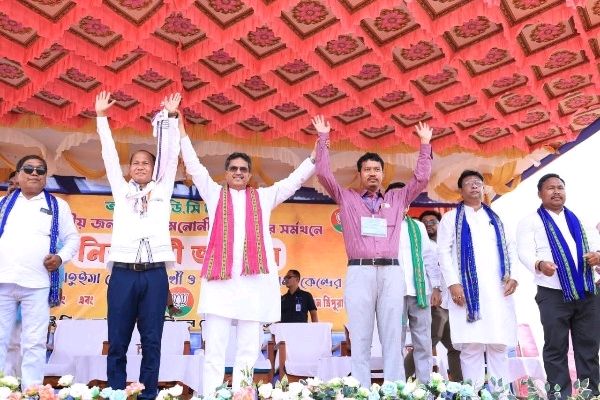
Dr. Saha campaigned for BJP candidates Bhumikananda Reang (8 Ganganagar–Gandachhara constituency) and Samir Ranjan Tripura (24 Raima Valley constituency), highlighting the party’s expanded footprint in ADC politics.
For the first time after coming to power in 2018, the BJP under Dr Saha is going solo and has fielded candidates in all 28 seats of the ADC, signalling an aggressive push to gain full control of the tribal autonomous body.
Surge in Political Mobilisation
The Chief Minister claimed that public confidence in Prime Minister Narendra Modi has strengthened across Tripura.
He pointed to fresh inductions into the BJP during the rally, stating that 710 voters from 251 families joined the party.
He welcomed the new entrants and framed their decision as a “timely shift” towards development politics.
He also reiterated that the BJP’s “double-engine government” at the Centre and state levels is working with a long-term roadmap extending to 2047.
‘New Tripura’ Vision Mirrors ‘New India’
Dr. Saha aligned the state’s political narrative with the national vision of “New India,” stressing inclusive growth.
He underlined the need to uplift all communities—tribal groups, caste communities, and minorities including Manipuris—through socio-economic progress and infrastructure expansion.
He argued that only a development-driven approach can transform Tripura and contribute to India’s broader growth story.
At the same time, he accused opposition parties of promoting unrest instead of progress, claiming that such politics hinders long-term development.
Peace vs Political Unrest
The Chief Minister asserted that voters now prefer stability over agitation. He encouraged citizens to distance themselves from parties that “create tension and confusion” and instead support governance focused on development.
Highlighting leadership outreach, he referred to the Mann Ki Baat programme, describing it as a unique platform where the Prime Minister connects directly with citizens.
Sharp Criticism of Opposition Record
Dr. Saha launched a strong attack on the opposition, particularly the United Progressive Alliance and the CPI(M).
He alleged that corruption defined the UPA era and claimed that the Left Front’s 35-year rule in Tripura failed to deliver meaningful development for tribal communities.
He said, “Tribal people remained neglected despite decades of governance. Even now, corruption persists in ADC administration.”
Triple-Engine Strategy Gains Momentum
The Chief Minister expressed confidence that voters are ready to hand BJP a decisive mandate in all 28 ADC seats.
He said such a result would establish a “triple-engine government”—Centre, state, and ADC—all led by the BJP.
According to him, this momentum has unsettled regional parties, which now face shrinking support bases.
News Analysis: Why ADC Elections Matter This Time
The upcoming TTAADC elections carry significant political weight beyond routine local governance. Since the rise of the Tipra Motha Party and its demand for Greater Tipraland, tribal politics in Tripura has entered a new phase.
The BJP’s strategy to contest all 28 seats signals a direct challenge to regional dominance in tribal belts.
Moreover, the “triple-engine government” narrative reflects a broader national strategy—aligning local governance bodies with state and central leadership to streamline policy implementation.
However, this approach also raises questions about regional autonomy versus centralised development models, a debate that continues to shape Tripura’s political discourse.