

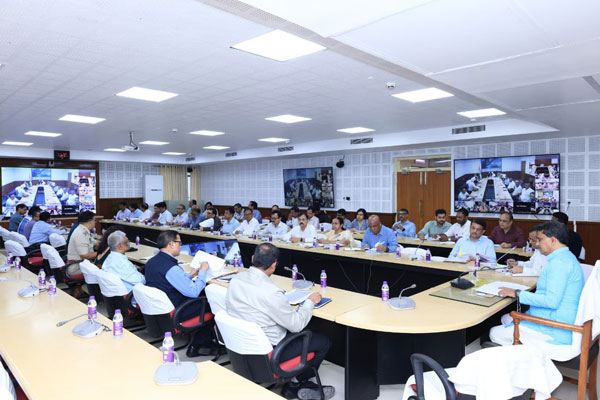
Dr Manik Saha Reviews ‘People-Centric ‘Governance
Tripura Chief Minister Prof. (Dr.) Manik Saha today underscored the “people-first” philosophy of his administration during a marathon review meeting at the State Secretariat in Agartala.
Chaired via the Task Monitoring System (TMS), the session brought together District Magistrates (DMs) and Superintendents of Police (SPs) from all eight districts virtually to assess the progress of public welfare projects and administrative efficiency.
The Chief Minister issued a stern directive to all departments to remain “vigilant and active.” He emphasized that the primary metric of success for the current government is the swift resolution of citizen grievances and the seamless execution of infrastructure and health initiatives.
Traffic, Healthcare, and Law & Order Monitoring
The administrative landscape of Tripura has undergone a paradigm shift over the last decade. It transitioned to a “Double-Engine” governance model centered on connectivity and digitized monitoring.
As Agartala evolves into a Smart City and the state positions itself as the gateway to Southeast Asia through the Indo-Bangla connectivity projects, the pressure on urban infrastructure and law enforcement has reached a critical juncture.
The Chief Minister’s emphasis on the Task Monitoring System (TMS) reflects a transition toward data-driven governance, moving away from traditional bureaucratic delays that historically hindered the progress of the Northeast.
For the local reader, these directives are not merely administrative formalities; they represent a direct response to the daily struggles involving traffic congestion in Agartala, the rising menace of narcotics among the youth, and the seasonal health vulnerabilities in tribal belts like Dhalai.
By demanding accountability from both DMs and SPs, Dr. Saha is signaling a unified command structure aimed at ensuring that the benefits of the central and state schemes reach the last mile, reinforcing the political narrative of “Sushasan” (Good Governance).
Urban Mobility and Infrastructure Deadlines
A significant portion of the review was dedicated to the deteriorating traffic conditions and infrastructure delays. Dr. Saha directed immediate interventions for the capital city and district headquarters, focusing on technological and structural solutions. He notably ordered that traffic electronic signals remain operational 24/7 and called for the expedited completion of new motor stands to de-congest the arterial roads.
Key Infrastructure and Administrative Directives:
-
Traffic Integrity: Ensure the weight of heavy vehicles is strictly monitored to prevent road damage and improve safety.
-
Health Vigilance: Directed the Health Department and Dhalai DM to initiate preventive measures against water-borne diseases like diarrhea and dysentery ahead of the monsoon peak.
-
Educational Standards: Compulsory maintenance of a disciplined learning environment and quality audits for the PM-POSHAN (Mid-Day Meal) scheme in schools.
-
Restoration Success: Officials confirmed that 99% of the power infrastructure damaged by the recent Kalbaisakhi storm has been successfully restored.
The Chief Minister also took a hardline stance against corruption in local offices. He specifically named sub-registry offices, nursing homes, and rehabilitation centers as areas requiring “strict monitoring” to ensure they operate transparently and without the influence of middlemen.
The “Drug-Free Tripura” Mandate and Border Security
Through the lens of national security, the Chief Minister’s focus on the railway network as a conduit for narcotics is a strategic pivot. As Tripura expands its rail connectivity with the rest of India and Bangladesh, the risk of the state being used as a transit point for the “Golden Triangle” trade increases. By directing the police administration to remain active at railway points, the government is treating the drug menace not just as a social issue, but as a direct threat to the state’s human capital and regional stability.
Economically, the emphasis on MGNREGA fund disbursement is vital for the rural economy. In a state where a significant portion of the workforce relies on daily wages, any delay in payments can lead to rural distress and migration.
Dr. Saha’s instruction to ensure that wages and allowances are paid on time is a calculated move to maintain the liquidity of the rural market. Furthermore, the push for quality road renovation is intrinsically linked to the “Green Gold” economy; efficient transport of rubber and bamboo from remote plantations to processing hubs is essential for maintaining Tripura’s competitive edge in the national market.
Verdict: The “enewstime editorial team” suggests that Dr. Manik Saha is tightening the administrative screws to prevent “mid-term fatigue.” By utilizing the TMS to bridge the gap between Agartala and the remote districts, the government is attempting to create a responsive ecosystem that can handle both natural disasters (like Kalbaisakhi) and systemic issues (like corruption) with equal agility.