

Synopsis: TPCC Chief on Women’s Reservation Bill
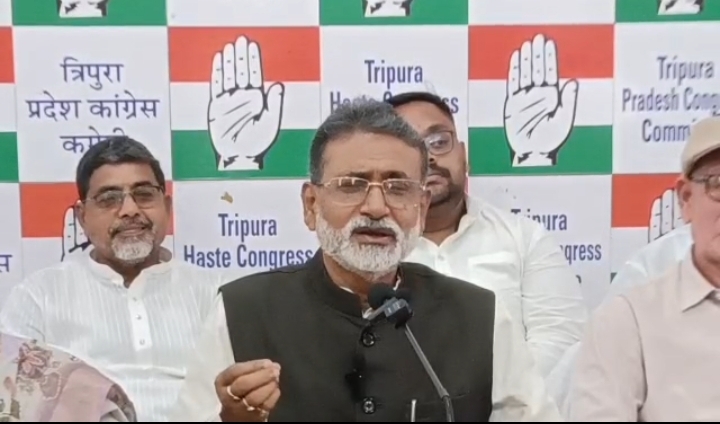
Agartala May 3: Tripura Pradesh Congress Committee (TPCC) President Asish Saha launched a blistering critique against the BJP and RSS in Agartala today.
Saha dismissed allegations that Congress opposes the Women’s Reservation Bill.
He dubbed the ruling party’s narrative as “misleading” while demanding the immediate implementation of the 33% quota.
Quick Glance: Key Highlights
-
Ideological Clash: Asish Saha claims RSS ideology historically marginalizes women, contradicting the BJP’s current “pro-women” stance.
-
Implementation Demand: Congress challenges the Centre to implement the 33% reservation immediately for the current 543 Parliamentary seats.
-
Historical Precedent: Saha highlighted that the 73rd and 74th Amendments under Rajiv Gandhi first brought women into local governance.
-
Tripura Assembly Critique: The TPCC chief labeled recent state assembly discussions on the Bill as “tokenistic” and legally incomplete.
The Congress Critique
Addressing a press conference in Agartala, TPCC President Asish Saha argued that the Bharatiya Janata Party (BJP) and the Rashtriya Swayamsevak Sangh (RSS) possess a foundational ideology that limits women to domestic roles.
Saha stated that describing women merely as “instruments for childbearing” is part of the ideological roots the BJP now tries to mask with political rhetoric regarding reservation.
He specifically took aim at Prime Minister Narendra Modi’s recent televised remarks from April 18, where the PM accused Congress of obstructing the Women’s Reservation Bill.
Saha termed these statements “unbecoming of a constitutional authority,” asserting that they diminish the dignity of the Prime Minister’s office.
The Historical Context of Women’s Quotas
Saha reminded the public that the Congress party has been the pioneer of legislative empowerment for women in India.
He cited the 1992 constitutional amendments that secured up to 50% representation in local bodies in several states.
| Initiative/Event | Year | Key Impact |
| 73rd & 74th Amendments | 1992 | 33-50% reservation in local self-governments |
| Women’s Reservation Bill (Passed) | 2023 | Framework for 33% seats in Parliament/Assemblies |
| Current Congress Demand | 2026 | Immediate enforcement for existing 543 seats |
“Tokenism” in Tripura Assembly
The Congress leader expressed surprise at how the Tripura Legislative Assembly handled the proposal related to the Bill.
He alleged that the state government’s approach was purely “tokenistic” to mislead female voters.
According to Saha, a genuine adoption would have required a formal ratification process within the Assembly to ensure the 33% reservation is legally binding at the state level.
He further criticized the Chief Minister and parliamentary ministers for making “false statements” during proceedings.
He condemned the derogatory references made toward former Prime Minister Indira Gandhi.
Call for Immediate Action
Saha concluded by challenging the BJP-led government to move beyond “nationwide campaigns of misinformation.”
People Also Ask (FAQ)
Q1: What is the Congress party’s stand on the Women’s Reservation Bill?
The Congress party, led locally by TPCC Chief Asish Saha, supports the immediate implementation of the 33% quota in Parliament and State Assemblies citing their historical role in local government reservations.
Q2: Why is the TPCC criticizing the BJP regarding women’s rights?
TPCC alleges that the BJP’s ideological mentor, the RSS, holds regressive views on women and that the current push for the Bill is politically motivated rather than a genuine shift in ideology.
Q3: What happened in the Tripura Assembly regarding the Bill?
The Congress party claims the state government presented the Bill in a “tokenistic” manner without the necessary formal ratification processes required for actual implementation.