

Agartala, April 11: The silence in Tripura’s hills today is a stark contrast to the month-long high-decibel political warfare that just concluded.
Tomorrow, April 12, nearly 9.62 lakh voters across the Tripura Tribal Areas Autonomous District Council (TTAADC) will decide the future of the state’s most influential constitutional body.
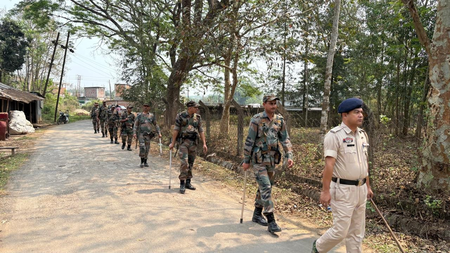
With recent sporadic clashes between the BJP and Tipra Motha party (TMP) activists, the state administration has made elaborate security arrangements across the 28 constituencies, Police sources said.
The stakes are higher than ever. For the TMP, this is a battle to retain its control over the ADC Administration. For the BJP, it is a test of its penetration into the tribal grassroots without backing of any regional party.
Meanwhile, the Left Front and Congress are fighting for political survival in a landscape that has shifted dramatically since 2018 and later in 2021 after the last TTAADC Polls.
Security Blanket : 13,500 Personnel on High Alert
To prevent a repeat of the pre-poll violence that left over 50 people injured including police personnel, the Tripura State Election Commission (SEC) and the police have deployed a massive force.
DGP Anurag Dhankar confirmed that the Central Government rushed 24 companies of Central Armed Police Forces (CAPF) to Agartala at the final hour.
“We have categorized 311 polling stations as ‘highly critical’ and 693 as ‘vulnerable.’ Our priority is a fear-free environment,” DGP Dhankar stated.
The security breakdown includes:
- 12 Companies of BSF (Border Security Force)
- 10 Companies of SSB (Sashastra Seema Bal)
- 2 Companies of CRPF (Central Reserve Police Force)
- 12,000 State Personnel from the Tripura State Rifles (TSR) and Civil Police.
The Numbers Game: A Four-Cornered Battle
Tomorrow’s polling will determine the fate of 173 candidates. While the BJP, TMP, and Left Front are contesting all 28 seats, the Congress follows closely with 27.
Interestingly, the BJP’s allies—TMP and IPFT—are facing off against each other in several pockets, showcasing the complex internal friction within the ruling coalition.
| Category | Statistic |
| Total Voters | 9,62,547 |
| Female Voters | 4,80,582 |
| Male Voters | 4,81,959 |
| Contesting Candidates | 173 (165 Male, 8 Female) |
| Polling Stations | 1,257 |
News Analysis: Why TTAADC 2026 is a Watershed Moment
The TTAADC is often called a “State within a State.” Governed under the Sixth Schedule, it controls 70% of Tripura’s land.
Historically, the ADC area was a Left Front bastion for 15 years until the Pradyot Kishore Deb Barman-led TMP swept the 2021 polls.
In 2026, the context has shifted. TMP is now a part of the NDA government at the state level, yet they are competing independently in the Council after alliance talks failed to reach consensus.
BJP never fought a poll battle without support of tribal based local party.
Even in the last Lok Sabha, BJP fielded its candidate from the ST-reserved East LS Constituency who is a cousin of the TMP Chief. Depriving local tribal leaders outside the Royal circle.
However, after the failed alliance talks, BJP and TMP went out in separate ways and raised the pitched against each other.
BJP’s campaign led by CM Dr Manik Saha highlighted Modi Government’s pro-tribal welfare schemes and sought people’s support for ‘triple engine‘ governance. He also pointed allegations of massive corruption in the TTAADC.
In contrast, TMP Campaign spearheaded by Pradyot Kishore focused on ethnicity especially land rights, implementation of The Tiprasa Accord and kokborok script etc.
People will have to cast their votes in favour of development and good governance or being influenced by ethnicity-centric call.
Human-Centric Impact: Beyond the Ballot
For the common man in areas like Kanchanpur or Gandatwisa, this election isn’t just about party symbols.
It is about lack of drinking water facility, power supply and road connectivity etc. Whatever basic infrastructure facilities are available now in limited areas reflect implementation of the central schemes.
According to sources, TMP had almost done nothing significant and visible for the development of the Council areas and welfare of the ‘Janajati’ people.
The counting of votes is scheduled for April 17, and the results are expected to set the tone for the 2028 State Assembly elections.