

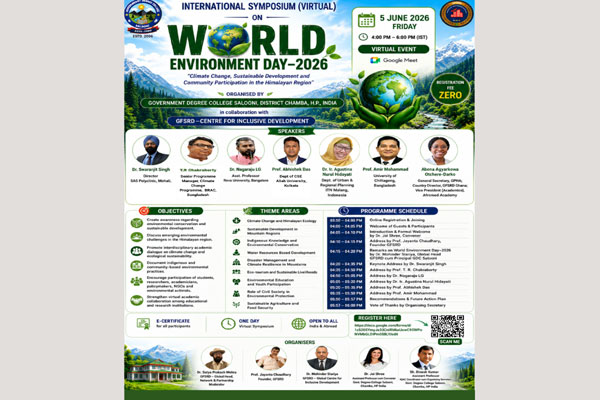
GFSRD and Government Degree College Salooni hosted an international symposium on World Environment Day (WED-2026), focusing on climate change, sustainable development, and community participation in the Himalayan region.
Kohima: Global Forum for Sustainable Rural Development (GFSRD)–Centre for Inclusive in collaboration with Government Degree College Salooni, Chamba, Himachal Pradesh, in collaboration with, successfully organized an International Virtual Symposium on World Environment Day (WED–2026) on the theme “Climate Change, Sustainable Development and Community Participation in the Himalayan Region.” The programme brought together distinguished academicians, researchers, environmental experts, students, policymakers and development practitioners from India and abroad to deliberate on pressing environmental challenges and sustainable development pathways.
The symposium commenced with the welcome of guests and participants, followed by a formal introduction by Dr. Jai Shree, Assistant Professor, Government Degree College Salooni and Convener of the programme. She highlighted the importance of collective environmental responsibility and the role of educational institutions in promoting environmental awareness.
Prof. Jayanta Choudhury, Founder, Global Forum for Sustainable Rural Development (GFSRD), addressed the gathering and emphasized the need for global collaboration, community participation and evidence-based approaches to address climate change and environmental degradation.
Keynote Address
The participants were then welcomed by Dr. Mohinder Slariya, Global Head, GFSRD–Centre for Inclusive Development and Principal, Government Degree College Salooni. He underscored the significance of World Environment Day and called for strengthening environmental stewardship among younger generations.
Dr Satya Prakash Mehra, GFSRD – Global Head, Network and Partnership gave the introductory speech which Dr. Abena Otchere-Darko, Country Director, GFSRD-Ghana made the concluding remarks and way forward.
The keynote address was delivered by Dr. Swaranjit Singh, Director, SAS Polyclinic, Mohali and Chairman, “Drink Buttermilk: Live Healthy.” He discussed the interrelationship between environmental health, public health and sustainable lifestyles, stressing the importance of environmentally responsible living.
The symposium featured a distinguished panel of international and national speakers:
Tapas Ranjan Chakraborty, Senior Programme Manager, Climate Change Programme, BRAC, Bangladesh shared insights on the role of technology and innovation in addressing environmental challenges.
Dr. Nagaraju L.G., Assistant Professor and IQAC Vertical Head, School of Management Studies, REVA University, Bengaluru, discussed sustainable management practices and community participation in development initiatives.
Dr. Ir. Agustina Nurul Hidayati, Department of Urban and Regional Planning, National Institute of Technology (NIT), Malang, Indonesia, presented international perspectives on climate resilience, sustainable urban planning and environmental governance.
Prof. Abhishek Das, Professor, Department of Computer Science and Engineering, Aliah University, Kolkata, highlighted the contribution of digital technologies and data-driven solutions in environmental conservation.
Prof. Amir Mohammad, University of Chittagong, Bangladesh, shared valuable experiences on climate adaptation and community-based environmental management in South Asia.
Young Climate Ambassador inspires
A special attraction of the symposium was the participation of Trapa Choudhury, GFSRD Child Climate Ambassador and student of St. Paul’s School, who joined as Special Guest.
She inspired participants with her message on youth engagement in climate action and emphasized the importance of environmental awareness among children and young people.
The symposium attracted total 314 faculty members, researchers, research scholars, students, environmental activists, NGOs, policymakers and civil society representatives from various institutions across India and abroad.
Climate Actions needed
The deliberations focused on climate change and Himalayan ecology, sustainable development in mountain regions, indigenous knowledge systems, disaster management, eco-tourism, sustainable agriculture, environmental education and community participation.
Participants stressed the need for collaborative action, policy innovation and grassroots engagement to address the growing environmental challenges facing the Himalayan region.
The programme concluded with recommendations for future action and strengthened academic collaboration among institutions working in the areas of environmental sustainability and inclusive development. A vote of thanks was delivered by Dinesh Kumar, Organising Secretary and IQAC Coordinator, Government Degree College Salooni.
The organizers expressed their gratitude to all speakers, participants and collaborating institutions for making the symposium a grand success and reaffirmed their commitment to promoting environmental awareness, sustainable development and community participation through future academic and outreach initiatives.
