

Three Farmer Producer Companies (FPCs) from Tripura have taken the state’s organic farming success to the global stage by exporting scented lemons, Kalikhasa aromatic rice and Queen pineapples to Dubai through Lulu Retail, highlighting how collective farming is creating new international market opportunities and improving income prospects for small farmers.
Agartala: Three Farmer Producer Companies (FPCs) from Tripura have demonstrated how collective farming and organised marketing can connect small growers with international buyers, as the state exported organic lemons, aromatic rice and Queen pineapples to Dubai through Gulf retail giant Lulu Retail. The export marks another milestone in Tripura’s efforts to transform its farmer collectives into globally competitive agri-business enterprises.
| You may also like: Global Tech Firms, Infra Firms Among Corporate Giants Eye Investment Opportunities in Tripura |
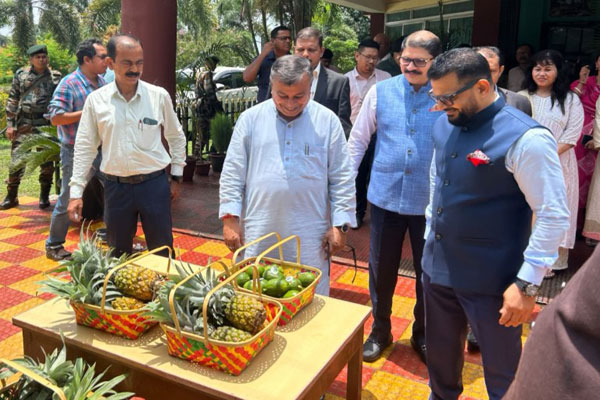
Agriculture and Farmers’ Welfare Minister Ratan Lal Nath flagged off the export consignment on Friday and said the achievement reflects the growing capability of the state’s Farmer Producer Companies to supply premium-quality organic produce to overseas markets.
Three FPCs Lead the Export Initiative
Unlike conventional exports driven by large companies, the latest shipment has been made possible through three Farmer Producer Companies representing hundreds of farmers across different districts.
Baramura Farmer Producer Company in Teliamura, Khowai district supplied 1,300 organic scented lemons, while Trishna Farmer Producer Company of Rajnagar in South Tripura contributed 182 kg of organic Kalikhasa aromatic rice. Khabaksa Farmer Producer Company in Killa, Gomati district shipped 350 Queen pineapples, one of Tripura’s best-known horticultural products.
The Minister said the successful shipment showcases the ability of organised farmer groups to meet international quality standards while maintaining organic production practices.
Small Farmers Gain Access to Global Markets
Nath said Farmer Producer Companies have emerged as an effective platform for aggregating produce from small and marginal farmers. By working collectively, growers can ensure uniform quality, improve packaging and negotiate better prices in premium markets.
He said the Dubai export is not merely a commercial transaction but an indication that farmers from remote parts of Tripura are becoming part of international supply chains.
The Minister credited the participating FPCs for maintaining strict quality standards and ensuring certified organic production, which has helped build confidence among overseas buyers.
Lulu Retail Opens a New Export Window
According to Nath, Dubai-based Lulu Retail provides a significant opportunity for Tripura’s farmers to expand their presence in the Gulf market.
He said Lulu is one of the largest retail chains operating across the Gulf Cooperation Council (GCC) countries and sources agricultural and food products from more than 85 countries.
The inclusion of Tripura’s organic products in such an established retail network is expected to enhance the visibility of the state’s agricultural produce among international consumers.
Officials believe the partnership could pave the way for regular exports if consistent supply and quality are maintained.
Organic Farming Strategy Shows Results
The Minister said the latest export follows the successful shipment of 10,000 kg of organic dried bird’s eye chilli from Tripura to Germany earlier this year.
He said consecutive exports to Europe and the Gulf indicate that the state’s investment in organic farming, certification and value addition is beginning to generate tangible results.
The government has been focusing on expanding certified organic cultivation, improving branding, strengthening processing facilities and creating better market linkages so that farmers can secure higher returns from their produce.
According to Nath, these initiatives are aimed at making agriculture more profitable while creating sustainable livelihood opportunities in rural areas.
FPC Model Emerging as a Growth Driver
Agriculture experts have increasingly identified Farmer Producer Companies as a key instrument for improving farmers’ bargaining power and reducing dependence on intermediaries.
By pooling produce, sharing infrastructure and accessing institutional support, FPCs enable small farmers to participate in high-value markets that would otherwise remain beyond their reach.
The latest export demonstrates how this model can help Tripura’s farmers compete in international markets despite limited individual landholdings.
Officials said similar initiatives involving spices, fruits and specialty rice varieties are expected to receive greater attention in the coming months as the state seeks to expand its agricultural exports.
Investment Commitments Strengthen Agriculture
Highlighting broader developments in the sector, Nath said the recently concluded Destination Tripura Business Conclave attracted substantial investment proposals across agriculture and allied sectors.
He informed that Memorandums of Understanding worth Rs 1,698.4 crore were signed in the Agriculture and Horticulture sectors. He also noted that major investment commitments were received in the power and renewable energy sectors, reflecting growing investor confidence in Tripura.
The Minister expressed optimism that additional partnerships and export opportunities would emerge as the state’s Farmer Producer Companies continue to strengthen production capacity and meet international quality standards.
He said the government’s long-term objective is to ensure that more farmers benefit from export-oriented agriculture, enabling rural communities to earn better incomes while establishing Tripura as a recognised source of premium organic produce in global markets.
