

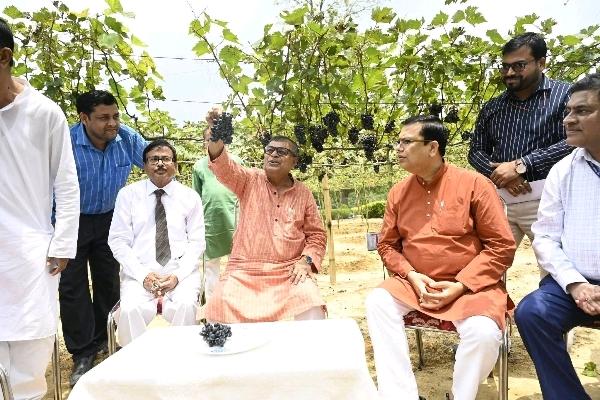
Tripura has taken a significant step toward diversifying its agricultural sector after successfully cultivating sweet grapes for the first time.
The state government, led by Agriculture Minister Ratan Lal Nath, has unveiled a comprehensive roadmap involving research, farmer training, and technology support to establish Tripura as a new grape-growing hub in Northeast India.
Quick Glance
- Tripura records its first successful cultivation of sweet grapes.
- Government plans trials of 18 additional grape varieties.
- Scientists have already succeeded in growing four grape varieties, including two wine grapes.
- Farmer training, vineyard clusters, and grape processing units are part of the future roadmap.
Agartala: Tripura is aiming to create a new chapter in its horticulture sector through large-scale grape cultivation. The initiative gained momentum after researchers successfully produced sweet grapes in the state, a development that could reshape agricultural opportunities for local farmers.
Speaking at a field day-cum-awareness programme on commercial grape farming in Chandipur, Unakoti district, Agriculture and Farmers Welfare Minister Ratan Lal Nath announced a series of measures to strengthen grape production across the state.
The event also witnessed the launch of projects supported by the National Bank for Agriculture and Rural Development (NABARD). Officials believe these projects will provide critical support for future expansion.
First Sweet Grapes Mark a Milestone for Tripura
During the programme, the Minister visited a vineyard where sweet grapes were successfully grown under local conditions. The achievement is considered a breakthrough because grape cultivation has traditionally remained limited to specific regions of India.
To encourage modern farming practices, Nath distributed power-operated agricultural equipment among farmers. He emphasized that technology adoption would play a crucial role in improving productivity and profitability.
According to the Minister, India’s average grape productivity stands at nearly 24 metric tonnes per hectare. He expressed confidence that Tripura could achieve competitive yields through scientific interventions and farmer participation.
Scientists Achieve Success With Four Grape Varieties
Researchers in Tripura have spent several years studying the feasibility of grape cultivation under the state’s climatic conditions.
Their efforts have already produced encouraging results. Scientists have successfully cultivated four grape varieties, including two varieties suitable for wine production.
Research activities at Krishi Vigyan Kendra (KVK), Unakoti resumed in 2024 after a gap of nearly two decades. Preliminary findings indicate improvements in sweetness levels, fruit quality, and overall production.
In September 2024, six grape varieties were introduced from the ICAR National Research Centre for Grapes and planted under experimental conditions. Scientists continue to monitor their adaptability and growth performance.
Research Focuses on Tripura’s Unique Climate
Tripura’s climate differs significantly from traditional grape-producing regions. Therefore, researchers are working to standardize cultivation techniques specifically suited to the state’s agro-climatic environment.
The objective is to identify grape varieties that can thrive despite local challenges. Scientists are also developing management practices capable of improving yield and fruit quality.
Special Interventions Deliver Positive Results
To address these issues, researchers have introduced advanced nutrient management systems and growth regulator applications.
These interventions aim to improve sweetness, fruit quality, and overall vineyard performance.
Officials reported that the results have been encouraging so far. Improved cultivation practices are already producing better-quality grapes compared to earlier trials.
Government Plans Trials on 18 More Grape Varieties
The state government has outlined an ambitious roadmap for expanding grape cultivation.
One major component involves testing 18 additional grape varieties to identify cultivars best suited to Tripura’s climate and soil conditions.
The government also plans to formulate policy recommendations based on ongoing research findings.
Future Roadmap for Grape Development
The proposed action plan includes:
- Expanded scientific research on grape cultivation.
- Development of location-specific cultivation technologies.
- Large-scale farmer training programmes.
- Establishment of grape cultivation clusters.
- Creation of vineyards in suitable locations.
- Technical and agricultural input support for growers.
- Training on grape juice and Ready-to-Serve (RTS) beverage production.
- Capacity building on post-harvest management.
- Setting up small-scale grape processing units for value addition.
Officials believe these initiatives can generate additional income opportunities for farmers while strengthening Tripura’s horticulture economy.
Farmers Expected to Benefit Through Value Addition
Beyond cultivation, the government is focusing on creating an integrated grape value chain.
Farmers will receive training in processing grapes into juice and RTS beverages. Plans are also underway to establish cluster-based processing facilities. Such infrastructure can reduce post-harvest losses and improve market returns.
Experts believe value-added products could significantly enhance farmer income while creating rural employment opportunities.
Strong Institutional Support Behind the Initiative
The programme was attended by Sports and Youth Affairs Minister Tinku Roy, senior officials from the Directorate of Horticulture, agricultural scientists, experts, and local farmers.
Their participation highlighted the growing importance of grape cultivation within Tripura’s broader agricultural development strategy.
With research progressing steadily and government support expanding, Tripura appears poised to emerge as a new destination for grape cultivation in Northeast India.
People Also Ask (FAQ)
Can grapes be cultivated successfully in Tripura?
Yes. Scientists have successfully grown sweet grapes and several other grape varieties under experimental conditions in Tripura.
Why is grape cultivation important for Tripura?
Grape farming can diversify agriculture, increase farmer income, promote value-added industries, and strengthen the state’s horticulture sector.
What support will farmers receive for grape cultivation?
Farmers will receive training, technical guidance, agricultural inputs, modern equipment support, and assistance for processing and post-harvest management.