

A fresh hike in CNG and PNG prices by Tripura Natural Gas Company Limited (TNGCL) has intensified concerns over the high taxation burden on natural gas consumers in Tripura. Trade bodies and consumer groups claim nearly 35 per cent of the retail gas price consists of taxes and levies imposed by state and central governments.
Quick Glance
- TNGCL revised CNG and PNG prices across Tripura from May 27
- Consumers allege nearly 35% of gas price comes from taxes and levies
- Commercial establishments fear rising operational and transport costs
- Consumer groups demand reduction of TRD cess and VAT on natural gas
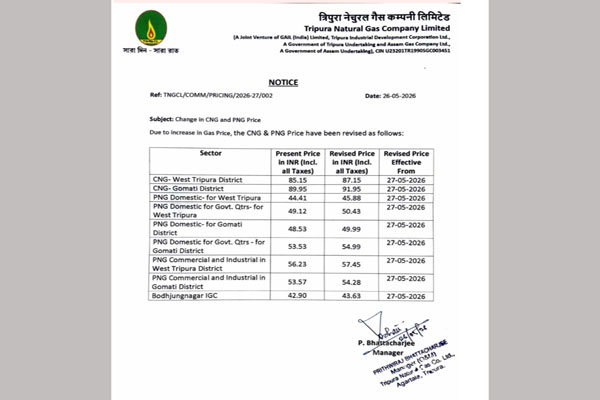
Agartala: Tripura Natural Gas Company Limited (TNGCL) on Monday announced another upward revision in prices of Compressed Natural Gas (CNG) and Piped Natural Gas (PNG) across the state. The revised rates will become effective from May 27, 2026.
The company cited increased gas procurement costs as the reason behind the latest revision. However, the hike has reignited public criticism over what consumers describe as an excessive tax burden on cleaner fuel in Tripura.
Transport operators, restaurant owners, households and industrial consumers have expressed concern over the repeated price increases. Many believe the actual burden stems less from the base gas cost and more from the taxation structure applied to natural gas.
Revised CNG and PNG Prices Across Tripura
Under the revised pricing structure, CNG prices in West Tripura district have increased from Rs 85.15 per kg to Rs 87.15 per kg. In Gomati district, the price has risen from Rs 89.95 to Rs 91.95 per kg.
Domestic PNG users in West Tripura will now pay Rs 45.88 per unit against the previous Rs 44.41. In Gomati district, domestic PNG rates have increased from Rs 48.53 to Rs 49.99 per unit.
Commercial and industrial consumers are also facing higher costs.
| Sector | Previous Rate | Revised Rate |
|---|---|---|
| CNG – West Tripura | Rs 85.15 | Rs 87.15 |
| CNG – Gomati | Rs 89.95 | Rs 91.95 |
| PNG Domestic – West Tripura | Rs 44.41 | Rs 45.88 |
| PNG Domestic – Gomati | Rs 48.53 | Rs 49.99 |
| PNG Commercial – West Tripura | Rs 56.23 | Rs 57.45 |
| PNG Commercial – Gomati | Rs 53.57 | Rs 54.28 |
| Bodhjungnagar IGC | Rs 42.90 | Rs 43.63 |
Government quarters using PNG are also affected. In West Tripura, the tariff has increased from Rs 49.12 to Rs 50.43 per unit. In Gomati district, the revised price stands at Rs 54.99 against the earlier Rs 53.53.
Why 35% Tax Burden Has Become a Major Issue
The latest revision has renewed debate over taxation on natural gas in Tripura.
Trade bodies and transport associations claim that almost 35 per cent of the final retail gas price paid by consumers consists of taxes and government-imposed levies. According to industry representatives, these include:
- 25 per cent Tripura Road Development (TRD) Cess
- State VAT
- Central Excise Duty
- Additional local levies and charges
Consumer groups argue that whenever the base gas price rises, the tax amount also increases proportionately. As a result, even moderate revisions in procurement costs create a significantly higher burden on end-users.
Economists say this “tax-on-price” structure magnifies retail fuel costs and affects every category of consumer, from households to industries.
A transport sector representative said the government still has enough scope to provide relief by rationalising taxes instead of passing the entire burden onto consumers.
Middle-Class Families Feeling the Pressure
The repeated PNG tariff hikes are now affecting monthly household budgets across Tripura.
Families dependent on PNG for cooking say utility expenses have steadily increased over the past few months. Middle-income and lower-income households are particularly concerned as inflation has already pushed up prices of food items, transport and essential commodities.
Government employees residing in official quarters are also witnessing rising monthly gas bills.
Residents in Agartala and surrounding urban areas said cleaner fuel adoption becomes financially difficult when taxation substantially inflates retail prices.
Businesses Fear Wider Inflationary Impact
Hotels, restaurants and commercial establishments have warned that higher gas prices may eventually increase prices of goods and services.
Restaurant owners say cooking fuel forms a major operational cost. Small industries operating in Bodhjungnagar Industrial Growth Centre (IGC) have also raised concern over rising production expenses.
Industrial operators fear reduced competitiveness if energy costs continue rising.
Economists believe simultaneous increases in CNG and PNG prices could eventually trigger broader inflationary pressure in Tripura because natural gas supports transportation, hospitality, domestic cooking and industrial production.
News Analysis: Can Tax Rationalisation Ease Consumer Burden?
The latest TNGCL revision has once again exposed the larger policy debate surrounding taxation on cleaner fuels in Tripura.
Natural gas is widely promoted as an environmentally friendly alternative to traditional fuels. However, consumers argue that high taxation discourages adoption and undermines affordability.
The 25 per cent TRD cess has emerged as the biggest point of criticism. Trade groups claim reducing this cess or lowering VAT could substantially reduce retail prices without severely affecting overall state revenue.
Another important issue is the cumulative effect of repeated small hikes. While each revision individually appears modest, consumers face a continuous increase in monthly expenditure over time.
For transport operators, higher CNG prices may eventually lead to fare revisions. Restaurants and industries may also transfer additional operational costs to consumers. This creates a ripple effect across the local economy.
Consumer organisations are now urging both the Tripura government and the Centre to review the taxation framework on natural gas and introduce targeted relief measures.
People Also Ask
Why have CNG and PNG prices increased in Tripura?
TNGCL stated that the revision became necessary due to higher gas procurement costs.
What taxes are included in Tripura’s natural gas pricing?
Consumers and trade bodies point to the 25% TRD cess, VAT, Central Excise Duty and other levies.
Which areas are affected by the latest gas price hike?
The revised prices apply mainly to West Tripura district, Gomati district and Bodhjungnagar Industrial Growth Centre.
