

The decision to stop private practice by doctors of the GB Hospital and Agartala Government Medical College (AGMC) has triggered a wider discussion on how to strengthen public healthcare delivery services in Tripura. While supporting the government’s move, physicians of the AGMC Teachers’ Forum have stressed that improving patient services requires more than restricting private practice. They have highlighted the need for stronger infrastructure, adequate manpower, better support systems and improved working conditions to transform GB Hospital into a high-quality tertiary care centre.
At a glance
- Doctors support improving public healthcare services but say a private practice ban alone cannot deliver better outcomes.
- Infrastructure expansion and manpower strengthening are key priorities for GB Hospital and AGMC.
- Super-speciality services require complete medical teams, including senior and junior residents.
- Faculty shortages and recruitment challenges may affect medical education and patient care.
- Doctors suggest AIIMS-level development through a comprehensive healthcare improvement plan.
Agartala: The Tripura government recently decided to prohibit private practice by doctors associated with GB Hospital and AGMC with the objective of improving government healthcare services. Health Secretary Kiran Gitte said Chief Minister Manik Saha held detailed discussions with the All Tripura Government Doctors’ Association and AGMC Teachers’ Forum before taking the decision.
The associations supported the proposal while suggesting measures such as DA revision based on Non-Practising Allowance (NPA), timely promotions and academic and research support.
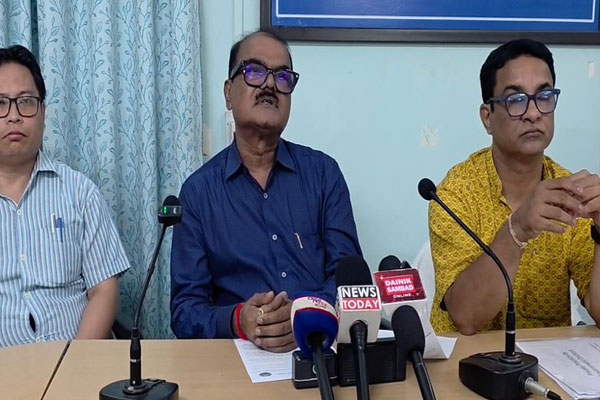
However, during a press conference, AGMC Teachers’ Forum president Dr Tapan Majumder and senior physician Dr Kanak Chowdhury explained that healthcare improvement requires a broader approach.
According to the doctors, stopping private practice can be one step, but it cannot independently solve challenges affecting public healthcare.
“Healthcare is a team effort. A doctor has a definite role, but the entire system depends on infrastructure, manpower and support services,” doctors said.
Manpower shortage remains a major challenge at GB Hospital
Doctors identified manpower shortage as one of the biggest barriers to improving services at GB Hospital.
They pointed out that shortages exist at different levels, including support staff, laboratory technicians and other essential healthcare workers.
According to them, improving patient care requires not only specialist doctors but also a complete healthcare team that can support diagnosis, treatment, emergency services and follow-up care.
Doctors said efforts are already being made to fill vacancies, but strengthening the system will require planned recruitment and long-term manpower management.
Infrastructure development must match the AIIMS model
Doctors said the government’s vision of developing GB Hospital and AGMC at the level of premier institutions like AIIMS requires comprehensive planning.
They argued that facilities, infrastructure and manpower should improve together before expecting similar standards of service.
The doctors said they had preferred a gradual approach where infrastructure development would come first, followed by policy changes.
They added that if the objective is to create a centre of excellence, then the hospital needs modern facilities, adequate staff and a strong academic environment.
Strengthening medical teams is essential for super-speciality care
Doctors also focused on the need for stronger support teams for super-speciality departments.
They explained that a super-specialist alone cannot provide round-the-clock healthcare services without adequate senior residents, junior residents, nurses and technical staff.
A specialist may work during scheduled hours, but continuous patient monitoring, follow-up and emergency response require a complete team.
Doctors said GB Hospital must develop the same team-based healthcare structure followed by major medical institutions across India.
Faculty shortage may affect medical college growth
Doctors warned that any sudden reduction in faculty strength could impact both medical education and hospital services.
They pointed out that the National Medical Commission (NMC) has minimum faculty and infrastructure requirements for maintaining recognition of medical colleges.
A department cannot function properly if multiple doctors leave and only limited faculty members remain, they said.
Doctors recalled that when AGMC started in 2005, the institution depended on faculty members from outside. But the situation has changed due to the expansion of medical colleges across the country and increased demand for experienced doctors.
They added that several departments are already facing challenges in attracting sufficient faculty.
Better working conditions needed to retain doctors
Doctors also raised concerns over salary differences and working conditions. They said the recent 20% salary increase has received mixed reactions among doctors. While some appreciated the revision, others questioned whether the increase adequately reflects the responsibility of government medical professionals.
They highlighted differences between institutions, stating that doctors in some premier institutes receive significantly higher remuneration compared with faculty members in Tripura.
According to doctors, competitive salary structures, timely promotions and academic opportunities are necessary to retain experienced professionals.
Doctors seek respectful implementation of healthcare reforms
Doctors clarified that they are not against reforms aimed at improving public healthcare.
They said if private practice affects patient services, then strengthening government healthcare should remain the priority.
However, they stressed that reforms must focus on creating a complete healthcare ecosystem.
The doctors said making GB Hospital comparable to AIIMS requires genuine transformation — including better infrastructure, sufficient manpower, improved facilities and stronger research and academic support.
They believe that a comprehensive improvement plan, rather than a single policy decision, will determine the future quality of healthcare services in Tripura.
