

The Government of Tripura on Saturday strongly defended its decision to ban private practice by government doctors, saying the move prioritises patients and public healthcare. Chief Minister Dr Manik Saha cited official records dating back to 1979 to show that previous governments had also favoured similar restrictions and asked private hospitals to recruit their own specialists.
Agartala: Seeking to counter mounting criticism over its decision to prohibit private practice by government doctors, the Tripura Government on Saturday asserted that the policy is rooted in decades-old administrative thinking and is intended to strengthen public healthcare rather than target the medical fraternity.
| You may also like: Tripura CM Reaffirms Zero-Tolerance On Drugs |
Chief Minister Dr Manik Saha, himself a senior dental surgeon, said the issue has existed for decades and previous governments had also considered banning private practice. He maintained that the present government acted only after extensive consultations with doctors and other stakeholders.
Government cites 1979 records to justify decision
Addressing reporters, Dr Saha revealed that while reviewing official files, he found a government note from 1979 showing that the then administration had also attempted to stop government doctors from engaging in private practice.
According to him, the document related to a meeting chaired by the then Chief Minister to review the functioning of Govind Ballabh Pant (GBP) Hospital.
The file proposed issuing fresh instructions prohibiting private practice. However, the then Health Secretary reportedly observed that repeated directives alone would not work unless the government initiated disciplinary action against violators.
Dr Saha said the document also recommended surprise inspections and vigilance monitoring to collect evidence against doctors suspected of violating the rules.
He noted that one proposal even suggested sending “bogus patients” to identify doctors engaged in private practice.
“Doctors are regarded as next only to God. Yet the official file recommended sending fake patients to catch them. That shows how seriously the issue was viewed even then,” he said.
The Chief Minister said he highlighted the old records because several political leaders who now criticise the government’s decision had been associated with similar proposals in the past.
AGMC proposal also supported ban
Dr Saha said the original proposal for establishing Agartala Government Medical College (AGMC) in 2000 had also recommended prohibiting private practice by government doctors.
However, the proposal could not be implemented because Tripura then faced an acute shortage of specialists.
He said the situation has changed significantly over the last two decades. The state now produces far more doctors and specialists through its own medical institutions, making the reform practical.
Private hospitals asked to appoint their own specialists
The Chief Minister also defended the government’s decision to discourage private hospitals from depending on government doctors for specialist services.
He said the government had invited representatives of private hospitals for discussions before taking the decision.
During the meeting, he asked whether the government had ever assured private hospitals that they could routinely rely on government-employed doctors.
“There was never any such assurance,” he said.
Dr Saha argued that private healthcare institutions should recruit their own full-time specialists instead of depending on doctors employed by the government.
He warned that if government doctors continue working simultaneously in government hospitals and private healthcare facilities, patient care in public hospitals would inevitably suffer.
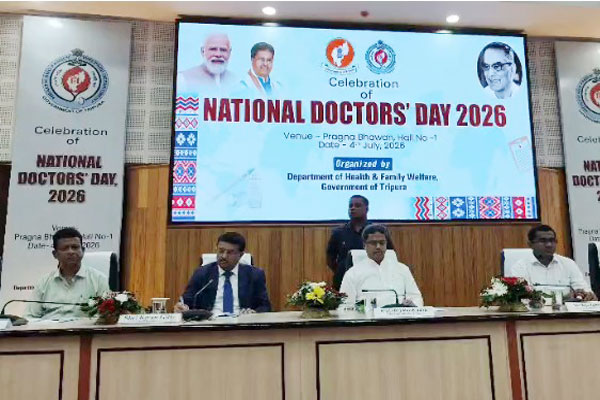
“Our priority is the patients who visit government hospitals. Government doctors must devote their full attention to public healthcare,” he said.
Government says controversy has been overstated
The Chief Minister also sought to downplay concerns over the impact of the ban.
He said the number of government doctors engaged in private practice is much smaller than public perception suggests.
According to him, patients in Tripura have several alternatives, including Tripura Medical College (TMC), ILS Hospital, IGM Hospital, and many retired specialists who continue to offer medical services.
“I believe people will gradually adapt once the new system stabilises,” he said.
Decision followed consultations with doctors
Rejecting allegations that the government imposed the policy unilaterally, Dr Saha said the Health Department held detailed discussions with representatives of government doctors, medical college faculty members and the Tripura Medical Education Service Association.
He said the government has already accepted several suggestions made by doctors.
Among the proposed measures is an amendment to the Tripura Medical Education Service Rules, wherever necessary.
The Chief Minister also directed the Health Secretary to maintain regular dialogue with doctors’ organisations to address concerns during implementation.
“We remain open to suggestions. Discussions will continue,” he said.
Promotions also being addressed
Dr Saha acknowledged concerns regarding delayed promotions for government doctors.
He said the matter remains pending before the Supreme Court.
Meanwhile, the government has granted ad hoc promotions and regularised the first phase.
A committee headed by a retired High Court judge is examining the next phase of promotions. The Chief Minister said he expects the committee to submit its report shortly, enabling the government to proceed with regular promotions.
Government seeks cooperation
Appealing to the medical fraternity for support, Dr Saha said the government has no intention of confronting doctors and continues to hold the profession in the highest regard.
He recalled the ideals of Bharat Ratna Dr Bidhan Chandra Roy and said the reforms aim to improve the quality of public healthcare while restoring greater public confidence in government hospitals.
According to the Chief Minister, the ban on private practice is ultimately intended to ensure that patients receive timely, affordable and quality treatment in government hospitals, while helping Agartala Government Medical College evolve into a true Centre of Excellence and supporting the broader vision of Viksit Bharat.
